
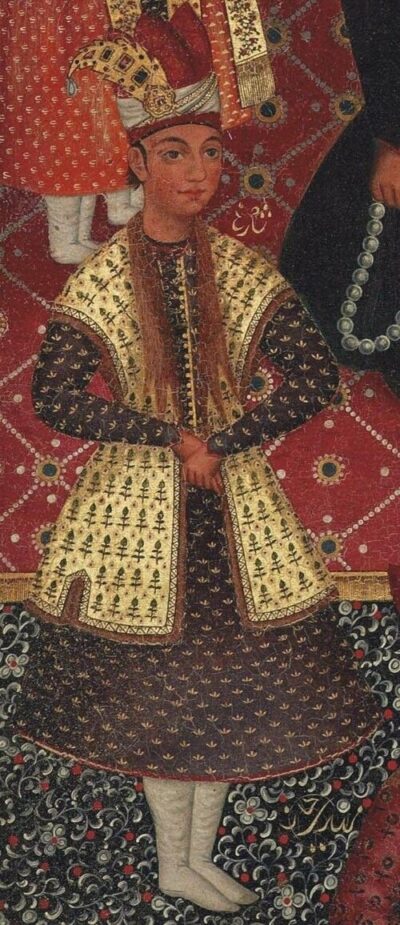
Shahrukh Afshar
Shahrukh Afshar was The fourth and last Afsharid king. Born March 21, 1734, in Mashhad. Died May 1796, in Damghan. Positions held include shah (1748–1760).
Facts
11 facts · 2 confirmed by two sources · 1 cited · 8 from one source
Where this comes from
Papalocal keeps its own record. It started from these sources; what each one said is kept here as it was copied, so a change on their side never changes this page by itself. Tap one to read its version.
What Wikidata says · copied November 17, 2026 · revision 2554003687
- Described as
- The fourth and last Afsharid king (1748–1796)
- Other names
- Shahrokh Mirza
- Born
- March 21, 1734
- Died
- May 1796 · 1 reference
- Born in
- Mashhad
- Died in
- Damghan
- Buried in
- Shahrukh Afshar Mausoleum · 1 reference
- Occupation
- sovereign
- Positions held
- shah (1748–1760)
- Children
- Nadir Mirza of Khorasan · 1 reference
- Father
- Reza Qoli Mirza Afshar
- Religion
- Islam; Shia Islam · 1 reference
- Wikipedias with a page
- 26
Wikidata item Q197884 (wikidata.org/wiki/Q197884), public domain (CC0). Copied November 17, 2026.
What Wikipedia says · copied November 17, 2026 · revision 1373012448
Shahrokh Mirza (Persian: شاهرخمیرزا; 1734–1796), better known by his dynastic title of Shahrokh Shah (شاهرخ شاه), was the Afsharid king (shah) of the western part of Khorasan (corresponding to the present-day Khorasan Province) from 1748 to 1796, with a two-month interruption.
A grandson of the Iranian conqueror Nader Shah (r. 1736–1747), Shahrokh was the son of Reza Qoli Mirza Afshar and his Safavid wife Fatemeh Soltan Begom, who was the sister of Tahmasp II, the penultimate Safavid shah of Iran. Shahrokh's half-Safavid descent made him stand out amongst his Afsharid relatives and was used to bolster the legitimacy of his grandfather. After the assassination of Nader Shah in 1747, his nephew Ali-qoli Khan (who assumed the regnal name Adel Shah), ascended the throne in Mashhad and had all of Nader Shah's descendants in fortress of Kalat massacred.
Shahrokh was spared in case his Safavid lineage would come of use and was instead kept in the fortress as a prisoner. While Adel Shah was battling his rebellious younger brother Ebrahim Mirza, a party of Turkic, Kurdish, and Arab tribal leaders took advantage of his absence and installed Shahrokh on the throne. Both Adel Shah and Ebrahim were eventually defeated and killed, but Shahrokh was not long afterwards overthrown by a party of dissident tribal leaders, who installed the Safavid pretender Mir Sayyed Mohammad (who assumed the regnal name of Suleiman II) on the throne. Shahrokh was soon blinded at the instigation of Mir Alam Khan Khuzayma and other leading nobles, much against Suleiman II's will.
A group of conspirators led by the Turco-Mongol tribal leader Yusuf Ali Khan Jalayir eventually deposed Suleiman II and restored Shahrokh to the throne.
- Born, in its opening lines
- 1734
- Died, in its opening lines
- 1796
From the Wikipedia article “Shahrokh Shah” (en.wikipedia.org/wiki/Shahrokh_Shah), by its contributors, under CC BY-SA 4.0 (creativecommons.org/licenses/by-sa/4.0/). Copied November 17, 2026; not changed.
Confirmed Two sources agree. Cited One source, and it names where it got it. One source One source, without a reference of its own. Sources disagree The sources disagree. We show the best-supported value and keep theirs below.
