
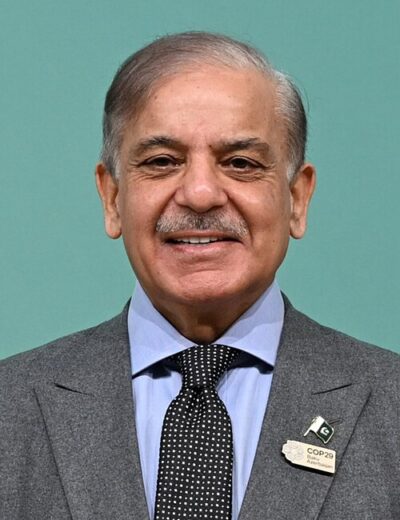
Shehbaz Sharif
Shehbaz Sharif is a Prime Minister of Pakistan (2022–2023; 2024–present). Born September 23, 1951, in Lahore. Positions held include Chief Minister of Punjab (2 times) (1997–2018), President of the Pakistan Muslim League (N) (2 times) (2009–) and Member of the 15th National Assembly of Pakistan. Educated at St. Anthony's High School and Government College University.
Facts
20 facts · 1 confirmed by two sources · 1 cited · 18 from one source
Where this comes from
Papalocal keeps its own record. It started from these sources; what each one said is kept here as it was copied, so a change on their side never changes this page by itself. Tap one to read its version.
What Wikidata says · copied November 16, 2026 · revision 2565375980
- Described as
- Prime Minister of Pakistan (2022–2023; 2024–present)
- Other names
- Shahbaz Sharif, Mian Muhammad Shahbaz Sharif, Mian Shahbaz Sharif, Mian Muhammad Shehbaz Sharif, HE Muhammad Shehbaz Sharif, Muhammad Shehbaz Sharif
- Born
- September 23, 1951
- Born in
- Lahore
- Citizen of
- Pakistan
- Occupation
- politician
- Positions held
- Chief Minister of Punjab (2 times) (1997–2018) · 1 reference; President of the Pakistan Muslim League (N) (2 times) (2009–); Member of the 15th National Assembly of Pakistan; Prime Minister of Pakistan (2022–) · 1 reference
- Political party
- Pakistan Muslim League (N)
- Education
- St. Anthony's High School; Government College University · 1 reference
- Spouse
- Tehmina Durrani
- Children
- Muhammad Hamza Shahbaz Sharif; Rabia Imran; Suleman Shahbaz
- Father
- Muhammad Sharif
- Mother
- Shamim Bibi · 1 reference
- Siblings
- Nawaz Sharif
- Religion
- Sunni Islam
- Website
- http://cm.punjab.gov.pk/ · 1 reference
- Wikipedias with a page
- 73
Wikidata item Q2096387 (wikidata.org/wiki/Q2096387), public domain (CC0). Copied November 16, 2026.
What Wikipedia says · copied November 16, 2026 · revision 1385809884
Mian Muhammad Shehbaz Sharif (born 23 September 1951) is a Pakistani politician and businessman who has served as the prime minister of Pakistan since 2024, being the only person to hold it for two consecutive terms, having previously been in the role between 2022 and 2023. He has also served as the chief minister of Punjab three times, spanning over 12 years, making him the longest-serving person in the role, the leader of the opposition, and the president of the Pakistan Muslim League (N).
Sharif was elected to the Punjab Assembly in 1988 and later to the National Assembly in 1990, when his brother became head of the conservative Islami Jamhuri Ittihad (IJI). He was re-elected to the Punjab Assembly in 1993 and appointed leader of the opposition. He was elected as chief minister of Punjab, for the first time on 20 February 1997. After the 1999 Pakistani coup d'état, Sharif and his brother were arrested and exiled the next year to Saudi Arabia at the request of the Saudis, returning to Pakistan in 2007. Sharif was elected chief minister for a second term after the 2008 general election, and for a third consecutive term following the 2013 Punjab provincial election. His tenure as Chief Minister was marked by several controversies, most notably the 2014 Model Town massacre, rise in sexual abuse cases, police brutality and corruption in the province. At the same time, his tenure saw major infrastructure, transportation and energy development projects across Punjab than in any other province.
Sharif was made the president of the PML(N) after his brother, Nawaz Sharif, was disqualified from holding office in the wake of the Panama Papers case. He was nominated as the leader of the opposition after the 2018 general election and elected as prime minister in April 2022 after the no-confidence motion against Imran Khan was passed. After the PML(N) won a plurality in the controversial 2024 general election, which was widely marred by allegations of electoral rigging and irregularities in his party's favour, Sharif became prime minister with a coalition government.
During his tenure, Pakistan has faced high inflation and economic difficulties, with an estimated 48% of the population living below the poverty line, leading to greater reliance on petroleum levies, indirect taxation and financial assistance from the IMF. His administration has faced criticism over the economic burden on low-income households, corruption and weak accountability in the public sector, as well as increased privileges for parliamentarians. He has also faced criticism over the 2022 constitutional crisis and the use of excessive force by security personnel during protests, as well as changes to the constitutional and military command structures, lifetime privileges and legal protections for senior military officers, and extensions of military chiefs' tenures. Human rights organisations, including Human Rights Watch, have documented restrictions on freedom of expression, violence against journalists, human rights violations, the misuse of cybercrime laws and digital censorship during his premiership. Critics have also accused his government of weakening fundamental rights and state institutions, and of seeking greater influence over judicial and military appointments.
He has also faced domestic and international criticism over the Imprisonment of Imran Khan, and the resurgence of militancy in Khyber Pakhtunkhwa and Balochistan, while opposition groups have accused his government of benefiting from alleged electoral rigging, allegations that have been disputed by the government. These criticisms intensified following the imposition of governor's rule in Khyber Pakhtunkhwa, which ended the opposition-led provincial government, and the subsequent arrests of Sohail Afridi and members of his cabinet, without clear legal grounds and access to courts, to undisclosed locations, with their whereabouts remaining unknown.
On foreign policy, he received international praise for Pakistan's diplomatic role in efforts to mediate between Iran and the United States and for strengthening defence cooperation with other countries through the Mecca Defence Alliance.
His rule as prime minister has been described by critics as increasingly authoritarian, citing actions against political opposition, restrictions on freedom of expression, and weakening democratic accountability.
- Born, in its opening lines
- September 23, 1951
From the Wikipedia article “Shehbaz Sharif” (en.wikipedia.org/wiki/Shehbaz_Sharif), by its contributors, under CC BY-SA 4.0 (creativecommons.org/licenses/by-sa/4.0/). Copied November 16, 2026; not changed.
Confirmed Two sources agree. Cited One source, and it names where it got it. One source One source, without a reference of its own. Sources disagree The sources disagree. We show the best-supported value and keep theirs below.
