
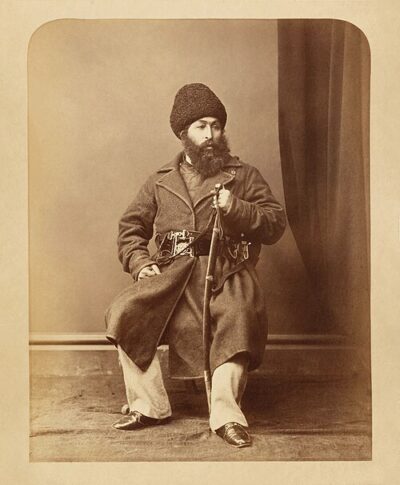
Sher Ali Khan
Sher Ali Khan was an Emir of Afghanistan. Born 1825, in Emirate of Afghanistan. Died February 21, 1879, in Kabul. Positions held include Emir of Afghanistan (2 times) (1863–1879).
Facts
14 facts · 2 confirmed by two sources · 0 cited · 12 from one source
What’s different
- Born: we show 1825 (Confirmed). Wikidata also lists 1823
Where this comes from
Papalocal keeps its own record. It started from these sources; what each one said is kept here as it was copied, so a change on their side never changes this page by itself. Tap one to read its version.
What Wikidata says · copied November 16, 2026 · revision 2516971703
- Described as
- Emir of Afghanistan (1863-1879)
- Other names
- Shere Ali
- Born
- 1825; 1823 · 1 reference
- Died
- February 21, 1879
- Born in
- Emirate of Afghanistan
- Died in
- Kabul
- Buried in
- Blue Mosque · 1 reference
- Citizen of
- Emirate of Afghanistan
- Occupation
- military personnel
- Positions held
- Emir of Afghanistan (2 times) (1863–1879)
- Children
- Mohammad Ayub Khan; Mohammad Yaqub Khan
- Father
- Dost Mohammad Khan
- Siblings
- Mohammad Afzal Khan; Mohammad Azam Khan
- Military rank
- Amir
- Wikipedias with a page
- 32
Wikidata item Q40427 (wikidata.org/wiki/Q40427), public domain (CC0). Copied November 16, 2026.
What Wikipedia says · copied November 16, 2026 · revision 1378430355
Sher Ali Khan Barakzai (c. 1825 – 21 February 1879) was Emir of Afghanistan after the death of his father Dost Mohammad Khan on 9 June 1863, until his overthrow during the Battle of Sheikhabad on 10 May 1866, and was restored to the throne on 8 September 1868, ruling until his death on 21 February 1879. He was one of the sons of Dost Mohammad Khan.
- Born, in its opening lines
- c. 1825
- Died, in its opening lines
- February 21, 1879
From the Wikipedia article “Sher Ali Khan” (en.wikipedia.org/wiki/Sher_Ali_Khan), by its contributors, under CC BY-SA 4.0 (creativecommons.org/licenses/by-sa/4.0/). Copied November 16, 2026; not changed.
Confirmed Two sources agree. Cited One source, and it names where it got it. One source One source, without a reference of its own. Sources disagree The sources disagree. We show the best-supported value and keep theirs below.
