
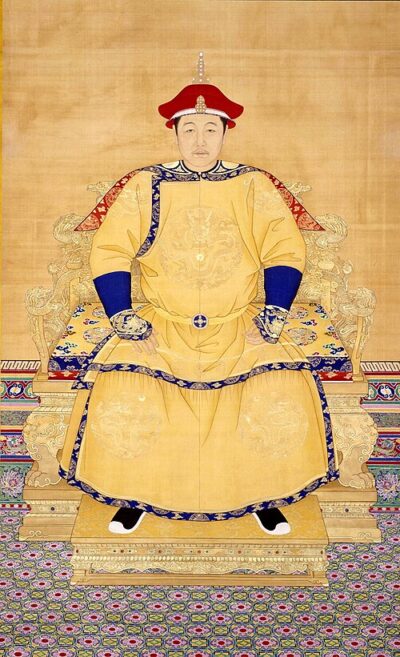
Shunzhi Emperor
Shunzhi Emperor was a Qing Dynasty emperor of China. Born March 15, 1638, in Mukden Palace. Died February 5, 1661, in Hall of Mental Cultivation. Positions held include Emperor of China (1644–1661) and emperor (1643–1661).
Facts
39 facts · 2 confirmed by two sources · 5 cited · 32 from one source
Where this comes from
Papalocal keeps its own record. It started from these sources; what each one said is kept here as it was copied, so a change on their side never changes this page by itself. Tap one to read its version.
What Wikidata says · copied November 16, 2026 · revision 2557703152
- Described as
- Qing Dynasty emperor of China (1638–1661)
- Other names
- Shun-chih Emperor, Fulin, Fu-lin, Shunzhi, Chidaoren, Xingchi, Shizu, Yiandaoren, Titian Longyun Dingtong Jianji Yingrui Qinwen Xianwu Dade Honggong Zhiren Chunxiao Zhang Huangdi, Taihe Zhuren, Tiyuanzhai Zhuren
- Born
- March 15, 1638 · 1 reference
- Died
- February 5, 1661 · 1 reference
- Born in
- Mukden Palace
- Died in
- Hall of Mental Cultivation
- Buried in
- Xiaoling Mausoleum (Qing dynasty)
- Cause of death
- smallpox · 1 reference
- Name at birth
- ᡶᡠᠯᡳᠨ
- Citizen of
- Qing dynasty · 1 reference
- Occupation
- monarch; painter
- Positions held
- Emperor of China (1644–1661) · 1 reference; emperor (1643–1661)
- Spouse
- Erdeni Bumba; Empress Xiaohuizhang; Empress Xiaokangzhang · 1 reference; Consort Zhen; Consort Dao; Consort Shu, of the Chen clan
- Children
- Niuniu; Fuquan; Kangxi Emperor · 2 references; Prince Rong; Changning; Qishou; Longxi; Yonggan; Princess Heshuo Gongchi
- Father
- Hong Taiji · 1 reference
- Mother
- Empress Dowager Xiaozhuang
- Siblings
- State Princess Wenzhuang; State Princess Aukhan; State Princess Jingduan; State Princess Yongmu; State Princess Shuhui; sixth daughter of Huang Taiji; State Princess Shuzhe; State Princess Yong'an; ninth daughter of Huang Taiji; tenth daughter of Huang Taiji
- Wikipedias with a page
- 52
Wikidata item Q310453 (wikidata.org/wiki/Q310453), public domain (CC0). Copied November 16, 2026.
What Wikipedia says · copied November 16, 2026 · revision 1381448793
The Shunzhi Emperor (15 March 1638 – 5 February 1661), personal name Fulin, was the second emperor of the Qing dynasty, and the first Qing emperor to rule over China proper. Upon the death of his father Hong Taiji, a committee of Manchu princes chose the 5-year-old Fulin as successor. The princes also appointed two co-regents: Dorgon, the 14th son of Nurhaci, and Jirgalang, one of Nurhaci's nephews, both of whom were members of the Aisin-Gioro clan. In November 1644, the Shunzhi Emperor was enthroned as emperor of China in Beijing.
From 1643 to 1650, political power lay mostly in the hands of the prince regent Dorgon. Under his leadership, the Qing conquered most of the territory of the fallen Ming dynasty, chased Ming loyalist regimes deep into the southwestern provinces, and established the basis of Qing rule over China proper despite highly unpopular policies such as the hair cutting edict of 1645, which forced all Qing male subjects to shave their forehead and braid their remaining hair into a queue resembling that of the Manchus. After Dorgon's death on the last day of 1650, the young Shunzhi Emperor started to rule personally. He tried, with mixed success, to fight corruption and to reduce the political influence of the Manchu nobility. In the 1650s, he faced a resurgence of Ming loyalist resistance, but by 1661 his armies had defeated the Qing's last enemies, Koxinga and the Prince of Gui, both of whom would succumb the following year.
The Shunzhi Emperor died at the age of 22 of smallpox, a disease endemic in China, but against which the Manchus had no immunity. He was succeeded by his third son, the Kangxi Emperor, who went on to reign for sixty years. Because fewer documents have survived from the Shunzhi era than from later eras of the Qing dynasty, this era is a relatively little-known period of Qing history.
- Born, in its opening lines
- March 15, 1638
- Died, in its opening lines
- February 5, 1661
From the Wikipedia article “Shunzhi Emperor” (en.wikipedia.org/wiki/Shunzhi_Emperor), by its contributors, under CC BY-SA 4.0 (creativecommons.org/licenses/by-sa/4.0/). Copied November 16, 2026; not changed.
Confirmed Two sources agree. Cited One source, and it names where it got it. One source One source, without a reference of its own. Sources disagree The sources disagree. We show the best-supported value and keep theirs below.
