
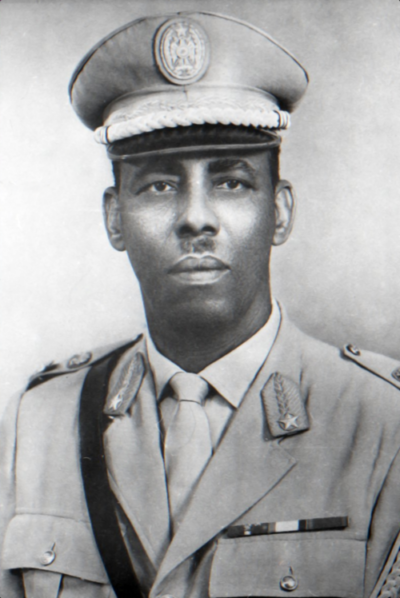
Siad Barre
Siad Barre was a Head of State of Somalia. Born October 6, 1919, in Shilavo. Died January 2, 1995, in Lagos. Positions held include chairperson of the Organisation of African Unity (1974–1975), President of Somalia (1969–1991) and Minister of Foreign Affairs (1976–1977). Awards include Order of the National Flag, Order of the Queen of Sheba and Order of the Nile.
Facts
30 facts · 2 confirmed by two sources · 4 cited · 23 from one source · 1 where the sources disagree
What’s different
- Born in: we show Shilavo (Sources disagree). Wikidata also lists Garbahaareey and Luuq
Where this comes from
Papalocal keeps its own record. It started from these sources; what each one said is kept here as it was copied, so a change on their side never changes this page by itself. Tap one to read its version.
What Wikidata says · copied November 16, 2026 · revision 2563066775
- Described as
- Head of State of Somalia (1919–1995)
- Other names
- Mohamed Siad Barre
- Born
- October 6, 1919 · 2 references
- Died
- January 2, 1995 · 4 references
- Born in
- Garbahaareey; Shilavo · 1 reference; Luuq · 1 reference
- Died in
- Lagos · 2 references
- Buried in
- Garbaharey District · 1 reference
- Cause of death
- myocardial infarction
- Citizen of
- Somalia; Italian Empire
- Occupation
- politician · 1 reference; military personnel; diplomat; military officer · 1 reference
- Positions held
- chairperson of the Organisation of African Unity (1974–1975); President of Somalia (1969–1991); Minister of Foreign Affairs (1976–1977); president · 1 reference
- Political party
- Somali Revolutionary Socialist Party
- Member of
- Supreme Revolutionary Council
- Awards
- Order of the National Flag · 1 reference; Order of the Queen of Sheba · 1 reference; Order of the Nile · 1 reference; Order of Georgi Dimitrov · 1 reference; Order of Lenin · 1 reference; Order of the Somali Star
- Children
- Maslah Mohammed Siad Barre · 1 reference
- Religion
- Islam
- Military branch
- Royal Italian Army · 1 reference; Somali Armed Forces
- Military rank
- general; major general
- Wikipedias with a page
- 59
Wikidata item Q209828 (wikidata.org/wiki/Q209828), public domain (CC0). Copied November 16, 2026.
What Wikipedia says · copied November 16, 2026 · revision 1381727709
Mohammed Siad Barre ( ; Somali: Maxamed Siyaad Barre; Arabic: محمد زياد بري; c. 6 October 1919 – 2 January 1995) was a Somali military officer, politician, and revolutionary who served as the third president of Somalia from 21 October 1969 to 26 January 1991.
Barre, the commander of the Somali National Army, became president of Somalia after the 1969 coup d'état that overthrew the Somali Republic following the assassination of President Abdirashid Shermarke. The Supreme Revolutionary Council military junta under Barre reconstituted Somalia as a one-party Marxist–Leninist communist state, renamed the country the Somali Democratic Republic and adopted scientific socialism. Barre spoke three languages, English, Somali and Italian.
Barre's early rule was characterised by attempts at widespread modernization, nationalization of banks and industry, promotion of cooperative farms, a new writing system for the Somali language, and anti-tribalism. In 1976, the Somali Revolutionary Socialist Party became the country's vanguard party. The following year Barre launched the Ogaden War against Ethiopia's Derg regime, supporting the Western Somali Liberation Front on a platform of Somali nationalism and pan-Somalism. Barre's popularity was highest during the seven months between September 1977 and March 1978 when Barre captured virtually the entirety of the Somali region. It declined from the late-1970s following Somalia's defeat in the Ogaden War, triggering the Somali Rebellion and severing ties with the Soviet Union. Somalia then allied itself with the Western powers and especially the United States for the remainder of the Cold War, although it maintained its Marxist–Leninist regime and also drew close to China.
Opposition grew in the 1980s and in 1991, Barre's government collapsed as the Somali Rebellion successfully ejected him from power, leading to the Somali Civil War and a massive power vacuum in its wake. Barre was forced into exile in Nigeria, where he died in 1995 on the way to the hospital after suffering a heart attack.
- Born, in its opening lines
- October 6, 1919
- Died, in its opening lines
- January 2, 1995
From the Wikipedia article “Siad Barre” (en.wikipedia.org/wiki/Siad_Barre), by its contributors, under CC BY-SA 4.0 (creativecommons.org/licenses/by-sa/4.0/). Copied November 16, 2026; not changed.
Confirmed Two sources agree. Cited One source, and it names where it got it. One source One source, without a reference of its own. Sources disagree The sources disagree. We show the best-supported value and keep theirs below.
