
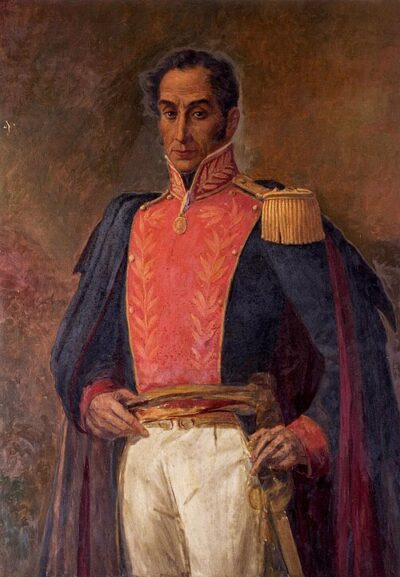
Simón Bolívar
Simón Bolívar was a Venezuelan statesman and military officer. Born July 24, 1783, in Caracas. Died December 17, 1830, in Quinta de San Pedro Alejandrino. Positions held include president of Bolivia (1825), President of Venezuela (2 times) (1813–1819) and President of Peru (1824–1827). Awards include Grand Cross of the Order of the Sun of Peru, honorary doctorate of the National University of San Marcos and liberator of Venezuela.
Facts
32 facts · 2 confirmed by two sources · 4 cited · 25 from one source · 1 where the sources disagree
What’s different
- Cause of death: we show tuberculosis (Sources disagree). Wikidata also lists typhoid fever
Where this comes from
Papalocal keeps its own record. It started from these sources; what each one said is kept here as it was copied, so a change on their side never changes this page by itself. Tap one to read its version.
What Wikidata says · copied November 16, 2026 · revision 2569269521
- Described as
- Venezuelan statesman and military officer (1783–1830)
- Other names
- Simón José Antonio de la Santísima Trinidad Bolívar Palacios Ponte y Blanco, Bolívar, Simon Bolivar, Simón José Antonio de la Santísima Trinidad Bolívar y Ponte Palacios y Blanco
- Born
- July 24, 1783 · 14 references
- Died
- December 17, 1830 · 12 references
- Born in
- Caracas · 2 references
- Died in
- Quinta de San Pedro Alejandrino
- Buried in
- Cathedral of Santa Marta (1830–1842); Caracas Cathedral (1842–1876); National Pantheon (1876–)
- Cause of death
- tuberculosis; typhoid fever
- Citizen of
- Spain (–1811); Venezuela (–1819) · 1 reference; Ecuador (–1827); Bolivia (–1825)
- Occupation
- politician · 2 references; military officer
- Positions held
- president of Bolivia (1825); President of Venezuela (2 times) (1813–1819); President of Peru (1824–1827); president (1819–1830); President of Colombia (1819–1830) · 1 reference
- Awards
- Grand Cross of the Order of the Sun of Peru; honorary doctorate of the National University of San Marcos; liberator of Venezuela (1813)
- Spouse
- María Teresa del Toro y Alayza (1802–1803) · 1 reference
- Father
- Juan Vicente de Bolívar y Ponte
- Mother
- María Concepción Palacios Aguirre Ariztía - Sojo Blanco Herrera
- Siblings
- María Antonia Bolívar Palacios; Juana Bolívar; Juan Vicente Bolívar Palacios
- Religion
- Regular Masonic jurisdictions
- Military rank
- general · 1 reference
- Lived in
- Casa del Vínculo y del Retorno; Ingenio Bolívar
- Wikipedias with a page
- 176
Wikidata item Q8605 (wikidata.org/wiki/Q8605), public domain (CC0). Copied November 16, 2026.
What Wikipedia says · copied November 16, 2026 · revision 1385147842
Simón José Antonio de la Santísima Trinidad Bolívar Palacios Ponte y Blanco (24 July 1783 – 17 December 1830) was a Venezuelan military officer and statesman who led what are currently the countries of Bolivia, Colombia, Ecuador, Panama, Peru, and Venezuela to independence from the Spanish Empire. He is known colloquially as El Libertador, "the Liberator", of America.
Bolívar was born in Caracas in the Captaincy General of Venezuela into a wealthy family of South American-born Spaniards (criollo) but lost both parents as a child. He was educated abroad and lived in Spain, as was common for men of upper-class families in his day. While living in Madrid from 1800 to 1802, he was introduced to Enlightenment philosophy and married María Teresa Rodríguez del Toro y Alaysa, who died in Venezuela from yellow fever in 1803. From 1803 to 1805, Bolívar embarked on a Grand Tour that ended in Rome, where he swore to end Spanish rule in the Americas. In 1807, Bolívar returned to Venezuela and promoted Venezuelan independence to other wealthy creoles. When Napoleon's Peninsular War weakened Spanish authority, Bolívar became a zealous combatant and politician in the Spanish American wars of independence.
Bolívar began his military career in 1810 as a militia officer in the Venezuelan War of Independence, fighting Royalist forces for the first and second Venezuelan republics and the United Provinces of New Granada. After Spanish forces subdued New Granada in 1815, Bolívar was forced into exile on Jamaica. In Haiti, Bolívar met and befriended Haitian revolutionary leader Alexandre Pétion. After promising to abolish slavery in Spanish America, Bolívar received military support from Pétion and returned to Venezuela. He established a third republic in 1817, and crossed the Andes to liberate New Granada in 1819. Bolívar and his allies defeated the Spanish in New Granada in 1819, Venezuela and Panama in 1821, Ecuador in 1822, Peru in 1824, and Bolivia in 1825. Venezuela, New Granada, Ecuador, and Panama were merged into the Republic of Colombia (Gran Colombia), with Bolívar as president there and in Peru and Bolivia.
In his final years, Bolívar became increasingly disillusioned with the South American republics. He was successively removed from his offices until he resigned the presidency of Colombia and died of tuberculosis in 1830. His legacy is diverse and far-reaching within Latin America and beyond. He is regarded as a hero and national and cultural icon throughout Latin America. The nations of Bolivia and Venezuela (as the Bolivarian Republic of Venezuela) are named after him, and he has been memorialized all over the world in the form of public art or street names and in popular culture.
- Born, in its opening lines
- July 24, 1783
- Died, in its opening lines
- December 17, 1830
From the Wikipedia article “Simón Bolívar” (en.wikipedia.org/wiki/Simón_Bolívar), by its contributors, under CC BY-SA 4.0 (creativecommons.org/licenses/by-sa/4.0/). Copied November 16, 2026; not changed.
Confirmed Two sources agree. Cited One source, and it names where it got it. One source One source, without a reference of its own. Sources disagree The sources disagree. We show the best-supported value and keep theirs below.
