
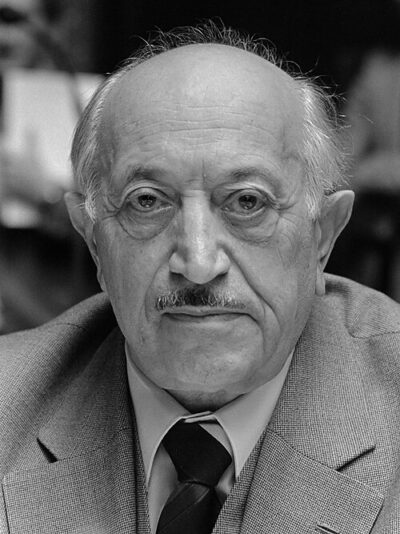
Simon Wiesenthal
Simon Wiesenthal was a Jewish Austrian Holocaust survivor and Nazi hunter. Born December 31, 1908, in Buchach. Died September 20, 2005, in Vienna. Awards include Knight of the Legion of Honour, Commander's Cross of the Order of Merit of the Federal Republic of Germany and Knight Commander of the Order of the British Empire.
Facts
35 facts · 2 confirmed by two sources · 16 cited · 17 from one source
Where this comes from
Papalocal keeps its own record. It started from these sources; what each one said is kept here as it was copied, so a change on their side never changes this page by itself. Tap one to read its version.
What Wikidata says · copied November 16, 2026 · revision 2569163256
- Described as
- Jewish Austrian Holocaust survivor and Nazi hunter (1908–2005)
- Born
- December 31, 1908 · 11 references
- Died
- September 20, 2005 · 9 references
- Born in
- Buchach · 2 references
- Died in
- Vienna · 2 references
- Buried in
- Old Cemetery of Herzliya
- Citizen of
- Second Polish Republic; Austria · 2 references; Hungary · 1 reference
- Occupation
- Nazis hunter; autobiographer; architect · 2 references; advocate · 1 reference; opinion journalist · 2 references; musician · 2 references; writer · 2 references; journalist · 2 references
- Political party
- Austrian People's Party
- Awards
- Knight of the Legion of Honour; Commander's Cross of the Order of Merit of the Federal Republic of Germany; Knight Commander of the Order of the British Empire; Great Golden Medal of Honour for Services to the Republic of Austria (2005) · 1 reference; Order of the White Lion 3rd Class; Presidential Medal of Freedom (2000) · 1 reference; Erasmus Prize (1992) · 1 reference; Four Freedoms Award – Freedom from Fear (1990) · 1 reference; Commander of the Order of Merit of the Grand Duchy of Luxembourg; Commander of the Order of Merit of the Italian Republic; Commander of the Order of Orange-Nassau; Commander of the Order of Polonia Restituta; honorary doctor of the Jagiellonian University of Krakow (1994) · 1 reference; honorary doctor of Ben-Gurion University; honorary doctor of the Bar-Ilan University
- Spouse
- Cyla Wiesenthal · 1 reference
- Religion
- Judaism
- Website
- https://www.wiesenthal.com/
- Wikipedias with a page
- 67
Wikidata item Q49086 (wikidata.org/wiki/Q49086), public domain (CC0). Copied November 16, 2026.
What Wikipedia says · copied November 16, 2026 · revision 1380367731
Simon Wiesenthal (31 December 1908 – 20 September 2005) was an Austrian Holocaust survivor, Nazi hunter, and writer. He studied architecture, and was living in Lviv at the outbreak of World War II. He survived the Janowska concentration camp (late 1941 to September 1944), the Kraków-Płaszów concentration camp (September to October 1944), the Gross-Rosen concentration camp, a death march to Chemnitz, Buchenwald, and the Mauthausen concentration camp (February to May 1945).
After the war, Wiesenthal did not return to his original profession as an architect, instead dedicating his life to tracking down and gathering information on fugitive Nazi war criminals, so that they could be brought to trial. In 1947, he co-founded the Jewish Historical Documentation Centre in Linz, Austria, where he and others gathered information for future war crime trials and aided Jewish refugees in their search for lost relatives. In 1961, he resumed this activity in Vienna, where he opened the Documentation Centre of the Association of Jewish Victims of the Nazi Regime and continued to try locating missing Nazi war criminals. He may have played a small role in locating Adolf Eichmann who was captured by Mossad in Buenos Aires in 1960, and worked closely with the Austrian justice ministry to prepare a dossier on Franz Stangl, who was sentenced to life imprisonment in 1971. Wiesenthal conducted research full-time, funded by donations from private individuals as well as the Mossad, Israel's principal intelligence agency.
In the 1970s and 1980s, Wiesenthal was involved in two high-profile events involving Austrian politicians. Shortly after Bruno Kreisky was inaugurated as Austrian chancellor in April 1970, Wiesenthal pointed out to the press that four of his new cabinet appointees had been members of the Nazi Party. Kreisky, angry, called Wiesenthal a "Jewish fascist", likened his organisation to the Mafia, and accused him of collaborating with the Nazis. Wiesenthal successfully sued for libel, the suit ending in 1989. In 1986, Wiesenthal was involved in the case of Kurt Waldheim, whose service in the Wehrmacht and probable knowledge of the Holocaust were revealed in the lead-up to the 1986 Austrian presidential elections. Wiesenthal, embarrassed that he had previously cleared Waldheim of any wrongdoing, suffered negative publicity as a result of this event.
With a reputation as a storyteller, Wiesenthal was the author of several memoirs containing tales that are only loosely based on actual events. These contain large amounts of inconsistencies and exaggerations, in particular concerning his role in Eichmann's capture in 1960, and are therefore not considered to be reliable sources. Wiesenthal died in his sleep at age 96 in Vienna in 2005, and was buried in the city of Herzliya in Israel. The Simon Wiesenthal Center, headquartered in Los Angeles, is named in his honour.
- Born, in its opening lines
- December 31, 1908
- Died, in its opening lines
- September 20, 2005
From the Wikipedia article “Simon Wiesenthal” (en.wikipedia.org/wiki/Simon_Wiesenthal), by its contributors, under CC BY-SA 4.0 (creativecommons.org/licenses/by-sa/4.0/). Copied November 16, 2026; not changed.
Confirmed Two sources agree. Cited One source, and it names where it got it. One source One source, without a reference of its own. Sources disagree The sources disagree. We show the best-supported value and keep theirs below.
