
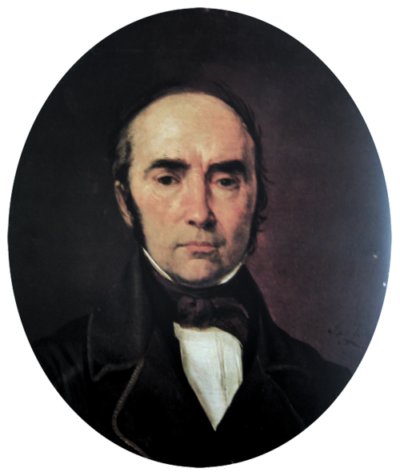
Simonas Daukantas
Simonas Daukantas was a Lithuanian historian and writer. Born October 28, 1793, in Kalviai. Died November 24, 1864, in Papilė. Educated at Vilnius University.
Facts
10 facts · 1 confirmed by two sources · 5 cited · 3 from one source · 1 where the sources disagree
What’s different
- Born: we show October 28, 1793 (Confirmed). Wikidata also lists October 26, 1793
- Died: we show November 24, 1864 (Sources disagree). Wikipedia says December 6, 1864
Where this comes from
Papalocal keeps its own record. It started from these sources; what each one said is kept here as it was copied, so a change on their side never changes this page by itself. Tap one to read its version.
What Wikidata says · copied November 18, 2026 · revision 2558238064
- Described as
- Lithuanian historian and writer (1793–1864)
- Born
- October 28, 1793 · 2 references; October 26, 1793 · 2 references
- Died
- November 24, 1864 · 2 references
- Born in
- Kalviai · 1 reference
- Died in
- Papilė · 2 references
- Citizen of
- Lithuania
- Occupation
- historian · 1 reference; writer · 1 reference; lexicographer · 1 reference; opinion journalist · 1 reference
- Education
- Vilnius University
- Wikipedias with a page
- 24
Wikidata item Q382666 (wikidata.org/wiki/Q382666), public domain (CC0). Copied November 18, 2026.
What Wikipedia says · copied November 18, 2026 · revision 1385312249
Simonas Daukantas (Polish: Szymon Dowkont; 28 October 1793 – 6 December 1864) was a Lithuanian/Samogitian historian, writer, and ethnographer. One of the pioneers of the Lithuanian National Revival, he is credited as the author of the first book on the history of Lithuania written in the Lithuanian language. Only a few of his works were published during his lifetime and he died in obscurity. However, his works were rediscovered during the later stages of the National Revival. His views reflected the three major trends of the 19th century: romanticism, nationalism, and liberalism.
Daukantas was born in Samogitia to a Lithuanian family. Likely a son of free peasants, he later produced proof of his noble birth to get university degree and a promotion in his government job. He attended schools in Kretinga and Žemaičių Kalvarija and was noted as an excellent student. Daukantas studied law at the University of Vilnius, though his interest lay in philology and history. After the graduation, he worked as a civil servant of the Russian Empire from 1825 to 1850. He first worked at the office of the Governor-General of Livonia, Estonia and Courland in Riga then moved to Saint Petersburg to work at the Governing Senate. At the Senate, he had the opportunity to study the Lithuanian Metrica, the state archive of the 14–18th century legal documents of the Grand Duchy of Lithuania. In 1850, Daukantas retired from his job due to poor health and moved back to Samogitia where he lived in Varniai under the care of bishop Motiejus Valančius for a few years. He hoped to publish some of his works with bishop's help, but the bishop prioritized religious work and they began to quarrel. In 1855, Daukantas moved to Jaunsvirlauka in present-day Latvia and later to Papilė where he died in obscurity in 1864.
While Daukantas knew seven languages, he published exclusively in Lithuanian. He was a prolific writer and worked on a wide range of books – studies on the history of Lithuania, publications of primary historical sources, collections of Lithuanian folklore, Polish–Lithuanian dictionaries, Latin textbook for schoolchildren, primer of the Lithuanian language, Catholic prayer book, agricultural manuals for peasants, translations of classical Roman texts, novel for youth inspired by Robinson Crusoe. However, only a few of these works were published during his lifetime. Of the four studies on history, he managed to publish only one, The Character of the Ancient Lithuanians, Highlanders, and Samogitians, in 1845. While he was a well read erudite who spent considerable time and effort in obtaining primary sources, his historical works are highly influenced by romantic nationalism and didactically idealize the past. He used poetic descriptions, rhetorical elements, and emotional language that brought his history works closer to a literary work. His histories are valued not for their scientific content, but for their contribution to the development of the Lithuanian national identity. After the closing of Vilnius University in 1832, Lithuanians did not have a professionally trained historian until 1904 and used Daukantas' histories extensively. Daukantas identified language as the determining factor of nationality and articulated the nationalist anti-Polish sentiment that became the fundamental ideas of the Lithuanian National Revival and that survive in Lithuanian historiography into the 21st century.
- Born, in its opening lines
- October 28, 1793
- Died, in its opening lines
- December 6, 1864
From the Wikipedia article “Simonas Daukantas” (en.wikipedia.org/wiki/Simonas_Daukantas), by its contributors, under CC BY-SA 4.0 (creativecommons.org/licenses/by-sa/4.0/). Copied November 18, 2026; not changed.
Confirmed Two sources agree. Cited One source, and it names where it got it. One source One source, without a reference of its own. Sources disagree The sources disagree. We show the best-supported value and keep theirs below.
