
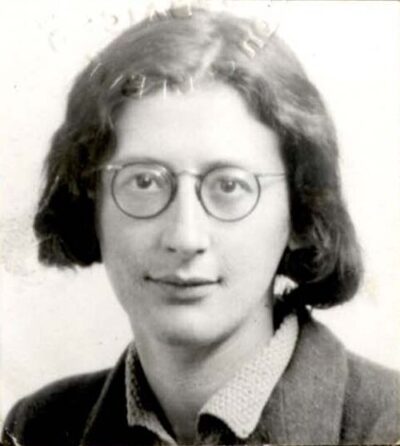
Simone Weil
Simone Weil was a French philosopher, writer, and social activist. Born February 3, 1909, in Paris. Died August 24, 1943, in Ashford. Known for The Need for Roots, Gravity and Grace and La condition ouvrière. Educated at Lycée Henri-IV and École Normale Supérieure. Awards include Ambassadors' Prize.
Facts
38 facts · 2 confirmed by two sources · 9 cited · 27 from one source
Where this comes from
Papalocal keeps its own record. It started from these sources; what each one said is kept here as it was copied, so a change on their side never changes this page by itself. Tap one to read its version.
What Wikidata says · copied November 16, 2026 · revision 2558238089
- Described as
- French philosopher, writer, and social activist (1909–1943)
- Other names
- Simone Adolphine Weil
- Born
- February 3, 1909 · 12 references
- Died
- August 24, 1943 · 11 references
- Born in
- Paris · 3 references
- Died in
- Ashford · 1 reference
- Buried in
- Bybrook Cemetery · 2 references
- Cause of death
- tuberculosis
- Citizen of
- France · 2 references
- Occupation
- philosopher · 4 references; secondary school teacher; writer · 4 references; autobiographer; poet · 1 reference; trade unionist; French resistance fighter; diarist · 1 reference
- Education
- Lycée Henri-IV; École Normale Supérieure; University of Paris; Lycée Fénelon, Paris
- Member of
- French Resistance; Confédération Générale du Travail
- Known for
- The Need for Roots; Gravity and Grace; La condition ouvrière; Reflections Concerning the Causes of Liberty and Social Oppression; Notebooks; Oppression and Liberty
- Awards
- Ambassadors' Prize (1950) · 1 reference
- Field
- political philosophy; ethics; poetry; metaphysics; cosmogony
- Father
- Bernard Weil
- Mother
- Selma Weil
- Siblings
- André Weil · 1 reference
- Religion
- nondenominational Christianity
- Military branch
- International Brigades
- Wikipedias with a page
- 98
Wikidata item Q157309 (wikidata.org/wiki/Q157309), public domain (CC0). Copied November 16, 2026.
What Wikipedia says · copied November 16, 2026 · revision 1382255683
Simone Adolphine Weil (; French: [simɔn adɔlfin vɛj]; 3 February 1909 – 24 August 1943) was a French philosopher, mystic, political activist and labourer. Despite her short life, her ideas concerning religion, spirituality and politics have remained widely influential in contemporary philosophy.
She was born in Paris to an Alsatian Jewish family. Her elder brother, André, would later become a renowned mathematician. After her graduation from formal education, Weil became a teacher. She taught intermittently throughout the 1930s, taking several breaks because of poor health and in order to devote herself to political activism. She assisted in the trade union movement, taking the side of the anarchists known as the Durruti Column in the Spanish Civil War. During a twelve-month period she worked as a labourer, mostly in car factories, so that she could better understand the working class.
Weil was very attracted to the ascetic egalitarian elements of Christianity, and became increasingly religious and inclined towards mysticism as her life progressed. She died of heart failure in 1943, while working for the Free French government in exile in Britain. Her uncompromising personal ethics may have contributed to her death—she had restricted her food intake in solidarity with the inhabitants of Nazi-occupied France.
Weil wrote throughout her life, although most of her writings did not attract much attention until after her death. In the 1950s and '60s, her work became famous in continental Europe and throughout the English-speaking world. Her philosophy and theological thought has continued to be the subject of extensive scholarship across a wide range of fields, covering politics, society, feminism, science, education and classics.
- Born, in its opening lines
- February 3, 1909
- Died, in its opening lines
- August 24, 1943
From the Wikipedia article “Simone Weil” (en.wikipedia.org/wiki/Simone_Weil), by its contributors, under CC BY-SA 4.0 (creativecommons.org/licenses/by-sa/4.0/). Copied November 16, 2026; not changed.
Confirmed Two sources agree. Cited One source, and it names where it got it. One source One source, without a reference of its own. Sources disagree The sources disagree. We show the best-supported value and keep theirs below.
