
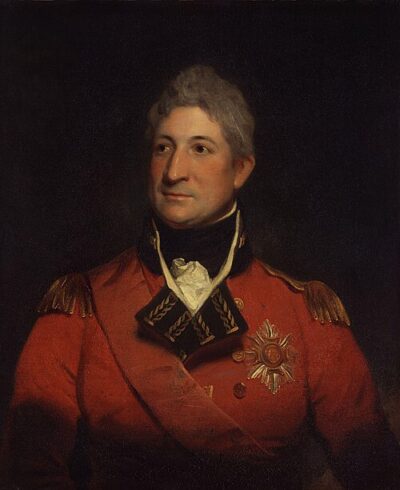
Sir Thomas Picton
Sir Thomas Picton was a Welsh general who served in the British Army. Born August 24, 1758, in Haverfordwest. Died June 18, 1815, in Battle of Waterloo. Positions held include member of the 5th Parliament of the United Kingdom, Governor of Tobago (1803) and Governor of Trinidad (1797–1803). Educated at Haverfordwest Grammar School. Awards include Knight Grand Cross of the Order of the Bath, Commander of the Order of the Tower and Sword and Army Gold Medal.
Facts
23 facts · 2 confirmed by two sources · 6 cited · 15 from one source
Where this comes from
Papalocal keeps its own record. It started from these sources; what each one said is kept here as it was copied, so a change on their side never changes this page by itself. Tap one to read its version.
What Wikidata says · copied November 18, 2026 · revision 2569023411
- Described as
- Welsh general who served in the British Army (1758-1815)
- Other names
- Thomas Picton
- Born
- August 24, 1758 · 3 references
- Died
- June 18, 1815 · 3 references
- Born in
- Haverfordwest
- Died in
- Battle of Waterloo
- Buried in
- St Paul's Cathedral (1859–)
- Citizen of
- Wales; United Kingdom of Great Britain and Ireland
- Occupation
- military officer; politician · 1 reference; captain general · 1 reference
- Positions held
- member of the 5th Parliament of the United Kingdom; Governor of Tobago (1803); Governor of Trinidad (1797–1803)
- Education
- Haverfordwest Grammar School · 1 reference
- Awards
- Knight Grand Cross of the Order of the Bath; Commander of the Order of the Tower and Sword; Army Gold Medal · 1 reference; Military Order of the Tower and Sword · 1 reference
- Father
- Thomas Picton · 1 reference
- Mother
- Cecil Powell · 1 reference
- Military branch
- British Army
- Military rank
- general; lieutenant general · 1 reference
- Wikipedias with a page
- 23
Wikidata item Q121734 (wikidata.org/wiki/Q121734), public domain (CC0). Copied November 18, 2026.
What Wikipedia says · copied November 18, 2026 · revision 1383713539
Lieutenant-General Sir Thomas Picton (24 August 1758 – 18 June 1815) was a British Army officer and colonial administrator. He fought in the Napoleonic Wars and died at the Battle of Waterloo. According to the historian Alessandro Barbero, Picton was "respected for his courage and feared for his irascible temperament". The Duke of Wellington called him "a rough foul-mouthed devil as ever lived", but found him capable.
While Picton's military prowess is not in doubt, as a colonial administrator he was considered to be a harsh disciplinarian, even by some at the time. He approved the use of torture during his governorship of Trinidad. He was put on trial in England for approving the picketing of a 14-year-old girl, Luisa Calderón, and convicted. He later had a retrial arguing that Trinidad was subject to Spanish law, in which no judgement was ever reached by the jury.
Controversy over Picton's use of torture has revived in recent years, and his role in the Atlantic slave trade has also come under scrutiny (he was a slave owner who was involved in slave catching). In 2020, Cardiff Council voted to remove his statue in the "Heroes of Wales" gallery in City Hall. In the same year, it was reported that a plaque was removed from his birthplace.
In 2022, the National Museum Cardiff relocated his portrait from its "Faces of Wales" gallery to a side room, accompanied by descriptions of his brutal treatment of the people of Trinidad. The town of Picton in New Zealand, named after him, has considered reverting to its Māori name in response to his actions as governor of Trinidad.
Picton is also remembered for his exploits under Wellington in the Iberian Peninsular War of 1807–1814, during which he displayed great bravery and persistence. He was killed in 1815 fighting at the Battle of Waterloo whilst commanding the 5th Infantry Division. During a crucial stage in the battle he was ordered by Wellington to intervene in the Allied centre, which was beginning to buckle under the weight of a heavy French assault. Picton led the 5th division in aggressive counter-advance which stopped d'Erlon's corps' attack against the allied centre left. The manoeuvre cost Picton his life when he was struck through the head by French shot. His body was carried from the field by soldiers of the 32nd Foot whom he had led in a bayonet charge against the French line. He was the most senior officer to die at Waterloo. At the time of his death he was a sitting Member of Parliament.
- Born, in its opening lines
- August 24, 1758
- Died, in its opening lines
- June 18, 1815
From the Wikipedia article “Thomas Picton” (en.wikipedia.org/wiki/Thomas_Picton), by its contributors, under CC BY-SA 4.0 (creativecommons.org/licenses/by-sa/4.0/). Copied November 18, 2026; not changed.
Confirmed Two sources agree. Cited One source, and it names where it got it. One source One source, without a reference of its own. Sources disagree The sources disagree. We show the best-supported value and keep theirs below.
