
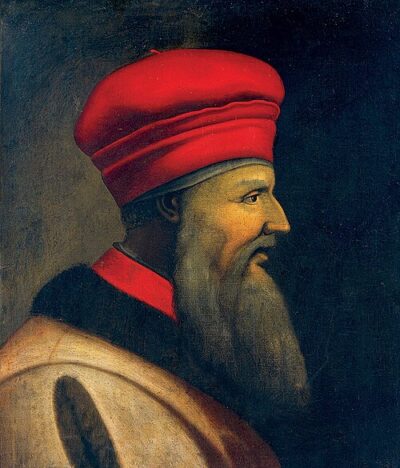
Skanderbeg
Skanderbeg was an Albanian noble and military commander. Born May 6, 1405, in Sinë. Died January 17, 1468, in Lezhë. Positions held include monarch. Educated at Enderun School. Awards include Athleta Christi.
Facts
25 facts · 2 confirmed by two sources · 6 cited · 17 from one source
Where this comes from
Papalocal keeps its own record. It started from these sources; what each one said is kept here as it was copied, so a change on their side never changes this page by itself. Tap one to read its version.
What Wikidata says · copied November 16, 2026 · revision 2558238902
- Described as
- Albanian noble and military commander (1405–1468)
- Other names
- Scanderbeg, Gjergj Kastrioti
- Born
- May 6, 1405
- Died
- January 17, 1468 · 3 references
- Born in
- Sinë
- Died in
- Lezhë · 1 reference
- Buried in
- Lezhë · 1 reference
- Cause of death
- malaria
- Citizen of
- Republic of Venice; Ottoman Empire
- Occupation
- aristocrat; statesperson; military commander; military leader · 1 reference; national hero · 1 reference
- Positions held
- monarch
- Education
- Enderun School
- Member of
- Order of the Dragon
- Awards
- Athleta Christi
- Spouse
- Donika Kastrioti · 1 reference
- Children
- Gjon Kastrioti II
- Father
- Jovan Kastriot
- Mother
- Voisava Kastrioti
- Siblings
- Mara Kastrioti
- Religion
- Christianity · 1 reference; Catholicism (1423–1443) · 1 reference
- Military rank
- commanding officer
- Wikipedias with a page
- 84
Wikidata item Q160614 (wikidata.org/wiki/Q160614), public domain (CC0). Copied November 16, 2026.
What Wikipedia says · copied November 16, 2026 · revision 1378504852
Gjergj Kastrioti (also known as Skanderbeg; c. 1405 – 17 January 1468) was an Albanian nobleman and military leader who led the League of Lezhë in the Ottoman-Albanian Wars until his death. Skanderbeg is considered to be a major figure of medieval Albanian history and today is the national hero of Albania.
A member of the noble Kastrioti family, Skanderbeg was sent as a hostage to the Ottoman court. He graduated from the Enderun School and entered the service of the Ottoman sultan Murad II (r. 1421–1451) for the next twenty years. His rise through the ranks culminated in his appointment as sanjakbey of the Sanjak of Dibra in 1440. During the Battle of Nish in 1443, he deserted the Ottomans and became the ruler of Krujë and nearby areas extending from Petrelë to Modrič. In March 1444, he established the League of Lezhë, with support from local noblemen, and unified the Albanian principalities.
In 1451, through the Treaty of Gaeta, Skanderbeg recognized de jure the sovereignty of the Kingdom of Naples over Albania, ensuring a protective alliance, although he remained a de facto independent ruler. In 1460–61, he supported Ferdinand I of Naples (r. 1458–1494) in his wars and led an Italian expedition against John II of Anjou (r. 1453–1470). In 1463, he was earmarked to be the chief commander of the crusading forces of Pope Pius II, but the Pope died while the armies were still gathering and the greater European crusade never took place. Together with Venetians, he fought against the Ottomans during the First Ottoman–Venetian War (1463–1479) until his death.
Skanderbeg ranks high in the military history of that time as the most persistent—and ever-victorious—opponent of the Ottoman Empire during its heyday. The central folk hero of the Albanians, Skanderbeg became a central figure in the Albanian National Awakening of the 19th century. He is honored in modern Albania and is commemorated with many monuments and cultural works. Skanderbeg's military skills presented a major obstacle to Ottoman expansion, and many in Western Europe considered him to be a model of Christian resistance against the Ottomans.
- Born, in its opening lines
- c. 1405
- Died, in its opening lines
- January 17, 1468
From the Wikipedia article “Skanderbeg” (en.wikipedia.org/wiki/Skanderbeg), by its contributors, under CC BY-SA 4.0 (creativecommons.org/licenses/by-sa/4.0/). Copied November 16, 2026; not changed.
Confirmed Two sources agree. Cited One source, and it names where it got it. One source One source, without a reference of its own. Sources disagree The sources disagree. We show the best-supported value and keep theirs below.
