
Sobekneferu
Sobekneferu was an Egyptian queen regnant. Born 19th century BC. Died 1793 BC. Positions held include pharaoh (-1798–-1793).
Facts
13 facts · 0 confirmed by two sources · 2 cited · 11 from one source
Where this comes from
Papalocal keeps its own record. It started from these sources; what each one said is kept here as it was copied, so a change on their side never changes this page by itself. Tap one to read its version.
What Wikidata says · copied November 16, 2026 · revision 2565546376
- Described as
- Egyptian queen regnant
- Other names
- Sebeknefru, Neferusobek, Skemiophris (in Manetho)
- Born
- 19th century BC
- Died
- 1793 BC
- Buried in
- Northern Mazghuna pyramid
- Citizen of
- Ancient Egypt; Middle Kingdom of Egypt
- Occupation
- statesperson; queen regnant
- Positions held
- pharaoh (-1798–-1793) · 1 reference
- Children
- Sekhemre Khutawy Sobekhotep
- Father
- Amenemhat III · 1 reference
- Siblings
- Amenemhat IV; Sekhemre Khutawy Sobekhotep · 1 reference; Amenemhat Sénébef · 1 reference
- Wikipedias with a page
- 48
Wikidata item Q228951 (wikidata.org/wiki/Q228951), public domain (CC0). Copied November 16, 2026.
What Wikipedia says · copied November 16, 2026 · revision 1385093720
Sobekneferu or Neferusobek (Egyptian: 𓄤𓄤𓄤𓆍, romanized: Sbk-nfrw, lit. 'Beauty of Sobek') was the first confirmed queen regnant (or 'female king') of ancient Egypt and the last pharaoh of the Twelfth Dynasty and of the Middle Kingdom. Her reign was brief, lasting three years, 10 months, and 24 days according to the Turin Canon in the 18th century BC. She distinguished herself from any potential prior female rulers by adopting the full royal titulary which was often modified to acknowledge her womanhood such as by the titles 'daughter of Re' and 'female Horus'. She was also the first ruler to associate with the crocodile god Sobek in her nomen and prenomen.
Sobekneferu ascended to the throne following the death of Amenemhat IV, her presumed brother and husband, albeit the relationship is unsubstantiated. The reasons for her accession are debated. One possibility is that her predecessor had no male heir to bestow the throne to, thus leaving his sister to take the mantle of king. Yet, there are two candidate sons and Thirteenth Dynasty kings, Sobekhotep I and Sonbef, that may have filiative nomina stating that they are 'Amenemhat's son'. If Amenemhat IV is meant, then it may be that she usurped the throne from them, perhaps because she perceived them to be illegitimate. She also never associated herself with Amenemhat IV, instead asserting her legitimacy through their presumptive father, Amenemhat III. It appears though, that Sokebhotep I modelled his prenomen after Sobekneferu's Nebty name, indicating that he may have sought legitimacy from his predecessor and also demonstrating the esteem she was held in.
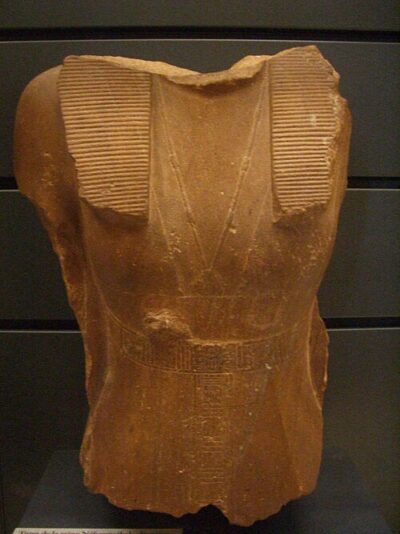
Contemporary evidence from her reign is scant. There are a few partial statues – one with her face, now lost – and a small corpus of seals and inscriptions that have been preserved. These mainly originate from Faiyum where she is credited with the completion of 'the Labyrinth' – the mortuary temple of Amenemhat III's pyramid at Hawara. One important inscription is a graffito recording the level of the Nile inundation at the fortress at Kumma in her third regnal year indicating that she maintained authority across Egypt. Her funerary monument remains unidentified, though a papyrus discovered in Harageh mentions a site called Sekhem Sobekneferu which may refer to it, and there is a storeroom administrator attested to on a stela providing evidence of an active funerary cult. Her rule is also attested to on several later king lists from the Thutmosid and Ramesside periods and in Manetho's Aegyptiaca.
From the Wikipedia article “Sobekneferu” (en.wikipedia.org/wiki/Sobekneferu), by its contributors, under CC BY-SA 4.0 (creativecommons.org/licenses/by-sa/4.0/). Copied November 16, 2026; not changed.
Confirmed Two sources agree. Cited One source, and it names where it got it. One source One source, without a reference of its own. Sources disagree The sources disagree. We show the best-supported value and keep theirs below.
