
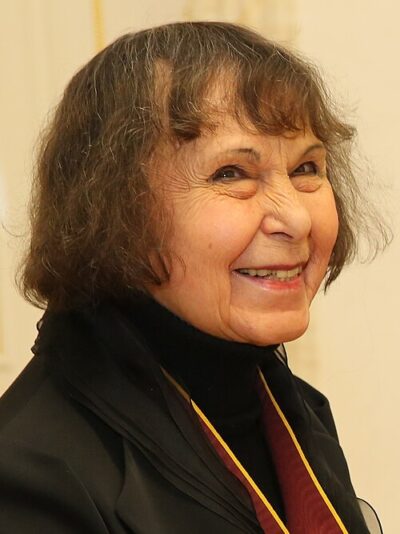
Sofia Gubaidulina
Sofia Gubaidulina was a Soviet and Russian composer. Born October 24, 1931, in Chistopol. Died March 13, 2025, in Appen. Known for The Deceitful Face of Hope and Despair and Johannes-Passion. Educated at Kazan Conservatory and Moscow Conservatory. Awards include Pour le Mérite for Sciences and Arts order, Knight Commander's Cross of the Order of Merit of the Federal Republic of Germany and Bach Prize of the Free and Hanseatic City of Hamburg.
Facts
42 facts · 2 confirmed by two sources · 11 cited · 29 from one source
Where this comes from
Papalocal keeps its own record. It started from these sources; what each one said is kept here as it was copied, so a change on their side never changes this page by itself. Tap one to read its version.
What Wikidata says · copied November 16, 2026 · revision 2568784195
- Described as
- Soviet and Russian composer (1931–2025)
- Other names
- Sofiya Asgatovna Gubaydulina
- Born
- October 24, 1931 · 10 references
- Died
- March 13, 2025 · 3 references
- Born in
- Chistopol · 3 references
- Died in
- Appen · 2 references
- Citizen of
- Soviet Union (–1991); Russia
- Occupation
- composer · 2 references; film score composer; classical pianist
- Education
- Kazan Conservatory (1949–1954); Moscow Conservatory (1954–1963) · 1 reference
- Member of
- Academy of Arts, Berlin; Academy of Arts of the GDR; Bavarian Academy of Fine Arts; American Academy of Arts and Letters
- Genre
- classical music · 1 reference
- Instrument
- piano · 1 reference
- Record label
- Deutsche Grammophon; Melodiya
- Known for
- The Deceitful Face of Hope and Despair; Johannes-Passion
- Awards
- Pour le Mérite for Sciences and Arts order; Knight Commander's Cross of the Order of Merit of the Federal Republic of Germany; Bach Prize of the Free and Hanseatic City of Hamburg (2007); Alexander Men Prize; Praemium Imperiale (1998) · 1 reference; Léonie Sonning Music Prize (1999); Order of Friendship; Honored art worker of the Russian Soviet Federative Socialist Republic (1990); Goethe Medal (2001) · 1 reference; BBVA Foundation Frontiers of Knowledge Award (2016); State Prize of the Russian Federation (1992); Order "Duslyk" (2016) · 1 reference; honorary citizen of Kazan · 1 reference; Order For Merit in Culture and Art · 1 reference; Order of Merit of the Federal Republic of Germany · 1 reference
- Field
- music · 1 reference; music composition · 1 reference; symphonic music · 1 reference; instrumental music · 1 reference; film score · 1 reference
- Religion
- Eastern Orthodox Church
- Wikipedias with a page
- 51
Wikidata item Q165668 (wikidata.org/wiki/Q165668), public domain (CC0). Copied November 16, 2026.
What Wikipedia says · copied November 16, 2026 · revision 1381718442
Sofia Asgatovna Gubaidulina (24 October 1931 – 13 March 2025) was a Soviet and Russian composer of modernist sacred music. She was highly prolific, producing numerous chamber, orchestral and choral works. Her output has been described as exploring the tensions between Western and Eastern music, and has been characterised by "innovative use of microtonality and chromaticism, rhythm over form and use of contrasting tonalities.
Her compositions have been praised for their "emotional intensity", while she described her music as bringing legato, that is, a sense of "connected flow into the fragmented staccato of life." Alongside Alfred Schnittke, Arvo Pärt and Edison Denisov, Gubaidulina was considered one of the foremost composers of the former Soviet Union who were disfavoured by the authorities including the KGB, but whose work became frequently commissioned and performed by major international orchestras, with her first major breakthrough being her violin concerto Offertorium (1980).
- Born, in its opening lines
- October 24, 1931
- Died, in its opening lines
- March 13, 2025
From the Wikipedia article “Sofia Gubaidulina” (en.wikipedia.org/wiki/Sofia_Gubaidulina), by its contributors, under CC BY-SA 4.0 (creativecommons.org/licenses/by-sa/4.0/). Copied November 16, 2026; not changed.
Confirmed Two sources agree. Cited One source, and it names where it got it. One source One source, without a reference of its own. Sources disagree The sources disagree. We show the best-supported value and keep theirs below.
