
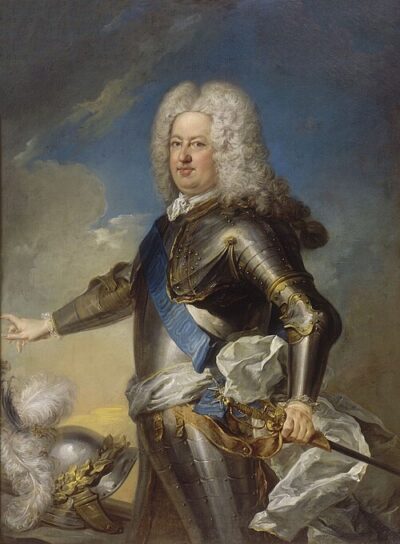
Stanisław Leszczyński
Stanisław Leszczyński was a King of Poland and Grand Duke of Lithuania. Born October 20, 1677, in Lviv. Died February 23, 1766, in Lunéville. Positions held include King of Poland (2 times) (1704–1736), Polish elector and Tenutary of Dubienka. Awards include Order of the Holy Spirit.
Facts
20 facts · 2 confirmed by two sources · 2 cited · 16 from one source
Where this comes from
Papalocal keeps its own record. It started from these sources; what each one said is kept here as it was copied, so a change on their side never changes this page by itself. Tap one to read its version.
What Wikidata says · copied November 16, 2026 · revision 2559145523
- Described as
- King of Poland and Grand Duke of Lithuania (1677–1766)
- Other names
- Stanislovas Leščinskis, Stanislav Leszczyński, Stanislaus Leczinski, Stanislas Leszczyński, Stanislas Leszczynski, Stanislas Leczinski, Stanislaus Leszczyński, Stanislas Leckzinski
- Born
- October 20, 1677 · 2 references
- Died
- February 23, 1766 · 2 references
- Born in
- Lviv · 1 reference
- Died in
- Lunéville
- Buried in
- Royal Tombs of the Wawel Cathedral (1938–)
- Citizen of
- France; Polish–Lithuanian Commonwealth
- Occupation
- art collector · 1 reference
- Positions held
- King of Poland (2 times) (1704–1736); Polish elector; Tenutary of Dubienka; Tenutary of Odolanów
- Member of
- Freemasonry
- Awards
- Order of the Holy Spirit · 1 reference
- Spouse
- Catherine Opalińska (1698–1747) · 1 reference
- Children
- Marie Leszczyńska · 1 reference; Anna Leszczyńska
- Father
- Rafał Leszczyński
- Mother
- Anna Leszczyńska (née Jabłonowska)
- Religion
- Catholicism
- Wikipedias with a page
- 58
Wikidata item Q54022 (wikidata.org/wiki/Q54022), public domain (CC0). Copied November 16, 2026.
What Wikipedia says · copied November 16, 2026 · revision 1377260635
Stanisław I Leszczyński (Stanisław Bogusław; 20 October 1677 – 23 February 1766), also Anglicised and Latinised as Stanislaus, was twice King of Poland and Grand Duke of Lithuania, and at various times Prince of Deux-Ponts, Duke of Bar and Duke of Lorraine.
During the Great Northern War, multiple candidates had emerged after the death of John III Sobieski for the elective kingship of Poland (which also included the Grand Duchy of Lithuania as part of the Poland-Lithuanian Commonwealth). Backed by powerful neighbors in Russia and Austria, the Sejm elected Augustus the Strong, Elector of Saxony to succeed John III in 1697 as August II. Russia's primary antagonist in the Great Northern War, Sweden had supported Stanisław Leszczyński for the throne, and after defeating a combined army of Saxon and Polish-Lithuanian forces, deposed Augustus II the Strong and installed Leszczyński as Stanisław in 1704.
In 1709, Charles XII of Sweden, Stanisław's main supporter, suffered a defeat by the Russians at the Battle of Poltava, and was subsequently driven into exile in the Ottoman Empire. As a result, Augustus II returned to the throne, and while Charles served his exile in the Ottoman Empire, Stanisław accepted the rule of the tiny state of Palatine Zweibrücken, a small state of the Holy Roman Empire which was in personal union with Sweden and located near the region of Alsace. After Charles's death in 1719, he moved to nearby Wissembourg in Alsace. In 1725, his daughter Marie Leszczyńska married Louis XV of France.
The death of Augustus II sparked the War of the Polish Succession in 1733. As had happened on the death of John III Sobieski, foreign intrigue and influence plagued the Sejm election. Despite the presence of Russian troops in the country, the Sejm, with support of the French, elected Stanisław to succeed Augustus II the Strong, while the Russians encouraged a group of break-away nobles to hold their own election, selecting instead Augustus III of Poland, son of Augustus II, to the kingship. War broke out almost immediately, evolving into a proxy war between the Bourbon and Habsburg dynasties and their supporters, with the Bourbon faction led by France and Spain, with their allies Sardinia and Sweden, while the Habsburg faction was led by Austria and their allies Russia, Prussia, and Saxony. After two years of fighting across the entire continent, a ceasefire was declared in 1735. Stanislaw officially abdicated in January 1736, and the Peace of Vienna was promulgated in 1738, whereby Augustus III was officially recognised as King of Poland, and Stanisław was compensated for losing the throne a second time with the duchies of Bar and Lorraine, both of which were nominally part of the Holy Roman Empire at the time.
While Duke of Lorraine, Stanisław lived out his remaining years at a country estate in Lunéville, and actively ruled Lorraine and Bar, sponsoring numerous public works projects. Nearby, Nancy, the historic capital of Lorraine, has a Place Stanislas (Stanisław Square) named in his honour, much of which was developed during his reign. He also took up political philosophy, engaging in discourse with other Enlightenment figures such as Jean Jacques Rousseau, and wrote philosophical treatises in his native Polish, making him a figure within the Polish Enlightenment. When he died in 1766, his titles passed to his son-in-law, Louis XV. His retaking of the Polish throne in 1733 formed the backdrop for Un giorno di regno, an opera by composer Giuseppe Verdi and librettist Felice Romani, which premiered in 1840.
- Born, in its opening lines
- October 20, 1677
- Died, in its opening lines
- February 23, 1766
From the Wikipedia article “Stanisław Leszczyński” (en.wikipedia.org/wiki/Stanisław_Leszczyński), by its contributors, under CC BY-SA 4.0 (creativecommons.org/licenses/by-sa/4.0/). Copied November 16, 2026; not changed.
Confirmed Two sources agree. Cited One source, and it names where it got it. One source One source, without a reference of its own. Sources disagree The sources disagree. We show the best-supported value and keep theirs below.
