
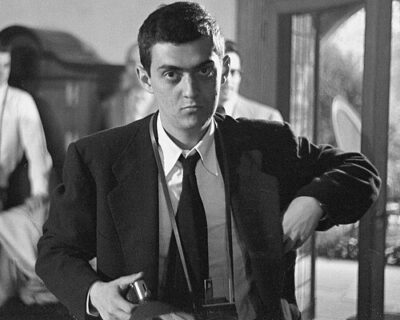
Stanley Kubrick
Stanley Kubrick was an American filmmaker and photographer. Born July 26, 1928, in The Bronx. Died March 7, 1999, in Childwickbury Manor. Known for 2001: A Space Odyssey, Dr. Strangelove and A Clockwork Orange. Educated at City College of New York and William Howard Taft High School. Awards include BAFTA Fellowship, Academy Award for Best Visual Effects and Golden Lion for Lifetime Achievement.
Facts
49 facts · 2 confirmed by two sources · 11 cited · 36 from one source
Where this comes from
Papalocal keeps its own record. It started from these sources; what each one said is kept here as it was copied, so a change on their side never changes this page by itself. Tap one to read its version.
What Wikidata says · copied November 13, 2026 · revision 2561511193
- Described as
- American filmmaker and photographer (1928–1999)
- Other names
- Kubrick
- Born
- July 26, 1928 · 16 references
- Died
- March 7, 1999 · 14 references
- Born in
- The Bronx · 1 reference
- Died in
- Childwickbury Manor · 3 references
- Buried in
- Childwickbury Manor · 1 reference
- Cause of death
- myocardial infarction
- Name at birth
- Stanley Kubrick · 1 reference
- Citizen of
- United States (1928–); United Kingdom · 1 reference
- Occupation
- film director · 1 reference; cinematographer; photographer · 2 references; film producer; screenwriter · 3 references; film editor; camera operator; executive producer
- Education
- City College of New York; William Howard Taft High School · 1 reference
- Member of
- Writers Guild of America West · 1 reference
- Sport
- chess
- Genre
- mystery film; horror film; thriller film; film noir; psychological horror film; war film
- Known for
- 2001: A Space Odyssey; Dr. Strangelove; A Clockwork Orange; The Shining; Eyes Wide Shut
- Awards
- BAFTA Fellowship (2000); Academy Award for Best Visual Effects (1969) · 1 reference; Golden Lion for Lifetime Achievement (1997); Science Fiction and Fantasy Hall of Fame (2014); Commandeur des Arts et des Lettres (1995) · 1 reference; National Board of Review Award for Best Film; BAFTA Award for Best Direction (1976) · 1 reference; Hugo Award for Best Dramatic Presentation (1965); Sitges Grand Honorary Award (2008)
- Field
- film direction; film production
- Spouse
- Ruth Sobotka (1954–1957) · 1 reference; Christiane Kubrick (1958–1999)
- Children
- Vivian Kubrick
- Religion
- atheism
- Height
- 1.69 m (5 ft 7 in)
- Website
- http://www.kubrickfilms.com · 1 reference
- Wikipedias with a page
- 160
Wikidata item Q2001 (wikidata.org/wiki/Q2001), public domain (CC0). Copied November 13, 2026.
What Wikipedia says · copied November 13, 2026 · revision 1385460306
Stanley Kubrick (July 26, 1928 – March 7, 1999) was an American filmmaker and photographer. A prominent figure of the New Hollywood era, Kubrick is regarded as one of the greatest and most influential filmmakers. His films spanned a number of genres and gained recognition for their attention to detail, innovative cinematography, extensive set design, and dark humor.
Born in New York City, Kubrick worked as a photographer for Look magazine in the late 1940s and early 1950s. He made his first major Hollywood film, The Killing, in 1956. This was followed by two collaborations with Kirk Douglas: the anti-war film Paths of Glory (1957) and the historical epic Spartacus (1960). In 1961, Kubrick settled in England. In 1978, he made his home at Childwickbury Manor with his wife Christiane, and it became his workplace where he centralized the writing, research, editing, and management of his productions. This permitted him almost complete artistic control over his films, with the rare advantage of financial support from major Hollywood studios. His first productions in England were two films with Peter Sellers: the comedy-drama Lolita (1962) and the Cold War satire Dr. Strangelove (1964).
A perfectionist who assumed direct control over most aspects of his filmmaking, Kubrick cultivated expertise in writing, editing, color grading, promotion, and exhibition. He was famous for the painstaking care taken in researching his films and staging scenes. He frequently asked for several dozen retakes of the same shot, often confusing and frustrating his actors. Many of Kubrick's films broke new cinematic ground and are now considered landmarks. The scientific realism and innovative special effects in his science fiction epic 2001: A Space Odyssey (1968) were a first in cinema history; the film earned him his only Academy Award (for Best Visual Effects) and is regarded as one of the greatest films ever made.
While many of Kubrick's films were controversial and initially received mixed reviews upon release—particularly the brutal A Clockwork Orange (1971), which Kubrick withdrew from circulation in the UK following a media frenzy—most were nominated for Academy Awards, Golden Globes, or BAFTA Awards, and underwent critical re-evaluations. With the horror film The Shining (1980), he became one of the first directors to make use of a Steadicam for stabilized and fluid tracking shots, a technology vital to his Vietnam War film Full Metal Jacket (1987). A few days after hosting a screening for his family and the stars of his final film, Eyes Wide Shut (1999), he died at the age of 70.
- Born, in its opening lines
- July 26, 1928
- Died, in its opening lines
- March 7, 1999
From the Wikipedia article “Stanley Kubrick” (en.wikipedia.org/wiki/Stanley_Kubrick), by its contributors, under CC BY-SA 4.0 (creativecommons.org/licenses/by-sa/4.0/). Copied November 13, 2026; not changed.
Confirmed Two sources agree. Cited One source, and it names where it got it. One source One source, without a reference of its own. Sources disagree The sources disagree. We show the best-supported value and keep theirs below.
