
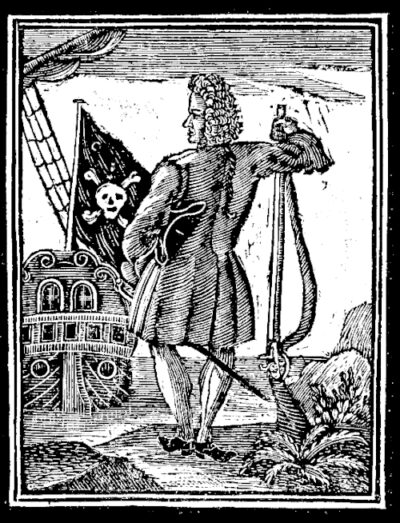
Stede Bonnet
Stede Bonnet was an early 18th-century Barbadian pirate. Born July 29, 1688, in Bridgetown. Died December 10, 1718, in Charleston.
Facts
11 facts · 2 confirmed by two sources · 4 cited · 5 from one source
Where this comes from
Papalocal keeps its own record. It started from these sources; what each one said is kept here as it was copied, so a change on their side never changes this page by itself. Tap one to read its version.
What Wikidata says · copied November 16, 2026 · revision 2566978700
- Described as
- early 18th-century Barbadian pirate
- Born
- July 29, 1688
- Died
- December 10, 1718 · 2 references
- Born in
- Bridgetown
- Died in
- Charleston · 1 reference
- Cause of death
- hanging to death
- Citizen of
- Kingdom of Great Britain; Kingdom of England
- Occupation
- privateer; pirate · 1 reference
- Spouse
- Mary Allumbey · 1 reference
- Children
- Edward Bonnet · 2 references
- Wikipedias with a page
- 29
Wikidata item Q444908 (wikidata.org/wiki/Q444908), public domain (CC0). Copied November 16, 2026.
What Wikipedia says · copied November 16, 2026 · revision 1384744621
Stede Bonnet (c. 1688 – 10 December 1718), known as the Gentleman Pirate, was an English pirate and landowner. Bonnet was born into a wealthy English family on the island of Barbados, and inherited the family estate after his father's death in 1694. Despite his lack of sailing experience, Bonnet decided he should turn to piracy and crime in the spring of 1717. He bought a sailing vessel, the Revenge, and travelled with his paid crew along the Eastern Seaboard of what is now the Eastern United States, capturing other vessels and burning other Barbadian ships.
Bonnet set sail for Nassau in the Bahamas, to the haven for pirates known as the "Republic of Pirates", but he was seriously wounded en route during an encounter with a Spanish warship. After arriving in Nassau, Bonnet met the infamous pirate Blackbeard, with whom he developed a close union despite initially being enemies. Incapable of leading his crew, Bonnet temporarily ceded his ship's command to Blackbeard. Before separating in December 1717, Blackbeard and Bonnet plundered and captured merchant ships along the East Coast. After Bonnet failed to capture the Protestant Caesar, his crew abandoned him to join Blackbeard aboard the Queen Anne's Revenge. Bonnet stayed on Blackbeard's ship as a guest, and did not command a crew again until summer 1718, when he was pardoned by North Carolina governor Charles Eden and received clearance to undertake privateering against Spanish shipping interests. Bonnet was tempted to resume his piracy but did not want to lose his pardon, so he adopted the alias "Captain Thomas" and changed his ship's name to Royal James. He had returned to piracy by July of 1718.
In August, Bonnet anchored Royal James on an estuary of the Cape Fear River to careen and repair the ship. In late August and September, Colonel William Rhett, with the authorisation of South Carolina's governor Robert Johnson, led a naval expedition against pirates on the river. Rhett's and Bonnet's men engaged in combat for hours, but the outnumbered pirates ultimately surrendered. Rhett arrested the pirates and brought them to Charles Town (now Charleston, South Carolina) in early October. Bonnet escaped on 24 October, but was soon recaptured on Sullivan's Island. On 10 November, Bonnet was brought to trial and charged with two acts of piracy. Judge Nicholas Trott sentenced him to death. Bonnet wrote to Johnson to ask for clemency, but Johnson endorsed the judge's decision, and Bonnet was hanged in Charles Town on 10 December.
- Born, in its opening lines
- c. 1688
- Died, in its opening lines
- December 10, 1718
From the Wikipedia article “Stede Bonnet” (en.wikipedia.org/wiki/Stede_Bonnet), by its contributors, under CC BY-SA 4.0 (creativecommons.org/licenses/by-sa/4.0/). Copied November 16, 2026; not changed.
Confirmed Two sources agree. Cited One source, and it names where it got it. One source One source, without a reference of its own. Sources disagree The sources disagree. We show the best-supported value and keep theirs below.
