
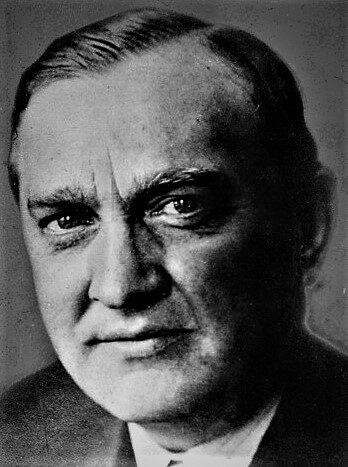
Stefan Banach
Stefan Banach was a Polish mathematician. Born March 30, 1892, in Kraków. Died August 31, 1945, in Lviv. Known for Banach space, Banach algebra and Banach–Tarski paradox. Educated at IV Liceum i Gimnazjum im. Henryka Sienkiewicza w Krakowie and Lviv Polytechnic. Awards include Order of the White Eagle.
Facts
43 facts · 2 confirmed by two sources · 16 cited · 25 from one source
Where this comes from
Papalocal keeps its own record. It started from these sources; what each one said is kept here as it was copied, so a change on their side never changes this page by itself. Tap one to read its version.
What Wikidata says · copied November 16, 2026 · revision 2567630383
- Described as
- Polish mathematician (1892–1945)
- Born
- March 30, 1892 · 10 references
- Died
- August 31, 1945 · 10 references
- Born in
- Kraków · 3 references
- Died in
- Lviv · 3 references
- Buried in
- Lychakiv Cemetery · 2 references
- Cause of death
- lung cancer · 1 reference
- Citizen of
- Cisleithania (–1918); Second Polish Republic (1918–1939); Ukrainian Soviet Socialist Republic (2 times) (1939–); Reichskommissariat Ukraine (1941–1944)
- Occupation
- mathematician · 1 reference; university teacher · 1 reference
- Worked for
- Lviv University (1922–1941) · 1 reference; Lviv Polytechnic (1920–1922) · 1 reference
- Education
- IV Liceum i Gimnazjum im. Henryka Sienkiewicza w Krakowie (1902–1910) · 1 reference; Lviv Polytechnic (1911–1913) · 1 reference; Jagiellonian University (1916–1920) · 2 references; Lviv University · 1 reference; Bartłomiej Nowodworski High School
- Member of
- Polish Academy of Learning (1924–); Lwów Scientific Society; Polish Mathematical Society (1919–); National Academy of Sciences of Ukraine (1939–); Warsaw Scientific Society · 1 reference
- Known for
- Banach space; Banach algebra; Banach–Tarski paradox; Banach manifold; uniform boundedness principle; Hahn–Banach theorem; Banach fixed-point theorem; Banach–Saks property; Banach–Mazur compactum; Banach–Alaoglu theorem
- Awards
- Order of the White Eagle (2018) · 1 reference
- Field
- mathematics; functional analysis; topology · 1 reference; Banach space · 1 reference; measure theory · 1 reference; integral · 1 reference
- Spouse
- Łucja Braus (1920–) · 1 reference
- Lived in
- Lviv
- Wikipedias with a page
- 79
Wikidata item Q180217 (wikidata.org/wiki/Q180217), public domain (CC0). Copied November 16, 2026.
What Wikipedia says · copied November 16, 2026 · revision 1383624633
Stefan Banach (Polish: [ˈstɛfan ˈbanax] ; 30 March 1892 – 31 August 1945) was a Polish mathematician who is generally considered one of the 20th century's most important and influential mathematicians. He was one of the founders of modern functional analysis, and an original member of the Lwów School of Mathematics. His major work was the 1932 book, Théorie des opérations linéaires (Theory of Linear Operations), the first monograph on the general theory of functional analysis.
Born in Kraków to a family of Goral descent, Banach showed a keen interest in mathematics and engaged in solving mathematical problems during school recess. After completing his secondary education, he befriended Hugo Steinhaus, with whom he established the Polish Mathematical Society in 1919 and later published the scientific journal Studia Mathematica. In 1920, he received an assistantship at the Lwów Polytechnic, subsequently becoming a professor in 1922 and a member of the Polish Academy of Learning in 1924. Banach was also a co-founder of the Lwów School of Mathematics, a school of thought comprising some of the most renowned Polish mathematicians of the interwar period (1918–1939).
Some of the most notable mathematical concepts that bear Banach's name include Banach spaces, Banach algebras, Banach measures, the Banach–Tarski paradox, the Hahn–Banach theorem, the Banach–Steinhaus theorem, the Banach–Mazur game, the Banach–Alaoglu theorem, Banach-Saks property, and the Banach fixed-point theorem.
- Born, in its opening lines
- March 30, 1892
- Died, in its opening lines
- August 31, 1945
From the Wikipedia article “Stefan Banach” (en.wikipedia.org/wiki/Stefan_Banach), by its contributors, under CC BY-SA 4.0 (creativecommons.org/licenses/by-sa/4.0/). Copied November 16, 2026; not changed.
Confirmed Two sources agree. Cited One source, and it names where it got it. One source One source, without a reference of its own. Sources disagree The sources disagree. We show the best-supported value and keep theirs below.
