
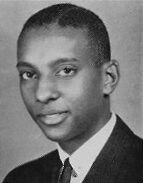
Stokely Carmichael
Stokely Carmichael was an American activist. Born June 29, 1941, in Port of Spain. Died November 15, 1998, in Conakry. Known for Black Power: The Politics of Liberation. Educated at Howard University and University of Toronto Mississauga.
Facts
21 facts · 2 confirmed by two sources · 2 cited · 17 from one source
Where this comes from
Papalocal keeps its own record. It started from these sources; what each one said is kept here as it was copied, so a change on their side never changes this page by itself. Tap one to read its version.
What Wikidata says · copied November 15, 2026 · revision 2558246734
- Described as
- American activist (1941-1998)
- Other names
- Kwame Ture, Stokely Standiford Churchill Carmichael
- Born
- June 29, 1941 · 5 references
- Died
- November 15, 1998 · 7 references
- Born in
- Port of Spain
- Died in
- Conakry
- Buried in
- Cameroun cemetery
- Cause of death
- prostate cancer
- Name at birth
- Stokely Standiford Churchill Carmichael · 1 reference
- Citizen of
- Trinidad and Tobago; United States · 1 reference; Guinea
- Occupation
- politician; human rights defender · 1 reference; activist; revolutionary
- Education
- Howard University; University of Toronto Mississauga; Bronx High School of Science
- Member of
- Black Panther Party; Student Nonviolent Coordinating Committee
- Known for
- Black Power: The Politics of Liberation
- Spouse
- Miriam Makeba (1969–1978) · 1 reference
- Wikipedias with a page
- 36
Wikidata item Q509860 (wikidata.org/wiki/Q509860), public domain (CC0). Copied November 15, 2026.
What Wikipedia says · copied November 15, 2026 · revision 1385036704
Kwame Ture ( KWAH-may TOOR-ay; born Stokely Standiford Churchill Carmichael; June 29, 1941 – November 15, 1998) was a Trinidadian-American activist who played a major role in the civil rights movement in the United States and the global pan-African movement. Born in Trinidad and Tobago, he moved to the United States at age 11 and became an activist while attending the Bronx High School of Science. Ture was a key leader in the development of the Black Power movement, first while leading the Student Nonviolent Coordinating Committee (SNCC), then as the "Honorary Prime Minister" of the Black Panther Party and as a leader of the All-African People's Revolutionary Party (A-APRP).
Carmichael was one of the original SNCC Freedom Riders of 1961 under Diane Nash's leadership. He became a major voting rights activist in Mississippi and Alabama after being mentored by Ella Baker and Bob Moses. Like most young people in the SNCC, he became disillusioned with the two-party system after the 1964 Democratic National Convention failed to recognize the Mississippi Freedom Democratic Party as official delegates from the state. Carmichael eventually decided to develop independent all-black political organizations, such as the Lowndes County Freedom Organization and, for a time, the national Black Panther Party. Inspired by Malcolm X's example, he articulated a philosophy of black power, and popularized it both by provocative speeches and more sober writings. The author Richard Wright is credited with coining the phrase in his 1954 book Black Power.
Carmichael became one of the most popular and controversial Black leaders of the late 1960s. FBI director J. Edgar Hoover secretly identified Carmichael as the man most likely to succeed Malcolm X as America's "black messiah". The FBI targeted him for counterintelligence activity through its COINTELPRO program, causing Carmichael to move to Africa in 1968. He reestablished himself in Ghana, and then Guinea by 1969. There, he adopted the name Kwame Ture, and began campaigning internationally for revolutionary socialist pan-Africanism. Ture died of prostate cancer in 1998 at the age of 57.
- Born, in its opening lines
- June 29, 1941
- Died, in its opening lines
- November 15, 1998
From the Wikipedia article “Stokely Carmichael” (en.wikipedia.org/wiki/Stokely_Carmichael), by its contributors, under CC BY-SA 4.0 (creativecommons.org/licenses/by-sa/4.0/). Copied November 15, 2026; not changed.
Confirmed Two sources agree. Cited One source, and it names where it got it. One source One source, without a reference of its own. Sources disagree The sources disagree. We show the best-supported value and keep theirs below.
