
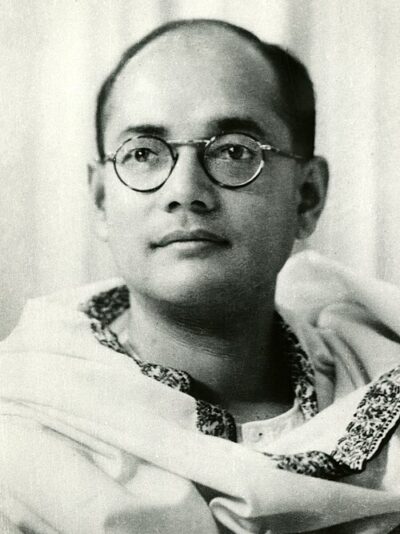
Subhas Chandra Bose
Subhas Chandra Bose was an Indian nationalist leader. Born January 23, 1897, in Cuttack. Died August 18, 1945, in Taihoku. Positions held include President of the Indian National Congress (1938–1939), Mayor of Kolkata (1930–1931) and commander-in-chief (1943–1945). Known for The Indian Struggle. Educated at University of Calcutta and Fitzwilliam College.
Facts
37 facts · 2 confirmed by two sources · 8 cited · 27 from one source
Where this comes from
Papalocal keeps its own record. It started from these sources; what each one said is kept here as it was copied, so a change on their side never changes this page by itself. Tap one to read its version.
What Wikidata says · copied November 16, 2026 · revision 2565538359
- Described as
- Indian nationalist leader (1897-1945)
- Other names
- Netaji, Subhash Chandra Bose
- Born
- January 23, 1897 · 5 references
- Died
- August 18, 1945 · 2 references
- Born in
- Cuttack · 2 references
- Died in
- Taihoku · 2 references
- Cause of death
- burn
- Citizen of
- British Raj
- Occupation
- politician · 1 reference; revolutionary · 1 reference; writer · 1 reference; freedom fighter; autobiographer; resistance fighter · 1 reference; political leader · 1 reference
- Positions held
- President of the Indian National Congress (1938–1939); Mayor of Kolkata (1930–1931) · 1 reference; commander-in-chief (1943–1945) · 1 reference
- Political party
- Indian National Congress; All India Forward Bloc
- Worked for
- Indian Civil Service (–1921)
- Education
- University of Calcutta; Fitzwilliam College; Presidency University; Scottish Church College; Ravenshaw Collegiate School; Bangabasi Morning College
- Known for
- The Indian Struggle · 1 reference
- Spouse
- Emilie Schenkl (1937–1945) · 1 reference
- Children
- Anita Bose Pfaff
- Father
- Janakinath Bose
- Mother
- Prabhabati Bose
- Siblings
- Sarat Chandra Bose · 1 reference; Sunil Chandra Bose; Suresh Chandra Bose · 1 reference
- Religion
- Hinduism
- Military branch
- Indian National Army · 1 reference
- Lived in
- Netaji Bhawan (–1941) · 1 reference
- Website
- https://netaji.org/
- Wikipedias with a page
- 78
Wikidata item Q2153 (wikidata.org/wiki/Q2153), public domain (CC0). Copied November 16, 2026.
What Wikipedia says · copied November 16, 2026 · revision 1385312186
Subhas Chandra Bose (23 January 1897 – 18 August 1945) was an Indian anti-colonial nationalist whose defiance of British authority in India made him a hero among many Indians, but his wartime alliances with Nazi Germany and the Empire of Japan left a legacy vexed by authoritarianism, antisemitism, and military failure. The honorific Netaji (Hindustani for "Respected Leader") was first applied to Bose in Germany in early 1942—by the Indian soldiers of the Indische Legion and by the German and Indian officials in the Special Bureau for India in Berlin. It is now used throughout India.
Bose was born into wealth and privilege in a large Bengali family in Orissa during the British Raj. The early recipient of an Anglo-centric education, he was sent after college to England to take the Indian Civil Service examination. He succeeded with distinction in the vital first exam but demurred at taking the routine final exam, citing nationalism to be the higher calling. Returning to India in 1921, Bose joined the nationalist movement led by Mahatma Gandhi and the Indian National Congress. He followed Jawaharlal Nehru to leadership in a group within the Congress which was less keen on constitutional reform and more open to socialism. Bose became Congress president in 1938. After reelection in 1939, differences arose between him and the Congress leaders, including Gandhi, over the future federation of British India and princely states, but also because discomfort had grown among the Congress leadership over Bose's negotiable attitude to non-violence, and his plans for greater powers for himself. After the large majority of the Congress Working Committee members resigned in protest, Bose resigned as president and was eventually ousted from the party.
Bose arrived in Nazi Germany in April 1941, where the leadership offered unexpected but equivocal sympathy for India's independence. German funds were employed to open a Free India Centre in Berlin. A 3,000-strong Free India Legion was recruited from among Indian POWs captured by Erwin Rommel's Afrika Korps to serve under Bose. Although peripheral to their main goals, the Germans inconclusively considered a land invasion of India throughout 1941. By the spring of 1942, the German army was mired in Russia and Bose became keen to move to southeast Asia, where Japan had just won quick victories. Adolf Hitler during his only meeting with Bose in late May 1942 agreed to arrange a submarine. During this time, Bose became a father; his wife, or companion, Emilie Schenkl, gave birth to a baby girl. Identifying strongly with the Axis powers, Bose boarded a German submarine in February 1943. Off Madagascar, he was transferred to a Japanese submarine from which he disembarked in Japanese-held Sumatra in May 1943.
With Japanese support, Bose revamped the Indian National Army (INA), which comprised Indian prisoners of war of the British Indian Army who had been captured by the Japanese in the Battle of Singapore. A Provisional Government of Free India (Azad Hind) was declared on the Japanese-occupied Andaman and Nicobar Islands and was nominally presided over by Bose. Although Bose was unusually driven and charismatic, the Japanese considered him to be militarily unskilled, and his soldierly effort was short-lived. In late 1944 and early 1945, the British Indian Army reversed the Japanese attack on India. Almost half of the Japanese forces and fully half of the participating INA contingent were killed. The remaining INA was driven down the Malay Peninsula and surrendered with the recapture of Singapore. Bose chose to escape to Manchuria to seek a future in the Soviet Union which he believed to have turned anti-British.
Bose died from third-degree burns after his plane crashed in Taiwan (then under Japanese occupation) on 18 August 1945. Some Indians did not believe that the crash had occurred, expecting Bose to return to secure India's independence. The Indian National Congress, the main instrument of Indian nationalism, praised Bose's patriotism but distanced itself from his tactics and ideology. The British Raj, never seriously threatened by the INA, charged 300 INA officers with treason in the Indian National Army trials, but eventually backtracked in the face of opposition by the Congress, and a new mood in Britain for rapid decolonisation in India. Bose's legacy is mixed. Among many in India, he is seen as a hero, his saga serving as a would-be counterpoise to the many actions of regeneration, negotiation, and reconciliation over a quarter-century through which the independence of India was achieved. His collaborations with Japanese fascism and Nazism pose serious ethical dilemmas, especially his reluctance to publicly criticise the worst excesses of German anti-Semitism from 1938 onwards or to offer refuge in India to its victims.
- Born, in its opening lines
- January 23, 1897
- Died, in its opening lines
- August 18, 1945
From the Wikipedia article “Subhas Chandra Bose” (en.wikipedia.org/wiki/Subhas_Chandra_Bose), by its contributors, under CC BY-SA 4.0 (creativecommons.org/licenses/by-sa/4.0/). Copied November 16, 2026; not changed.
Confirmed Two sources agree. Cited One source, and it names where it got it. One source One source, without a reference of its own. Sources disagree The sources disagree. We show the best-supported value and keep theirs below.
