
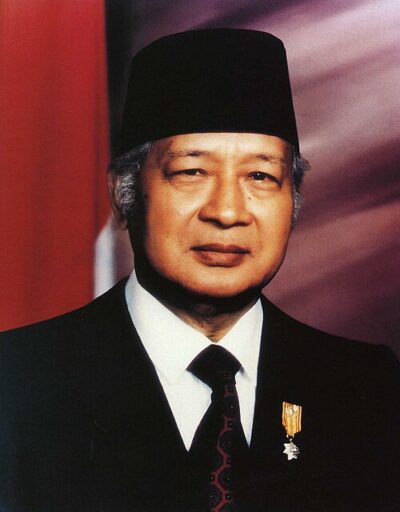
Suharto
Suharto was the 2nd President of Indonesia (1968—1998) and Acting President of Indonesia (1967—1968). Born June 8, 1921, in Kemusuk. Died January 27, 2008, in Jakarta. Positions held include Secretary General of the Non-Aligned Movement (1992–1995), President of Indonesia (1967–1998) and Minister of Defence (1966–1971). Awards include Knight Grand Cross of the Order of the Bath, Collar of the Order of Isabella the Catholic and Grand Cross of the Order of Good Hope.
Facts
42 facts · 2 confirmed by two sources · 4 cited · 36 from one source
Where this comes from
Papalocal keeps its own record. It started from these sources; what each one said is kept here as it was copied, so a change on their side never changes this page by itself. Tap one to read its version.
What Wikidata says · copied November 16, 2026 · revision 2569562892
- Described as
- 2nd President of Indonesia (1968—1998) and Acting President of Indonesia (1967—1968)
- Other names
- Muhammad Suharto, Soeharto
- Born
- June 8, 1921 · 10 references
- Died
- January 27, 2008 · 12 references
- Born in
- Kemusuk
- Died in
- Jakarta
- Buried in
- Astana Giribangun
- Cause of death
- kidney failure
- Citizen of
- Indonesia; Dutch East Indies
- Occupation
- politician · 1 reference; military personnel
- Positions held
- Secretary General of the Non-Aligned Movement (1992–1995); President of Indonesia (1967–1998); Minister of Defence (1966–1971) · 1 reference
- Political party
- Golkar
- Awards
- Knight Grand Cross of the Order of the Bath; Collar of the Order of Isabella the Catholic (1981) · 1 reference; Grand Cross of the Order of Good Hope (1997) · 1 reference; Order of the Nile; Star of the Republic of Indonesia; Bintang Mahaputera; Knight Grand Cross with Collar of the Order of Merit of the Italian Republic; Order of Prince Yaroslav the Wise, 1st class · 1 reference; Order of the Chrysanthemum · 1 reference; Order of Sikatuna · 1 reference; Order of the Rajamitrabhorn · 1 reference; Order of the Liberator · 1 reference; Order of Merit for National Foundation · 1 reference; Order of the Crown of the Realm · 1 reference; Order of Pahlavi · 1 reference
- Spouse
- Tien Soeharto (1947–1996) · 1 reference
- Children
- Tutut Soeharto · 1 reference; Sigit Harjojudanto; Bambang Trihatmodjo; Titiek Suharto; Tommy Suharto; Mamiek Soeharto
- Father
- Kertosudiro
- Mother
- Sukirah
- Religion
- Sunni Islam
- Military branch
- Indonesian Army · 1 reference
- Military rank
- Jenderal Besar
- Height
- 1.68 m (5 ft 6 in) · 1 reference
- Wikipedias with a page
- 119
Wikidata item Q44819 (wikidata.org/wiki/Q44819), public domain (CC0). Copied November 16, 2026.
What Wikipedia says · copied November 16, 2026 · revision 1385790306
Suharto (8 June 1921 – 27 January 2008) was an Indonesian military general and politician who served as the second and longest-serving president of Indonesia from 1967 to 1998.
Suharto was born in Kemusuk, near the city of Yogyakarta, during the Dutch colonial era. He grew up in humble circumstances. His Javanese Muslim parents divorced not long after his birth, and he lived with foster parents for much of his childhood. During the Japanese occupation, Suharto served in the Japanese-organized Indonesian security forces. During Indonesia's independence struggle, he joined the newly formed Indonesian Army and rose to the rank of major general some time after full Indonesian independence was achieved. An attempted coup on 30 September and 1 October 1965 was countered by Suharto-led troops. The army subsequently led a nationwide violent anti-communist purge. In March 1967, the MPRS appointed Suharto as acting president, and he was appointed president the following year. When Suharto came to power, inflation was running at over 650%. He appointed an economic advisory group that implemented free market policies, and by 1969 the country entered a period of price stability. Suharto ordered an invasion of East Timor in 1975, followed by a 23-year occupation of the country and genocide.
Under his "New Order" regime, Suharto established a strong, centralised government dominated by the military, evolving from an initial oligarchic military dictatorship into a deeply authoritarian state centred on a cult of personality that elevated him as the nation's undisputed dictator. His staunch anti-communist stance and ability to maintain political stability across Indonesia's vast and diverse archipelago secured significant economic and diplomatic backing from Western powers, particularly the United States, during the Cold War. During much of his presidency, Indonesia underwent rapid industrialisation, sustained economic growth (with GDP growing at around 7% per annum) improved education, and a rise in domestic entrepreneurship, developments that led the People's Consultative Assembly (MPR) to name him "Father of Development" (Indonesian: Bapak Pembangunan) in 1982. In 1986, he was awarded the Ceres Medal by the United Nations Food and Agriculture Organization (FAO) for achieving self-sufficiency in rice production. However, by the 1990s, his regime's increasing authoritarianism and widespread corruption fueled public dissatisfaction, which reached a breaking point during the 1997 Asian financial crisis that plunged the country into economic turmoil and widespread unrest. Under immense pressure, Suharto resigned in May 1998 after more than three decades in power. Suharto died in January 2008 and received a state military funeral with full honors. The Indonesian government declared a week of national mourning.
Suharto was widely regarded as a military dictator by international observers. His 32-year presidency and legacy are highly divisive, and he remains a controversial figure among the Indonesian general public. He has been praised for making Indonesia into an economic success story, bringing stability to the region particularly during the Cold War period, and leading Indonesia when it played a significant role in international affairs. Others denounce his authoritarian rule, widespread corruption, and extensive human rights violations. His 31-year dictatorship is considered one of the most brutal and corrupt of the 20th century: he was central to the perpetration of mass killings against alleged communists and subsequent persecution of ethnic Chinese, Islamists, irreligious people, and trade unionists.
- Born, in its opening lines
- June 8, 1921
- Died, in its opening lines
- January 27, 2008
From the Wikipedia article “Suharto” (en.wikipedia.org/wiki/Suharto), by its contributors, under CC BY-SA 4.0 (creativecommons.org/licenses/by-sa/4.0/). Copied November 16, 2026; not changed.
Confirmed Two sources agree. Cited One source, and it names where it got it. One source One source, without a reference of its own. Sources disagree The sources disagree. We show the best-supported value and keep theirs below.
