
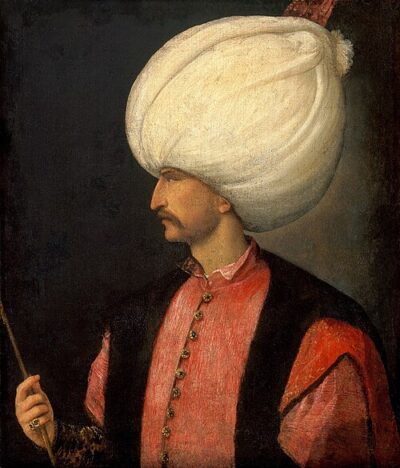
Suleiman the Magnificent
Suleiman the Magnificent was the tenth and greatest Sultan of Ottoman Empire. Born November 6, 1494, in Trabzon. Died September 6, 1566, in Szigetvár. Positions held include sultan of the Ottoman Empire (1520–1566) and caliph (1520–1566).
Facts
36 facts · 2 confirmed by two sources · 10 cited · 24 from one source
Where this comes from
Papalocal keeps its own record. It started from these sources; what each one said is kept here as it was copied, so a change on their side never changes this page by itself. Tap one to read its version.
What Wikidata says · copied November 16, 2026 · revision 2569999462
- Described as
- the tenth and greatest Sultan of Ottoman Empire (1520–1566)
- Other names
- Kanuni, Muhibbî, Muhibbi, Sulayman, Suleiman I, I. Süleyman, Muhteşem Süleyman, Kanuni Sultan Süleyman
- Born
- November 6, 1494 · 1 reference
- Died
- September 6, 1566 · 1 reference
- Born in
- Trabzon · 1 reference
- Died in
- Szigetvár · 2 references
- Buried in
- Tomb of Suleiman the Magnificent
- Occupation
- ruler; legislator; military leader · 1 reference; politician · 1 reference; sultan · 1 reference
- Positions held
- sultan of the Ottoman Empire (1520–1566) · 1 reference; caliph (1520–1566)
- Spouse
- Hürrem Sultan (1531–1558) · 1 reference; Mahidevran Hatun (1514–1566); Fülane Hatun · 1 reference; Gülfem Hatun · 1 reference
- Children
- Şehzade Mustafa; Şehzade Mehmed; Mihrimah Sultan; Selim II · 1 reference; Şehzade Bayezid; Şehzade Murad; Raziye Osmanoğlu · 1 reference; Șehzade Cihangir · 1 reference; Şehzade Abdullah · 1 reference; Фатьма-Нур; Şehzade Mahmud; Шехзаде Ахмед
- Father
- Selim I · 1 reference
- Mother
- Hafsa Sultan
- Siblings
- Hatice Sultan; Beyhan Sultan; Şah Huban Sultan; Fatma Sultan · 1 reference; Hafize Sultan · 1 reference
- Religion
- Islam · 1 reference
- Wikipedias with a page
- 153
Wikidata item Q8474 (wikidata.org/wiki/Q8474), public domain (CC0). Copied November 16, 2026.
What Wikipedia says · copied November 16, 2026 · revision 1384460317
Suleiman I (6 November 1494 – 6 September 1566), commonly known as Suleiman the Magnificent, was the Ottoman sultan from 1520 to 1566.
The longest reign among the Ottoman sultans, his rule brought about a notable peak in the Ottoman Empire's economic, military and political power, and raised the number of the empire's subjects to at least 25 million people.
After succeeding his father Selim I on 30 September 1520, Suleiman began his reign by launching military campaigns against the Christian powers of Central and Eastern Europe and the Mediterranean; Belgrade fell to him in 1521 and Rhodes in 1522, and at Mohács in 1526, Suleiman broke the strength of the Kingdom of Hungary. Hungary was subsequently divided, with much of it incorporated directly into the empire. However, his defeat at the siege of Vienna in 1529 prevented him from advancing further into Europe. Suleiman also fought for years against the Shia Islamic Safavid Empire of Iran and annexed Iraq. In North Africa, Ottoman Tripolitania was established and the Ottoman fleet dominated the seas from the Mediterranean to the Red Sea and into the Persian Gulf.
Suleiman personally instituted major judicial changes pertaining to society, education, taxation, and criminal law. His reforms, carried out in conjunction with the Ottoman chief judicial official Ebussuud Efendi, brought together the two forms of Ottoman law: sultanic (Kanun) and Islamic (Sharia).
He was also a distinguished poet and goldsmith; and a great patron of fine culture, overseeing the "Golden Age" of the Ottoman Empire which was at the height of its artistic, literary, and architectural development.
In 1534, Suleiman broke with Ottoman tradition by marrying Hürrem, an influential woman from his Imperial Harem who helped usher in the "Sultanate of Women" period in Ottoman history. Upon Suleiman's death in 1566, he was succeeded by his and Hürrem's son Selim II. The death of Suleiman marks a watershed moment in Ottoman history, although scholars typically regard the period after his death to be one of crisis and adaptation rather than of simple decline. In the following decades, the Ottoman Empire began to experience significant political, institutional, and economic changes, a period often referred to as the Era of Transformation.
- Born, in its opening lines
- November 6, 1494
- Died, in its opening lines
- September 6, 1566
From the Wikipedia article “Suleiman the Magnificent” (en.wikipedia.org/wiki/Suleiman_the_Magnificent), by its contributors, under CC BY-SA 4.0 (creativecommons.org/licenses/by-sa/4.0/). Copied November 16, 2026; not changed.
Confirmed Two sources agree. Cited One source, and it names where it got it. One source One source, without a reference of its own. Sources disagree The sources disagree. We show the best-supported value and keep theirs below.
