
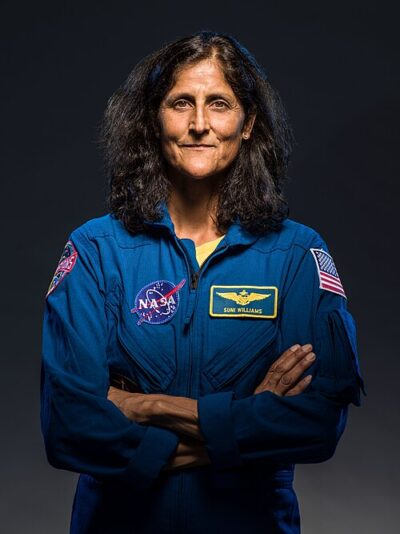
Sunita Williams
Sunita Williams is an American astronaut and naval officer. Born September 19, 1965, in Euclid. Positions held include ISS Expedition commander (2 times) (2012–2025). Educated at Needham High School and United States Naval Academy. Awards include NASA Distinguished Service Medal (2 times), NASA Space Flight Medal (2 times) and Padma Bhushan.

Facts
45 facts · 1 confirmed by two sources · 41 cited · 3 from one source
Where this comes from
Papalocal keeps its own record. It started from these sources; what each one said is kept here as it was copied, so a change on their side never changes this page by itself. Tap one to read its version.
What Wikidata says · copied November 13, 2026 · revision 2562261094
- Described as
- American astronaut and naval officer
- Other names
- Sunita Lyn Williams, Sunita L. Williams, Suni Williams
- Born
- September 19, 1965 · 3 references
- Born in
- Euclid · 5 references
- Name at birth
- Sunita Lyn Pandya · 1 reference
- Citizen of
- United States
- Occupation
- engineer; naval officer · 1 reference; naval aviator (1989–) · 1 reference; test pilot · 2 references; flight engineer · 1 reference; astronaut · 3 references; athletics competitor; helicopter pilot · 1 reference
- Positions held
- ISS Expedition commander (2 times) (2012–2025) · 1 reference
- Worked for
- National Aeronautics and Space Administration (1998–2025) · 3 references; United States Navy (–2017) · 3 references
- Education
- Needham High School (–1983) · 2 references; United States Naval Academy (–1987) · 2 references; Florida Institute of Technology (–1995) · 2 references; United States Naval Test Pilot School (1993) · 1 reference
- Member of
- Expedition 33 · 1 reference; Society of Experimental Test Pilots · 1 reference
- Sport
- athletics · 1 reference; marathon running · 1 reference; triathlon · 1 reference
- Awards
- NASA Distinguished Service Medal (2 times) (2007, 2013) · 1 reference; NASA Space Flight Medal (2 times) (2007, 2013) · 1 reference; Padma Bhushan (2008) · 3 references; Medal "For Merit in Space Exploration" (2011) · 2 references; honorary doctorate (2013) · 2 references; Women in Space Science Award (2015) · 1 reference; Legion of Merit · 1 reference; Navy & Marine Corps Achievement Medal · 2 references; Navy and Marine Corps Commendation Medal · 4 references; Humanitarian Service Medal · 2 references; National Defense Service Medal · 1 reference; BBC 100 Women (2024) · 1 reference; Defense Superior Service Medal · 1 reference; Doctor of Humane Letters (2025) · 2 references; Michael Collins Trophy (2026) · 2 references
- Father
- Deepak Pandya · 2 references
- Religion
- Hinduism · 2 references
- Military branch
- United States Navy (1983–2017) · 2 references
- Military rank
- captain · 1 reference; ensign (1987) · 1 reference
- Lived in
- Needham · 1 reference
- Wikipedias with a page
- 73
Wikidata item Q55177 (wikidata.org/wiki/Q55177), public domain (CC0). Copied November 13, 2026.
What Wikipedia says · copied November 13, 2026 · revision 1380090855
Sunita Lyn Williams (née Pandya; born September 19, 1965) is an American retired Navy captain and NASA astronaut. Williams served aboard the International Space Station as a flight engineer for Expedition 14, Expedition 15, Expedition 32, and Expedition 71 and commander of Expedition 33 and Expedition 72. A member of NASA's Commercial Crew program, she became the first woman to fly on a flight test of an orbital spacecraft during the 2024 Boeing Crew Flight Test and had her stay extended by technical problems aboard the ISS for more than nine months. She is one of the most experienced spacewalkers: her nine spacewalks are second-most by a woman, and her total spacewalk time of 62 hours and 6 minutes is fourth overall and the most by a woman.
- Born, in its opening lines
- September 19, 1965
From the Wikipedia article “Sunita Williams” (en.wikipedia.org/wiki/Sunita_Williams), by its contributors, under CC BY-SA 4.0 (creativecommons.org/licenses/by-sa/4.0/). Copied November 13, 2026; not changed.
Confirmed Two sources agree. Cited One source, and it names where it got it. One source One source, without a reference of its own. Sources disagree The sources disagree. We show the best-supported value and keep theirs below.
