
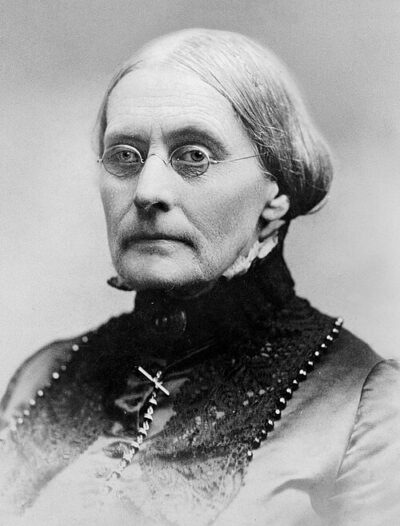
Susan B. Anthony
Susan B. Anthony was an American women's rights activist. Born February 15, 1820, in Adams. Died March 13, 1906, in Rochester. Known for The Revolution. Awards include National Women's Hall of Fame.
Facts
25 facts · 2 confirmed by two sources · 8 cited · 14 from one source · 1 where the sources disagree
What’s different
- Cause of death: we show heart failure (Sources disagree). Wikidata also lists pneumonia
Where this comes from
Papalocal keeps its own record. It started from these sources; what each one said is kept here as it was copied, so a change on their side never changes this page by itself. Tap one to read its version.
What Wikidata says · copied November 13, 2026 · revision 2561591898
- Described as
- American women's rights activist (1820–1906)
- Other names
- Susan Brownell Anthony, Ентоні, Сьюзан Энтони, Susan Brownell, Suzan Braunel Entoni, Susan B Anthony, Anthony, Susan Brownell, Susan Anthony, Сузан Браунел Ентони, Anthony, Susan Brownnell, Susan B. Anthonyová, Susanna B. Anthony
- Born
- February 15, 1820 · 6 references
- Died
- March 13, 1906 · 6 references
- Born in
- Adams · 1 reference
- Died in
- Rochester · 1 reference
- Buried in
- Mount Hope Cemetery · 1 reference
- Cause of death
- heart failure · 1 reference; pneumonia · 1 reference
- Name at birth
- Susan Anthony
- Citizen of
- United States
- Occupation
- women's rights activist; human rights defender · 1 reference; abolitionist; writer · 1 reference; civil rights advocate; feminist · 1 reference; suffragist
- Political party
- Republican Party
- Member of
- Daughters of the American Revolution
- Known for
- The Revolution
- Awards
- National Women's Hall of Fame (1973) · 1 reference
- Field
- women's suffrage
- Father
- Daniel Anthony · 1 reference
- Mother
- Lucy Read · 1 reference
- Siblings
- Daniel Read Anthony; Mary Stafford Anthony; Jacob Merritt Anthony
- Wikipedias with a page
- 93
Wikidata item Q192245 (wikidata.org/wiki/Q192245), public domain (CC0). Copied November 13, 2026.
What Wikipedia says · copied November 13, 2026 · revision 1385417774
Susan B. Anthony (born Susan Anthony; February 15, 1820 – March 13, 1906) was an American social reformer and women's rights activist who played a pivotal role in the women's suffrage movement. Born into a Quaker family committed to social equality, she collected anti-slavery petitions at the age of 17. In 1856, she became the New York state agent for the American Anti-Slavery Society.
In 1851, she met Elizabeth Cady Stanton, who became her lifelong friend and co-worker in social reform activities, primarily in the field of women's rights. Together they founded the New York Women's State Temperance Society after Anthony was prevented from speaking at a temperance conference because she was female. During the Civil War they founded the Women's Loyal National League, which conducted the largest petition drive in United States history up to that time, collecting nearly 400,000 signatures in support of the abolition of slavery. After the war, they initiated the American Equal Rights Association, which campaigned for equal rights for all, including both women and African Americans. They began publishing a women's rights newspaper in 1868 called The Revolution. A year later, they founded the National Woman Suffrage Association as part of a split in the women's movement. The split was formally healed in 1890 when their organization merged with the rival American Woman Suffrage Association to form the National American Woman Suffrage Association, with Anthony as its key force. Anthony and Stanton began working with Matilda Joslyn Gage in 1876 on what eventually grew into the six-volume History of Woman Suffrage. The interests of Anthony and Stanton diverged somewhat in later years, but the two remained close friends.
In 1872, Anthony was arrested in her hometown of Rochester, New York, for voting in violation of laws that allowed only men to vote. She was convicted in a widely publicized trial. Although she refused to pay the fine, the authorities declined to take further action. In 1878, Anthony and Stanton arranged for Congress to be presented with an amendment giving women the right to vote. Introduced by Senator Aaron A. Sargent, it later became known colloquially as the Susan B. Anthony Amendment. It was eventually ratified as the Nineteenth Amendment to the U.S. Constitution in 1920.
Anthony traveled extensively in support of women's suffrage, giving as many as 75 to 100 speeches per year and working on many state campaigns. She worked internationally for women's rights, playing a key role in creating the International Council of Women, which is still active. She also helped to bring about the World's Congress of Representative Women at the World's Columbian Exposition in Chicago in 1893.
When she first began campaigning for women's rights, Anthony was harshly ridiculed and accused of trying to destroy the institution of marriage. Public perception of her changed radically during her lifetime, however. Her 80th birthday was celebrated in the White House at the invitation of President William McKinley. She became the first female citizen to be depicted on U.S. coinage when her portrait appeared on the 1979 dollar coin.
- Born, in its opening lines
- February 15, 1820
- Died, in its opening lines
- March 13, 1906
From the Wikipedia article “Susan B. Anthony” (en.wikipedia.org/wiki/Susan_B._Anthony), by its contributors, under CC BY-SA 4.0 (creativecommons.org/licenses/by-sa/4.0/). Copied November 13, 2026; not changed.
Confirmed Two sources agree. Cited One source, and it names where it got it. One source One source, without a reference of its own. Sources disagree The sources disagree. We show the best-supported value and keep theirs below.
