
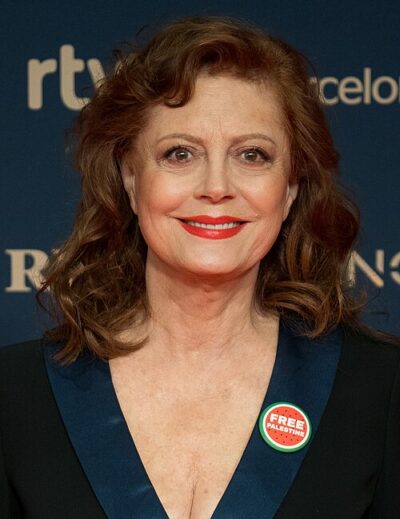
Susan Sarandon
Susan Sarandon is an American actress and activist. Born October 4, 1946, in Jackson Heights. Positions held include UNICEF Goodwill Ambassador (1999–). Educated at The Catholic University of America and Edison High School. Awards include Donostia Award, Academy Award for Best Actress and New Jersey Hall of Fame.
Facts
31 facts · 1 confirmed by two sources · 6 cited · 24 from one source
Where this comes from
Papalocal keeps its own record. It started from these sources; what each one said is kept here as it was copied, so a change on their side never changes this page by itself. Tap one to read its version.
What Wikidata says · copied November 13, 2026 · revision 2566818327
- Described as
- American actress and activist
- Other names
- Susan Tomalin, Susan Abigail Tomalin, Susan Abigail Sarandon
- Born
- October 4, 1946 · 10 references
- Born in
- Jackson Heights · 1 reference
- Name at birth
- Susan Abigail Tomalin
- Citizen of
- United States
- Occupation
- film actor; voice actor; film producer; actor · 2 references; television actor; activist
- Positions held
- UNICEF Goodwill Ambassador (1999–) · 1 reference
- Political party
- Democratic Party
- Education
- The Catholic University of America (1964–1968); Edison High School (–1964) · 1 reference
- Awards
- Donostia Award (1994); Academy Award for Best Actress (1996) · 2 references; New Jersey Hall of Fame (2010) · 1 reference; Crystal Award (1994) · 1 reference; BAFTA Award for Best Actress in a Leading Role · 1 reference; star on Hollywood Walk of Fame · 1 reference; Mary Pickford Award; Sitges Grand Honorary Award (2017); Hasty Pudding Woman of the Year (1996); Screen Actors Guild Award for Outstanding Performance by a Female Actor in a Leading Role
- Spouse
- Chris Sarandon (1967–1979)
- Children
- Eva Amurri; Miles Robbins
- Religion
- Catholicism
- Lived in
- Pound Ridge
- Height
- 1.65 m (5 ft 5 in)
- Website
- http://www.susan-sarandon.com/ · 1 reference
- Wikipedias with a page
- 104
Wikidata item Q133050 (wikidata.org/wiki/Q133050), public domain (CC0). Copied November 13, 2026.
What Wikipedia says · copied November 13, 2026 · revision 1385472126
Susan Abigail Sarandon ( sə-RAN-dən; née Tomalin; born October 4, 1946) is an American actor. With a career spanning over five decades, she has received accolades, including an Academy Award, an Actor Award, and a British Academy Film Award, in addition to nominations for seven Emmy Awards, ten Golden Globes, and a Grammy Award.
Sarandon made her film debut in Joe (1970) and appeared on the soap operas A World Apart (1970–1971) and Search for Tomorrow (1972). She gained prominence for her role in the musical horror film The Rocky Horror Picture Show (1975). After receiving four Oscar nominations for Atlantic City (1980), Thelma & Louise (1991), Lorenzo's Oil (1992), and The Client (1994), Sarandon won the Academy Award for Best Actress for playing Helen Prejean in Dead Man Walking (1995). Her other notable films include Pretty Baby (1978), The Hunger (1983), The Witches of Eastwick (1987), Bull Durham (1988), Little Women (1994), Stepmom (1998), Enchanted (2007), The Lovely Bones (2009), Cloud Atlas (2012), Tammy (2014), and The Meddler (2015).
Sarandon made her Broadway debut in the play An Evening with Richard Nixon (1972) and returned to the stage in the 2009 revival of Exit the King. On television, she had guest roles on the sitcoms Friends (2001) and Malcolm in the Middle (2002), as well as starring roles as an advocate in the HBO film You Don't Know Jack (2010), Doris Duke in the HBO film Bernard and Doris (2008), and Bette Davis in the FX miniseries Feud (2017).
Also known for her social and political activism, Sarandon was appointed a UNICEF Goodwill Ambassador in 1999 and received the Action Against Hunger Humanitarian Award in 2006.
- Born, in its opening lines
- October 4, 1946
From the Wikipedia article “Susan Sarandon” (en.wikipedia.org/wiki/Susan_Sarandon), by its contributors, under CC BY-SA 4.0 (creativecommons.org/licenses/by-sa/4.0/). Copied November 13, 2026; not changed.
Confirmed Two sources agree. Cited One source, and it names where it got it. One source One source, without a reference of its own. Sources disagree The sources disagree. We show the best-supported value and keep theirs below.
