
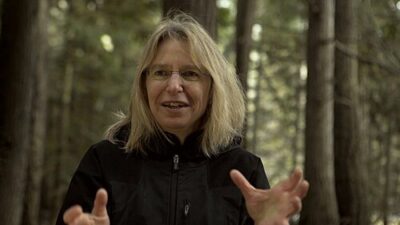
Suzanne W. Simard
Suzanne W. Simard is a Canadian forest ecologist. Born 1960, in British Columbia. Educated at Oregon State University and University of British Columbia. Awards include Lewis Thomas Prize, Kew International Medal and Time 100.
Facts
15 facts · 0 confirmed by two sources · 10 cited · 5 from one source
Where this comes from
Papalocal keeps its own record. It started from these sources; what each one said is kept here as it was copied, so a change on their side never changes this page by itself. Tap one to read its version.
What Wikidata says · copied November 16, 2026 · revision 2568687353
- Described as
- Canadian forest ecologist
- Other names
- S. Simard, S Simard, Suzanne W Simard, Suzanne Simard
- Born
- 1960 · 2 references
- Born in
- British Columbia
- Citizen of
- Canada
- Occupation
- ecologist; naturalist · 1 reference; university teacher · 2 references
- Worked for
- University of British Columbia · 1 reference
- Education
- Oregon State University; University of British Columbia · 1 reference
- Awards
- Lewis Thomas Prize (2023) · 1 reference; Kew International Medal · 1 reference; Time 100 (2024) · 1 reference
- Field
- ecology · 1 reference; forest ecosystem · 1 reference
- Website
- https://suzannesimard.com
- Wikipedias with a page
- 21
Wikidata item Q26702907 (wikidata.org/wiki/Q26702907), public domain (CC0). Copied November 16, 2026.
What Wikipedia says · copied November 16, 2026 · revision 1382041369
Suzanne Simard (born 1960) is a Canadian forestry scientist and conservationist who is best known for her research on forest ecology and plant intelligence.
Simard is a Professor in the Department of Forest and Conservation Sciences at the University of British Columbia. After growing up in the Monashee Mountains, British Columbia, she received her PhD in Forest Sciences at Oregon State University. Prior to working at the University of British Columbia, Simard worked as a research scientist at the British Columbia Ministry of Forests.
Simard is known for the research she conducted on the underground networks of forests characterized by fungi and roots. She studies how these fungi and roots facilitate communication and interaction between trees and plants of an ecosystem. Within the communication between trees and plants is the exchange of carbon, water, nutrients and defense signals between trees. Simard is also a leader of TerreWEB, an initiative set to train graduate students and post-doctoral fellows in global change science and its communication.
She used rare carbon isotopes as tracers in both field and greenhouse experiments to measure the flow and sharing of carbon between individual trees and species, and discovered, for instance, that birch and Douglas fir share carbon. Birch trees receive extra carbon from Douglas firs when the birch trees lose their leaves, and birch trees supply carbon to Douglas fir trees that are in the shade.
From the Wikipedia article “Suzanne Simard” (en.wikipedia.org/wiki/Suzanne_Simard), by its contributors, under CC BY-SA 4.0 (creativecommons.org/licenses/by-sa/4.0/). Copied November 16, 2026; not changed.
Confirmed Two sources agree. Cited One source, and it names where it got it. One source One source, without a reference of its own. Sources disagree The sources disagree. We show the best-supported value and keep theirs below.
