
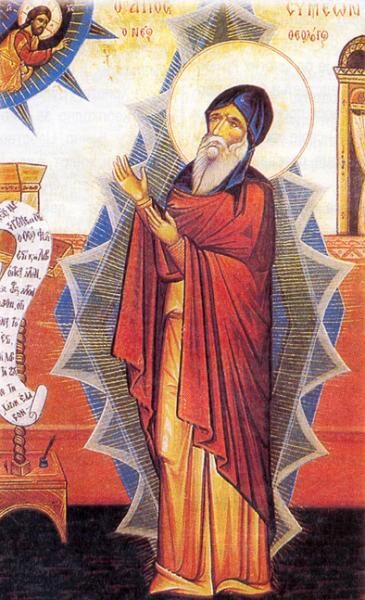
Symeon the New Theologian
Symeon the New Theologian was a Christian saint, monk, and theologian. Born 949, in Galatia. Died March 12, 1022, in Marmara Region. Positions held include abbot.
Facts
16 facts · 2 confirmed by two sources · 7 cited · 7 from one source
Where this comes from
Papalocal keeps its own record. It started from these sources; what each one said is kept here as it was copied, so a change on their side never changes this page by itself. Tap one to read its version.
What Wikidata says · copied November 16, 2026 · revision 2567014877
- Described as
- Christian saint, monk, and theologian
- Born
- 949
- Died
- March 12, 1022
- Born in
- Galatia
- Died in
- Marmara Region
- Citizen of
- Byzantine Empire
- Occupation
- Christian monk; philosopher; writer; mystic · 1 reference; theologian · 1 reference; monk · 1 reference
- Positions held
- abbot · 1 reference
- Field
- theology · 1 reference; spirituality · 1 reference; hesychasm · 1 reference
- Religion
- Eastern Orthodoxy
- Wikipedias with a page
- 36
Wikidata item Q381710 (wikidata.org/wiki/Q381710), public domain (CC0). Copied November 16, 2026.
What Wikipedia says · copied November 16, 2026 · revision 1367679011
Saint Symeon the New Theologian (Greek: Συμεὼν ὁ Νέος Θεολόγος; c. 949 – 12 March 1022) was an Eastern Orthodox monk and poet who was one of the three saints canonized by the Eastern Orthodox Church and given the title of "Theologian" (along with John the Apostle and Gregory of Nazianzus). "Theologian" was not applied to Symeon in the modern academic sense of theological study; the title was intended only to recognise someone who spoke from personal experience of the vision of God. One of his principal teachings was that humans could and should experience theoria (literally "contemplation," or direct experience of God).
Symeon was born into the Byzantine nobility and given a traditional education. At age fourteen, he met Symeon the Studite, a renowned monk of the Monastery of Stoudios in Constantinople, who convinced him to give his own life to prayer and asceticism under the elder Symeon's guidance. By the time he was thirty, Symeon the New Theologian became the abbot of the Monastery of Saint Mamas, a position he held for twenty-five years. He attracted many monks and clergy with his reputation for sanctity, though his teachings brought him into conflict with church authorities, who would eventually send him into exile. His most well known disciple was Nicetas Stethatos who wrote the Life of Symeon.
Symeon is recognized as the first Eastern Christian mystic to share his own mystical experiences freely. Some of his writings are included in the Philokalia, a collection of texts by early Christian mystics on contemplative prayer and hesychast teachings. Symeon wrote and spoke frequently about the importance of experiencing directly the grace of God, often talking about his own experiences of God as divine light. Another common subject in his writings was the need of putting oneself under the guidance of a spiritual father. The authority for many of his teachings derived from the traditions of the Desert Fathers, early Christian monks and ascetics. Symeon's writings include Hymns of Divine Love, Ethical Discourses, and The Catechetical Discourses.
- Born, in its opening lines
- c. 949
- Died, in its opening lines
- March 12, 1022
From the Wikipedia article “Symeon the New Theologian” (en.wikipedia.org/wiki/Symeon_the_New_Theologian), by its contributors, under CC BY-SA 4.0 (creativecommons.org/licenses/by-sa/4.0/). Copied November 16, 2026; not changed.
Confirmed Two sources agree. Cited One source, and it names where it got it. One source One source, without a reference of its own. Sources disagree The sources disagree. We show the best-supported value and keep theirs below.
