
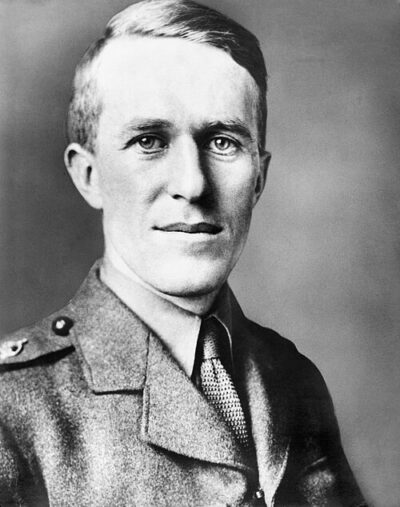
T. E. Lawrence
T. E. Lawrence was a British archaeologist, army officer and diplomat. Born August 16, 1888, in Tremadog. Died May 19, 1935, in Bovington Camp. Known for Seven Pillars of Wisdom. Educated at Jesus College and Magdalen College. Awards include Knight of the Legion of Honour, Croix de guerre 1914–1918 and Companion of the Order of the Bath.
Facts
33 facts · 2 confirmed by two sources · 13 cited · 17 from one source · 1 where the sources disagree
What’s different
- Cause of death: we show traffic collision (Sources disagree). Wikidata also lists motorcycle accident
Where this comes from
Papalocal keeps its own record. It started from these sources; what each one said is kept here as it was copied, so a change on their side never changes this page by itself. Tap one to read its version.
What Wikidata says · copied November 16, 2026 · revision 2565595197
- Described as
- British archaeologist, army officer and diplomat (1888–1935)
- Other names
- of Arabia Lawrence, John Hume Ross, Thomas Edward Shaw, T. E. Shaw, T.E. Lawrence, Lawrence of Arabia
- Born
- August 16, 1888 · 10 references
- Died
- May 19, 1935 · 12 references
- Born in
- Tremadog · 1 reference
- Died in
- Bovington Camp
- Buried in
- St Nicholas Church, Moreton · 1 reference
- Cause of death
- traffic collision; motorcycle accident
- Citizen of
- United Kingdom; United Kingdom of Great Britain and Ireland (–1927)
- Occupation
- anthropologist; archaeologist · 1 reference; autobiographer; writer · 3 references; military officer · 1 reference; screenwriter; translator; castellologist
- Worked for
- University of Oxford
- Education
- Jesus College (1907–1910); Magdalen College (1910–); City of Oxford High School for Boys
- Known for
- Seven Pillars of Wisdom
- Awards
- Knight of the Legion of Honour (1916) · 1 reference; Croix de guerre 1914–1918 (1918) · 1 reference; Companion of the Order of the Bath (1917) · 1 reference; Distinguished Service Order (1918) · 1 reference
- Field
- castellology
- Father
- Sir Thomas Chapman, 7th Baronet · 1 reference
- Mother
- Sarah Junner · 1 reference
- Siblings
- Arnold Walter Lawrence · 1 reference
- Military branch
- British Army; Royal Air Force
- Military rank
- Lieutenant Colonel · 1 reference; colonel · 1 reference
- Wikipedias with a page
- 92
Wikidata item Q170596 (wikidata.org/wiki/Q170596), public domain (CC0). Copied November 16, 2026.
What Wikipedia says · copied November 16, 2026 · revision 1385918173
Thomas Edward Lawrence (16 August 1888 – 19 May 1935) was a British Army officer, archaeologist, diplomat, and writer known for his role during the Arab Revolt and Sinai and Palestine campaign against the Ottoman Empire in the First World War. The breadth and variety of his activities and associations, and Lawrence's ability to describe them vividly in writing, earned him international fame as Lawrence of Arabia, a title used for the 1962 film based on his wartime activities.
Lawrence was born in Tremadog, Carnarvonshire, Wales, the illegitimate son of Sir Thomas Chapman, an Anglo-Irish landowner, and Sarah Lawrence (née Junner), a governess in the employ of Chapman. In 1896, Lawrence moved to Oxford, attending the City of Oxford High School for Boys, and read history at Jesus College, Oxford, from 1907 to 1910. Between 1910 and 1914, he worked as an archaeologist for the British Museum, chiefly at Carchemish in Ottoman Syria.
After the outbreak of war in 1914, Lawrence joined the British Army and was stationed at the Arab Bureau, a military intelligence unit in Egypt. In 1916, he travelled to Mesopotamia and Arabia on intelligence missions and became involved with the Arab revolt against Ottoman rule. Lawrence was ultimately assigned to the British Military Mission in the Hejaz as a liaison to Emir Faisal, a leader of the revolt. He participated in engagements with the Ottoman military culminating in the capture of Damascus in October 1918.
After the war's end, he joined the Foreign Office, working with Faisal. In 1922, Lawrence retreated from public life and served as an enlisted man in the Army and Royal Air Force (RAF) until 1935. He published Seven Pillars of Wisdom in 1926, an autobiographical account of his participation in the Arab Revolt. Lawrence also translated books into English and wrote The Mint, which detailed his service in the RAF. He corresponded extensively with prominent artists, writers, and politicians, and also participated in the development of rescue motorboats for the RAF. Lawrence's public image resulted in part from the sensationalised reporting of the Arab Revolt by American journalist Lowell Thomas, as well as from Seven Pillars of Wisdom. In 1935, Lawrence died at the age of 46 after being injured in a motorcycle crash in Dorset.
- Born, in its opening lines
- August 16, 1888
- Died, in its opening lines
- May 19, 1935
From the Wikipedia article “T. E. Lawrence” (en.wikipedia.org/wiki/T._E._Lawrence), by its contributors, under CC BY-SA 4.0 (creativecommons.org/licenses/by-sa/4.0/). Copied November 16, 2026; not changed.
Confirmed Two sources agree. Cited One source, and it names where it got it. One source One source, without a reference of its own. Sources disagree The sources disagree. We show the best-supported value and keep theirs below.
