
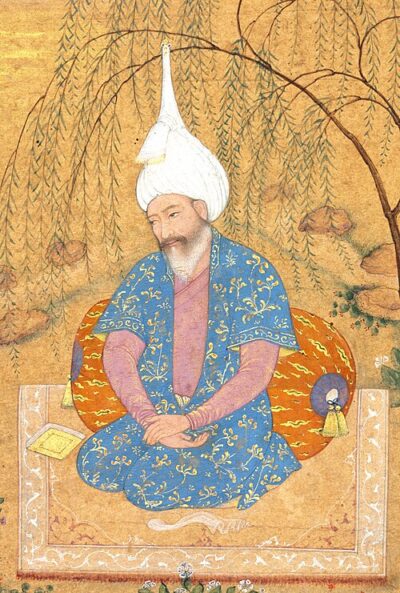
Tahmasp I
Tahmasp I was a Safavid Shah of Iran from 1524 to 1576. Born February 22, 1514, in Shahabad, Isfahan. Died May 14, 1576, in Qazvin. Positions held include list of Safavid monarchs (1524–1576).
Facts
25 facts · 2 confirmed by two sources · 3 cited · 20 from one source
Where this comes from
Papalocal keeps its own record. It started from these sources; what each one said is kept here as it was copied, so a change on their side never changes this page by itself. Tap one to read its version.
What Wikidata says · copied November 16, 2026 · revision 2560908718
- Described as
- Safavid Shah of Iran from 1524 to 1576
- Born
- February 22, 1514
- Died
- May 14, 1576
- Born in
- Shahabad, Isfahan
- Died in
- Qazvin
- Buried in
- Imam Reza Shrine · 2 references
- Cause of death
- poison
- Citizen of
- Safavid Iran
- Occupation
- sovereign
- Positions held
- list of Safavid monarchs (1524–1576)
- Field
- governance · 1 reference
- Spouse
- Sultanum Begum · 1 reference; Sultan-Agha Khanum · 1 reference
- Children
- Ismail II; Mohammad Khodabanda; Suleiman Mirza; Pari Khan Khanum · 1 reference; Haydar Mirza Safavi · 1 reference; Ali Mirza · 1 reference; Zeynab Begum · 1 reference; Maryam Begum · 1 reference
- Father
- Ismail I
- Mother
- Tajlu Begum
- Siblings
- Bahram Mirza
- Religion
- Islam · 1 reference; Twelver Shiism · 3 references
- Wikipedias with a page
- 60
Wikidata item Q298410 (wikidata.org/wiki/Q298410), public domain (CC0). Copied November 16, 2026.
What Wikipedia says · copied November 16, 2026 · revision 1385658261
Tahmasp I (Persian: طهماسب یکم, romanized: Ṭahmāsb or تهماسب یکم Tahmâsb; 22 February 1514 – 14 May 1576) was the second shah of Safavid Iran from 1524 until his death in 1576. He was the eldest son of Shah Ismail I and his principal consort, the Mawsillu princess Tajlu Khanum.
Tahmasp ascended the throne after the death of his father on 23 May 1524. The first years of Tahmasp's reign were marked by civil wars between the Qizilbash leaders until 1532, when he asserted his authority and began an absolute monarchy. He soon faced a long-lasting war with the Ottoman Empire, which was divided into three phases. The Ottoman sultan, Suleiman the Magnificent, tried to install his own candidates on the Safavid throne. The war ended with the Peace of Amasya in 1555, with the Ottomans gaining sovereignty over Iraq, much of Kurdistan, and western Georgia. Tahmasp also had conflicts with the Uzbeks of Bukhara over Khorasan, with them repeatedly raiding Herat. In 1528, at the age of fourteen, he defeated the Uzbeks in the Battle of Jam by using artillery.
Tahmasp was a patron of the arts and was an accomplished painter himself. He built a royal house of arts for painters, calligraphers and poets. Later in his reign, he came to despise poets, shunning many and exiling them to the Mughal court of India. Tahmasp is known for his religious piety and fervent zealotry for the Shia branch of Islam. He bestowed many privileges on the clergy and allowed them to participate in legal and administrative matters. In 1544 he demanded that the fugitive Mughal emperor Humayun convert to Shi'ism in return for military assistance to reclaim his throne in India. Nevertheless, Tahmasp still negotiated alliances with the Christian powers of the Republic of Venice and the Habsburg monarchy who were also rivals of the Ottoman Empire.
Tahmasp's succession was disputed even before his death; after his death a civil war erupted, causing the deaths of most of the royal family. His reign, spanning nearly fifty-two years, was the longest of any Safavid ruler. While contemporary Western accounts were critical of him, modern historians recognize Tahmasp as a courageous and capable commander who preserved and expanded his father's empire. His reign marked a pivotal shift in Safavid ideological policy: he ended the Turkoman Qizilbash tribes' veneration of his father as the Messiah and instead established himself as a pious and orthodox Shia king. Tahmasp also initiated a long-term process, later continued by his successors, to diminish Qizilbash influence in Safavid politics. This was achieved by introducing a "third force" composed of Islamized Georgians and Armenians.
- Born, in its opening lines
- February 22, 1514
- Died, in its opening lines
- May 14, 1576
From the Wikipedia article “Tahmasp I” (en.wikipedia.org/wiki/Tahmasp_I), by its contributors, under CC BY-SA 4.0 (creativecommons.org/licenses/by-sa/4.0/). Copied November 16, 2026; not changed.
Confirmed Two sources agree. Cited One source, and it names where it got it. One source One source, without a reference of its own. Sources disagree The sources disagree. We show the best-supported value and keep theirs below.
