
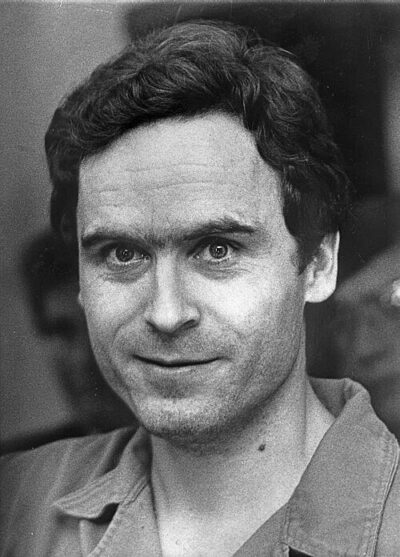
Ted Bundy
Ted Bundy was an American serial killer. Born November 24, 1946, in Burlington. Died January 24, 1989, in Florida State Prison. Educated at University of Washington and University of Puget Sound.
Facts
22 facts · 2 confirmed by two sources · 5 cited · 15 from one source
Where this comes from
Papalocal keeps its own record. It started from these sources; what each one said is kept here as it was copied, so a change on their side never changes this page by itself. Tap one to read its version.
What Wikidata says · copied November 13, 2026 · revision 2562716928
- Described as
- American serial killer (1946–1989)
- Other names
- Theodore Robert "Ted" Bundy, Teddy, Theodore Robert Bundy, Theodore Robert Cowell
- Born
- November 24, 1946 · 4 references
- Died
- January 24, 1989 · 4 references
- Born in
- Burlington · 1 reference
- Died in
- Florida State Prison
- Buried in
- Cascade Range
- Cause of death
- electrocution
- Name at birth
- Theodore Robert Cowell
- Citizen of
- United States
- Occupation
- psychologist; serial killer
- Political party
- Republican Party
- Education
- University of Washington (–1972) · 1 reference; University of Puget Sound (1965–) · 1 reference; University of Utah; Temple University; Woodrow Wilson High School
- Field
- serial murder · 1 reference
- Religion
- Methodism · 1 reference; The Church of Jesus Christ of Latter-day Saints (1975–) · 1 reference
- Lived in
- Tacoma; Salt Lake City
- Height
- 1.78 m (5 ft 10 in)
- Wikipedias with a page
- 81
Wikidata item Q192218 (wikidata.org/wiki/Q192218), public domain (CC0). Copied November 13, 2026.
What Wikipedia says · copied November 13, 2026 · revision 1383742332
Theodore Robert Bundy (né Cowell; November 24, 1946 – January 24, 1989), also known by the alias Chris Hagen, was an American serial killer who kidnapped, raped, and murdered dozens of young women and girls between 1974 and 1978. His modus operandi typically consisted of convincing his target that he was in need of assistance or duping them into believing he was an authority figure. He would then lure his victim to his vehicle, at which point he would bludgeon them unconscious, then restrain them with handcuffs before driving them to a remote location to be sexually assaulted and killed.
Bundy killed his first definitively-known victim in February 1974 in Washington State, and his later crimes stretched to Oregon, Colorado, Utah, Idaho, and Florida. He frequently revisited the bodies of his victims, grooming and performing sex acts on the corpses until decomposition and destruction by wild animals made further interactions impossible. Along with the murders, Bundy was also a prolific burglar, and on a few occasions he broke into homes at night and bludgeoned, maimed, strangled, and sexually assaulted the occupants in their sleep.
In 1975, Bundy was arrested and jailed in Utah for aggravated kidnapping and attempted criminal assault. He then became a suspect in a progressively longer list of unsolved homicides in several states. Facing murder charges in Colorado, Bundy engineered two dramatic escapes and committed further assaults in Florida, including three murders, before being recaptured in 1978. For the Florida homicides, he received three death sentences in two trials. Bundy was executed in the electric chair at Florida State Prison, in Bradford County, on January 24, 1989.
Biographer Ann Rule characterized Bundy as "a sadistic sociopath who took pleasure from another human's pain and the control he had over his victims, to the point of death and even after." He once described himself as "the most cold-hearted son of a bitch you'll ever meet", a statement with which attorney Polly Nelson, a member of his last defense team, agreed. She wrote that "Ted was the very definition of heartless evil."
- Born, in its opening lines
- November 24, 1946
- Died, in its opening lines
- January 24, 1989
From the Wikipedia article “Ted Bundy” (en.wikipedia.org/wiki/Ted_Bundy), by its contributors, under CC BY-SA 4.0 (creativecommons.org/licenses/by-sa/4.0/). Copied November 13, 2026; not changed.
Confirmed Two sources agree. Cited One source, and it names where it got it. One source One source, without a reference of its own. Sources disagree The sources disagree. We show the best-supported value and keep theirs below.
