
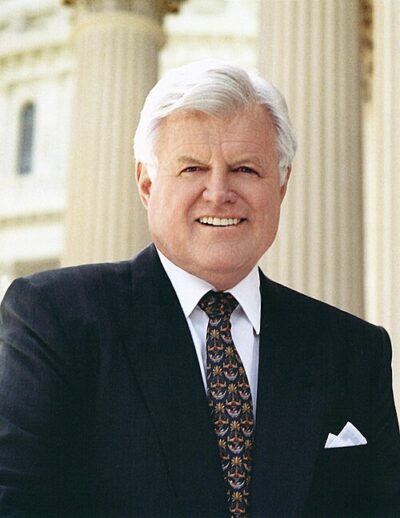
Ted Kennedy
Ted Kennedy was an United States Senator from Massachusetts from 1962 to 2009. Born February 22, 1932, in Dorchester. Died August 25, 2009, in Hyannis Port. Positions held include district attorney (1961–) and United States senator (1962–2009). Educated at University of Virginia School of Law and Harvard College. Awards include Knight Commander of the Order of the British Empire, Presidential Medal of Freedom and Four Freedoms Award – Freedom Medal.
Facts
56 facts · 2 confirmed by two sources · 40 cited · 13 from one source · 1 where the sources disagree
What’s different
- Cause of death: we show brain cancer (Sources disagree). Wikidata also lists brain tumor
Where this comes from
Papalocal keeps its own record. It started from these sources; what each one said is kept here as it was copied, so a change on their side never changes this page by itself. Tap one to read its version.
What Wikipedia says · copied November 13, 2026 · revision 1385424320
Edward Moore Kennedy (February 22, 1932 – August 25, 2009) was an American lawyer and politician who represented Massachusetts in the United States Senate from 1962 until his death in 2009. A member of the Democratic Party, he was the second-most-senior member of the Senate when he died. He is ranked fifth in U.S. history for length of continuous service as a senator. Kennedy was the younger brother of President John F. Kennedy and U.S. Attorney General and U.S. Senator Robert F. Kennedy, an uncle of U.S. Secretary of Health and Human Services Robert F. Kennedy Jr., and the father of former U.S. Representative Patrick J. Kennedy.
Born into the prominent Kennedy family in Boston, Kennedy attended Harvard University. After a brief stint with the United States Army, he earned his law degree from the University of Virginia. Kennedy began his career as an assistant district attorney in Suffolk County, Massachusetts before being elected to the U.S. Senate in a special election in 1962 to fill the vacant Senate seat previously held by his brother John, who had taken office to become president of the United States. He was elected to a full six-year term two years later in 1964 and re-elected seven more times. After the Chappaquiddick incident in 1969 resulted in the death of his automobile passenger, Mary Jo Kopechne, Kennedy pleaded guilty to a charge of leaving the scene of an accident and received a two-month suspended sentence. The incident and its aftermath hindered his chances of becoming U.S. president.
In 1980, Kennedy ran in the Democratic presidential primaries for the party's presidential nomination, but lost to the incumbent president, Jimmy Carter. Kennedy was known for his oratorical skills. His 1968 eulogy for his brother Robert and his 1980 rallying cry for modern American liberalism were among his best-known speeches. He became recognized as "The Lion of the Senate" through his long tenure and influence. Kennedy and his staff wrote more than 300 bills that were enacted into law. Unabashedly liberal, Kennedy championed an interventionist government that emphasized economic and social justice, but he was also known for working with Republicans to find compromises.
Kennedy played a major role in passing many laws, including the Immigration and Nationality Act of 1965, the National Cancer Act of 1971, the COBRA health insurance provision, the Comprehensive Anti-Apartheid Act of 1986, the Americans with Disabilities Act of 1990, the Ryan White AIDS Care Act, the Civil Rights Act of 1991, the Mental Health Parity Act, the S-CHIP children's health program, the No Child Left Behind Act, and the Edward M. Kennedy Serve America Act. During the 2000s, he led several unsuccessful immigration reform efforts. Over the course of his Senate career, Kennedy made efforts to enact universal health care, which he called the "cause of my life". By his later years, Kennedy had come to be viewed as a major figure and spokesman for American progressivism. He died of a brain tumor (glioblastoma) at his home in Hyannis Port, Massachusetts, at the age of 77 in August 2009, one year after being diagnosed with the illness.
- Born, in its opening lines
- February 22, 1932
- Died, in its opening lines
- August 25, 2009
From the Wikipedia article “Ted Kennedy” (en.wikipedia.org/wiki/Ted_Kennedy), by its contributors, under CC BY-SA 4.0 (creativecommons.org/licenses/by-sa/4.0/). Copied November 13, 2026; not changed.
What Wikidata says · copied November 14, 2026 · revision 2569146606
- Described as
- United States Senator from Massachusetts from 1962 to 2009
- Other names
- Edward Moore "Ted" Kennedy, Edward Kennedy, Edward M. Kennedy, Edward Moore Kennedy
- Born
- February 22, 1932 · 11 references
- Died
- August 25, 2009 · 10 references
- Born in
- Dorchester
- Died in
- Hyannis Port · 4 references
- Buried in
- Arlington National Cemetery · 1 reference
- Cause of death
- brain cancer · 2 references; brain tumor · 1 reference
- Name at birth
- Edward Moore Kennedy
- Citizen of
- United States · 1 reference
- Occupation
- politician · 2 references; lawyer · 1 reference; autobiographer; jurist · 1 reference
- Positions held
- district attorney (1961–) · 1 reference; United States senator (1962–2009) · 1 reference
- Political party
- Democratic Party · 1 reference
- Education
- University of Virginia School of Law (–1959) · 3 references; Harvard College (1950–1956) · 5 references; Milton Academy (1946–1950) · 2 references; The Hague Academy of International Law (1958) · 3 references; Portsmouth Abbey School · 1 reference; Fessenden School
- Member of
- American Academy of Arts and Sciences
- Teams
- Harvard Crimson football · 2 references
- Sport
- American football · 1 reference
- Awards
- Knight Commander of the Order of the British Empire (2009) · 1 reference; Presidential Medal of Freedom (2009) · 2 references; Four Freedoms Award – Freedom Medal (1999) · 1 reference; Profile in Courage Award (2009) · 1 reference; Nansen Refugee Award (2009) · 2 references; Order of the Aztec Eagle (2008); Order of Merit; Labor Hall of Honor (2015) · 1 reference; Pardes Humanitarian Prize in Mental Health (2016) · 1 reference; Grand Officer of the Order of the Sun of Peru (1986) · 1 reference; Fellow of the American Academy of Arts and Sciences; Order of the Companions of O. R. Tambo · 1 reference; Dr. Nathan Davis Award for United States Senators (2009)
- Field
- gun control
- Spouse
- Joan Bennett Kennedy (1958–1982) · 2 references; Victoria Reggie Kennedy (1992–2009) · 2 references
- Children
- Kara Kennedy · 2 references; Edward M. Kennedy Jr. · 2 references; Patrick J. Kennedy · 2 references
- Father
- Joseph P. Kennedy Sr. · 1 reference
- Mother
- Rose Kennedy · 1 reference
- Siblings
- Joseph P. Kennedy Jr. · 1 reference; John F. Kennedy · 1 reference; Rosemary Kennedy · 1 reference; Kathleen Cavendish · 1 reference; Eunice Kennedy Shriver · 1 reference; Patricia Kennedy Lawford · 1 reference; Robert F. Kennedy · 1 reference; Jean Kennedy Smith · 1 reference
- Religion
- Catholicism · 1 reference
- Military branch
- United States Army (1951–1953) · 3 references
- Website
- http://kennedy.senate.gov/ · 1 reference
- Wikipedias with a page
- 73
Wikidata item Q134549 (wikidata.org/wiki/Q134549), public domain (CC0). Copied November 14, 2026.
Confirmed Two sources agree. Cited One source, and it names where it got it. One source One source, without a reference of its own. Sources disagree The sources disagree. We show the best-supported value and keep theirs below.
