
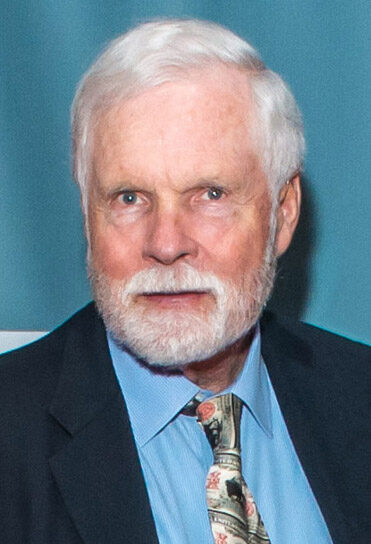
Ted Turner
Ted Turner was an American media mogul. Born November 19, 1938, in Cincinnati. Died May 6, 2026, in Lamont. Educated at Brown University and The McCallie School. Awards include Peabody Awards, Humanist of the Year and International Emmy Directorate Award.
Facts
53 facts · 2 confirmed by two sources · 29 cited · 22 from one source
Where this comes from
Papalocal keeps its own record. It started from these sources; what each one said is kept here as it was copied, so a change on their side never changes this page by itself. Tap one to read its version.
What Wikidata says · copied November 13, 2026 · revision 2563576682
- Described as
- American media mogul (1938–2026)
- Other names
- Robert Edward Turner, Robert Turner, Robert Edward Turner III
- Born
- November 19, 1938 · 8 references
- Died
- May 6, 2026 · 2 references
- Born in
- Cincinnati · 2 references
- Died in
- Lamont · 1 reference
- Cause of death
- dementia with Lewy bodies
- Name at birth
- Robert Edward Turner III
- Citizen of
- United States
- Occupation
- media proprietor; philanthropist; environmentalist; sailor; sports executive; baseball manager; television producer · 1 reference; entrepreneur · 1 reference
- Political party
- Democratic Party
- Worked for
- Metro-Goldwyn-Mayer
- Education
- Brown University; The McCallie School · 1 reference
- Sport
- baseball · 1 reference; sailing · 1 reference
- Awards
- Peabody Awards (1998) · 1 reference; Humanist of the Year (1990); International Emmy Directorate Award (1990) · 1 reference; Delta Prize for Global Understanding (2006) · 1 reference; Audubon Medal (1991) · 1 reference; honorary doctorate of Haifa University (2000); Emperor Has No Clothes Award (2001) · 1 reference; Edward R. Murrow Lifetime Achievement Award (2000) · 1 reference; star on Hollywood Walk of Fame · 1 reference; Sports Lifetime Achievement Award (2014) · 1 reference; Weintal Prize for Diplomatic Reporting (1990) · 1 reference; Walter Cronkite Award for Excellence in Journalism (1990) · 1 reference; Time Person of the Year (1991) · 1 reference; Jane Fonda Humanitarian Award (1999) · 1 reference; Bower Award for Business Leadership (2006) · 1 reference
- Field
- entrepreneurship · 1 reference; media company · 1 reference; cable television · 1 reference; television production · 1 reference; philanthropy · 1 reference
- Spouse
- Judith Nye (1960–1964) · 1 reference; Jane Shirley Smith (1965–1988) · 1 reference; Jane Fonda (1991–2001) · 1 reference
- Children
- Laura Lee Turner · 1 reference; Robert Edward Turner IV · 1 reference; Rhett Turner · 1 reference; Beauregard Turner · 1 reference; Jennie Turner · 1 reference
- Father
- Robert Edward Turner II · 1 reference
- Mother
- Florence Rooney · 1 reference
- Religion
- Anglicanism
- Website
- https://tedturner.com
- Wikipedias with a page
- 74
Wikidata item Q193368 (wikidata.org/wiki/Q193368), public domain (CC0). Copied November 13, 2026.
What Wikipedia says · copied November 13, 2026 · revision 1385522381
Robert Edward Turner III (November 19, 1938 – May 6, 2026) was an American businessman, television producer, media proprietor, and philanthropist. He founded CNN, the first 24-hour cable news channel, and WTBS, which pioneered the superstation concept in cable television. Turner also founded the television networks TNT, TBS, The Cartoon Network, Inc., and Turner Classic Movies, and acquired professional wrestling company Jim Crockett Promotions, which became the basis of the promotion World Championship Wrestling (WCW).
Turner began his media empire in March 1963 when he took over his father's billboard business—Turner Outdoor Advertising, then worth $1 million—after his father's suicide at the age of 53. His purchase of an Atlanta UHF station in 1970 began the Turner Broadcasting System. In 1980, he founded CNN, one of the most prominent news networks in the world. Turner owned the Atlanta Braves baseball team, which won the 1995 World Series. He turned the team into a nationally popular franchise, and he launched the charitable Goodwill Games. Turner was also a passionate proponent of professional wrestling as a television product, having aired wrestling on TBS dating back to 1971, and credited wrestling with helping TBS gain a national footprint with the coming of cable television. In 1988, Turner purchased Jim Crockett Promotions, which he then rebranded as WCW, a promotion that would supersede the World Wrestling Federation (WWF, now WWE) in popularity during the mid-1990s, an era now called the Monday Night War.
As a philanthropist, he gave $1 billion to create the United Nations Foundation, a public charity to broaden U.S. support for the United Nations; Turner served as co-chairman of its board of directors. In 2001, he co-founded the Nuclear Threat Initiative (NTI) with U.S. senator Sam Nunn (D‑GA), a non-partisan organization dedicated to reducing global reliance on and preventing the proliferation of nuclear, chemical, and biological weapons.
In 2020, Forbes awarded Turner a perfect philanthropy score of 5, the highest possible rating, placing him among an exclusive group of just ten Forbes 400 members, alongside Warren Buffett, George Soros, Eli Broad, and others who have each given away at least 20% of their fortune.
Turner was also known for his controversial statements, which earned him the nicknames "The Mouth of the South" and "Captain Outrageous". He was the largest private landowner in the United States until John C. Malone surpassed him in 2011. He used much of his land for ranches to re-popularize bison meat for his Ted's Montana Grill chain, having amassed the largest privately owned bison herd in the world. Turner devoted much of his assets to environmental causes and also created the environmental-themed animated series Captain Planet and the Planeteers.
- Born, in its opening lines
- November 19, 1938
- Died, in its opening lines
- May 6, 2026
From the Wikipedia article “Ted Turner” (en.wikipedia.org/wiki/Ted_Turner), by its contributors, under CC BY-SA 4.0 (creativecommons.org/licenses/by-sa/4.0/). Copied November 13, 2026; not changed.
Confirmed Two sources agree. Cited One source, and it names where it got it. One source One source, without a reference of its own. Sources disagree The sources disagree. We show the best-supported value and keep theirs below.
