
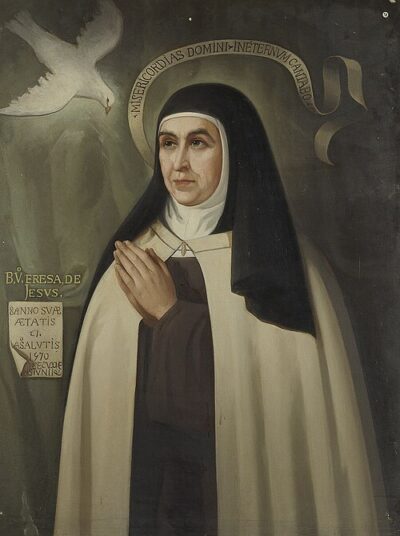
Teresa of Ávila
Teresa of Ávila was a Roman Catholic saint. Born March 28, 1515, in Ávila. Died October 15, 1582, in Monastery of the Anunciación. Positions held include prior. Known for The Interior Castle.
Facts
33 facts · 1 confirmed by two sources · 5 cited · 27 from one source
Where this comes from
Papalocal keeps its own record. It started from these sources; what each one said is kept here as it was copied, so a change on their side never changes this page by itself. Tap one to read its version.
What Wikidata says · copied November 16, 2026 · revision 2567308511
- Described as
- Roman Catholic saint (1515-1582)
- Other names
- Teresa of Avila, Teresa de Jesús, Teresa de, Saint Cepeda y Ahumada, Teresa, Teresa de Ávila, Teresa Sanchez de Cepeda y Ahumada, Teresa de Jesus, Saint Thérèse de Jésus, Theresa, Saint Theresa de Jesus, Teresa Sanchez Cepeda Davila y Ahumada, Avil̔skaia Tereza
- Born
- March 28, 1515 · 2 references
- Died
- October 15, 1582 · 1 reference
- Born in
- Ávila · 1 reference
- Died in
- Monastery of the Anunciación · 2 references
- Buried in
- sepulcher of Saint Teresa of Avila
- Name at birth
- Teresa Sánchez de Cepeda Dávila y Ahumada
- Citizen of
- Spain · 2 references; Crown of Castile
- Occupation
- writer; philosopher; founder of Catholic religious community; religious sister; cloistered nun; poet; author · 1 reference; nun · 1 reference
- Positions held
- prior
- Genre
- devotional literature
- Known for
- The Interior Castle
- Field
- religious reformer · 1 reference
- Father
- Alonso Sánchez de Cepeda
- Mother
- Beatriz de Ahumada
- Siblings
- Hernando de Ahumada; Rodrigo de Cepeda y Ahumada; Juan de Cepeda y Ahumada; Lorenzo de Cepeda y Ahumada; Antonio de Cepeda y Ahumada; Pedro de Cepeda y Ahumada; Jerónimo Cepeda y Ahumada; Agustín De Cepeda y Ahumada; Juana de Cepeda y Ahumada; María de Cepeda y del Peso
- Religion
- Catholic Church · 1 reference
- Wikipedias with a page
- 110
Wikidata item Q174880 (wikidata.org/wiki/Q174880), public domain (CC0). Copied November 16, 2026.
What Wikipedia says · copied November 16, 2026 · revision 1384635342
Teresa of Ávila (born Teresa Sánchez de Cepeda Dávila y Ahumada; 28 March 1515 – 4 or 15 October 1582), religious name Teresa of Jesus, was a Carmelite nun, prominent Spanish mystic and spiritual reformer.
Active during the Counter-Reformation, Teresa became the central figure of a movement of spiritual and monastic renewal, reforming the Carmelite orders of both women and men. The movement was later joined by the younger Carmelite friar and mystic Saint John of the Cross, with whom she established the Discalced Carmelites. A formal papal decree adopting the split from the old order was issued in 1580.
Teresa's autobiography, The Life of Teresa of Jesus, and her books The Interior Castle and The Way of Perfection are prominent works on Christian mysticism and Christian meditation practice. In her autobiography, written as a defense of her ecstatic mystical experiences, she discerns four stages in the ascent of the soul to God: mental prayer and meditation; the prayer of quiet; absorption-in-God; ecstatic consciousness. The Interior Castle, written as a spiritual guide for her Carmelite sisters, uses the illustration of seven mansions within the castle of the soul to describe the different states one's soul can be in during life.
Forty years after her death, in 1622, Teresa was canonized by Pope Gregory XV. On 27 September 1970 Pope Paul VI proclaimed Teresa the first female Doctor of the Church in recognition of her centuries-long spiritual legacy to the Catholic Church.
- Born, in its opening lines
- March 28, 1515
From the Wikipedia article “Teresa of Ávila” (en.wikipedia.org/wiki/Teresa_of_Ávila), by its contributors, under CC BY-SA 4.0 (creativecommons.org/licenses/by-sa/4.0/). Copied November 16, 2026; not changed.
Confirmed Two sources agree. Cited One source, and it names where it got it. One source One source, without a reference of its own. Sources disagree The sources disagree. We show the best-supported value and keep theirs below.
