
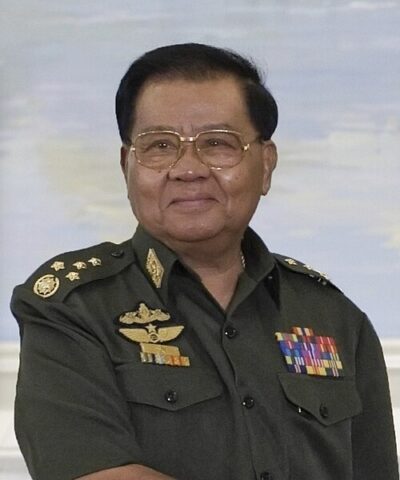
Than Shwe
Than Shwe is a Burmese senior general and head of state of Myanmar of Myanmar from 1992 to 2011. Born February 2, 1933, in Kyaukse. Positions held include Prime Minister of Myanmar (1992–2003), Commander-in-Chief of Defence Services (1992–2011) and President of Myanmar (1992–2011). Known for Uppatasanti Pagoda and Naypyidaw. Educated at Officers Training School, Bahtoo and M.V. Frunze Military Academy. Awards include Order of Burma.
Facts
34 facts · 1 confirmed by two sources · 4 cited · 29 from one source
Where this comes from
Papalocal keeps its own record. It started from these sources; what each one said is kept here as it was copied, so a change on their side never changes this page by itself. Tap one to read its version.
What Wikidata says · copied November 16, 2026 · revision 2563060854
- Described as
- Burmese senior general and head of state of Myanmar of Myanmar from 1992 to 2011
- Other names
- Senior General Than Shwe, U Than Shwe, General Than Shwe, Bogyoke Than Shwe, Bogyokegyi Than Shwe, Bogyoke Hmu Gyi Than Shwe, Agga Maha Thray Sithu Than Shwe
- Born
- February 2, 1933 · 2 references
- Born in
- Kyaukse
- Citizen of
- Myanmar
- Occupation
- politician · 1 reference; military personnel · 1 reference; military officer; military leader; head of government · 1 reference
- Positions held
- Prime Minister of Myanmar (1992–2003); Commander-in-Chief of Defence Services (1992–2011); President of Myanmar (1992–2011); State Peace and Development Council (1992–2011)
- Political party
- State Peace and Development Council; Union Solidarity and Development Association; Burma Socialist Programme Party
- Education
- Officers Training School, Bahtoo; M.V. Frunze Military Academy
- Member of
- State Peace and Development Council
- Known for
- Uppatasanti Pagoda; Naypyidaw
- Awards
- Order of Burma
- Spouse
- Kyaing Kyaing
- Children
- Kyi Kyi Shwe; Thandar Shwe; Kyaing San Shwe · 1 reference; Tun Naing Shwe
- Religion
- Theravāda; Buddhism
- Military branch
- Myanmar Army (1953–2011)
- Military rank
- Senior General; general
- Lived in
- Myanmar; Naypyidaw; Yangon
- Wikipedias with a page
- 53
Wikidata item Q202553 (wikidata.org/wiki/Q202553), public domain (CC0). Copied November 16, 2026.
What Wikipedia says · copied November 16, 2026 · revision 1383698542
Than Shwe (Burmese: သန်းရွှေ; pronounced [θáɰ̃ ʃwè]; born 2 February 1933) is a retired Burmese military officer who ruled Myanmar as the second chairman of the State Law and Order Restoration Council, later as the only chairman of the State Peace and Development Council, as well as the commander-in-chief of Defence Services from 1992 until his resignation in 2011, and concurrently served as the eighth prime minister of Myanmar from 1992 to 2003. He previously served as the deputy commander-in-chief of Defence Services from 1985, and the vice chairman of the State Peace and Development Council, and deputy prime minister of Myanmar from 1988 until 1992.
Born in Kyaukse in Upper Burma, Than Shwe received military training and in 1953 joined the Tatmadaw (armed forces), and rose through the ranks. In 1985, he was appointed the deputy commander-in-chief of Defence Services. In 1988, following a coup d'état that followed the 8888 Uprising, Than Shwe was appointed the vice chairman of the newly formed State Peace and Development Council (SPDC) and deputy prime minister by Saw Maung, the new leader of Myanmar. In 1992, Saw Maung stepped down and Than Shwe immediately became the new leader of Myanmar.
As head of state, Than Shwe played a major role in shaping the country's political landscape. He adopted the 2008 Constitution, implementation of various policies aimed at economic development, modernization and infrastructure improvements, and as well as also being involved in efforts to stabilize the country and manage internal conflicts. In 2011, Than Shwe announced his retirement, and officially stepped down as head of state, facilitating the transition to his chosen successor, Thein Sein. As the head of the Armed Forces, he was succeeded by Senior General Min Aung Hlaing.
While Than Shwe's tenure recorded achievements, it also faced scrutiny and criticism, particularly regarding allegations of human rights abuses and restrictions on political freedoms. His tenure coincided with a period of political transition and international scrutiny, with Myanmar experiencing both internal and external challenges. Despite being retired, Than Shwe continues to wield significant influence within the military.
- Born, in its opening lines
- February 2, 1933
From the Wikipedia article “Than Shwe” (en.wikipedia.org/wiki/Than_Shwe), by its contributors, under CC BY-SA 4.0 (creativecommons.org/licenses/by-sa/4.0/). Copied November 16, 2026; not changed.
Confirmed Two sources agree. Cited One source, and it names where it got it. One source One source, without a reference of its own. Sources disagree The sources disagree. We show the best-supported value and keep theirs below.
