
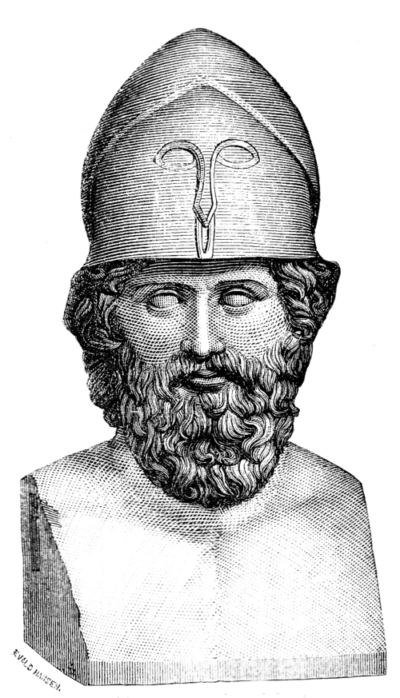
Themistocles
Themistocles was an Athenian politician and general (c. 524–459 BC). Born 524 BC, in Athens. Died 459 BC, in Magnesia on the Maeander. Positions held include eponymous archon (-492–-491) and strategos.
Facts
24 facts · 0 confirmed by two sources · 5 cited · 18 from one source · 1 where the sources disagree
What’s different
- Buried in: we show Magnesia on the Maeander (Sources disagree). Wikidata also lists Tomb of Themistokles, Piraeus
Where this comes from
Papalocal keeps its own record. It started from these sources; what each one said is kept here as it was copied, so a change on their side never changes this page by itself. Tap one to read its version.
What Wikidata says · copied November 16, 2026 · revision 2552067925
- Described as
- Athenian politician and general (c. 524–459 BC)
- Other names
- Themistokles
- Born
- 524 BC
- Died
- 459 BC
- Born in
- Athens · 1 reference
- Died in
- Magnesia on the Maeander · 1 reference
- Buried in
- Magnesia on the Maeander · 1 reference; Tomb of Themistokles, Piraeus
- Citizen of
- Classical Athens; Achaemenid Empire · 1 reference
- Occupation
- politician; soldier · 1 reference
- Positions held
- eponymous archon (-492–-491); strategos
- Field
- politics · 1 reference; naval vessel · 1 reference
- Spouse
- Archippe
- Children
- Archeptolis; Mnesiptolema; Nikomache; Asia; Hellas
- Father
- Neocles
- Mother
- Abrotonon
- Siblings
- Agesilaus
- Religion
- polytheistic religion
- Military rank
- strategos · 1 reference
- Wikipedias with a page
- 81
Wikidata item Q179552 (wikidata.org/wiki/Q179552), public domain (CC0). Copied November 16, 2026.
What Wikipedia says · copied November 16, 2026 · revision 1383594196
Themistocles (; Ancient Greek: Θεμιστοκλῆς, Themistoklēs; c. 524 – c. 459 BC) was an Athenian politician and general. He was one of a new breed of non-aristocratic politicians who rose to prominence in the early years of the Athenian democracy. As a politician, Themistocles was a populist, having the support of lower-class Athenians, and generally being at odds with the Athenian nobility. Elected archon in 493 BC, he convinced the polis to increase the naval power of Athens, a recurring theme in his political career. During the first Persian invasion of Greece, he fought at the Battle of Marathon (490 BC), and may have been one of the ten Athenian strategoi (generals) in that battle.
In the years after Marathon, and in the run-up to the second Persian invasion of 480–479 BC, Themistocles became the most prominent politician in Athens. He continued to advocate for a strong Athenian navy, and in 483 BC he persuaded the Athenians to build a fleet of 200 triremes; these proved crucial in the forthcoming conflict with Persia. During the second invasion, he commanded the Athenian navy at the battles of Artemisium and Salamis in 480 BC. Due to his subterfuge, the Allies successfully lured the Persian fleet into the Straits of Salamis, and the decisive Greek victory there was the turning point of the war. The invasion was conclusively repulsed the following year after the Persian defeat at the land battle of Plataea.
After the conflict ended, Themistocles continued his pre-eminence among Athenian politicians. However, he aroused the hostility of Sparta by ordering the re-fortification of Athens, and his perceived arrogance began to alienate him from the Athenians. In 472 or 471 BC, he was ostracised, and went into exile in Argos. The Spartans now saw an opportunity to destroy Themistocles, and implicated him in the alleged treasonous plot of 478 BC of their own general Pausanias. Themistocles thus fled from southern Greece. Alexander I of Macedon (r. 498–454 BC) temporarily gave him sanctuary at Pydna before he traveled to Asia Minor, where he entered the service of the Persian king Artaxerxes I (reigned 465–424 BC). He was made governor of Magnesia, and lived there for the rest of his life.
Themistocles died in 459 BC, probably of natural causes. His reputation was posthumously rehabilitated, and he was re-established as a hero of the Athenian, and indeed Greek, cause. Themistocles can still reasonably be thought of as "the man most instrumental in achieving the salvation of Greece" from the Persian threat, as Plutarch describes him. His naval policies would have a lasting impact on Athens as well, since maritime power became the cornerstone of the Athenian Empire and golden age. Thucydides assessed Themistocles as "a man who exhibited the most indubitable signs of genius; indeed, in this particular he has a claim on our admiration quite extraordinary and unparalleled".
From the Wikipedia article “Themistocles” (en.wikipedia.org/wiki/Themistocles), by its contributors, under CC BY-SA 4.0 (creativecommons.org/licenses/by-sa/4.0/). Copied November 16, 2026; not changed.
Confirmed Two sources agree. Cited One source, and it names where it got it. One source One source, without a reference of its own. Sources disagree The sources disagree. We show the best-supported value and keep theirs below.
