
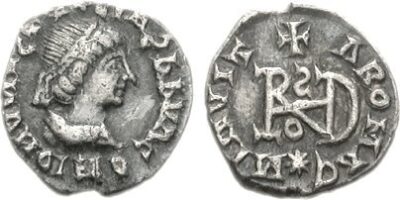
Theodoric the Great
Theodoric the Great was a king of the Germanic Ostrogoths and ruler of Italy. Born May 12, 454, in Carnuntum. Died August 30, 526, in Ravenna. Positions held include Monarch of Italy (493–526), patrician and magister militum.
Facts
23 facts · 0 confirmed by two sources · 7 cited · 16 from one source
Where this comes from
Papalocal keeps its own record. It started from these sources; what each one said is kept here as it was copied, so a change on their side never changes this page by itself. Tap one to read its version.
What Wikidata says · copied November 16, 2026 · revision 2569131405
- Described as
- king of the Germanic Ostrogoths and ruler of Italy (493–526)
- Other names
- Theodoric, Theodericus, Flavius Theodoricus II, Theoderīcus, Theodorīcus, Theodoricus, Theoderic
- Born
- May 12, 454
- Died
- August 30, 526 · 2 references
- Born in
- Carnuntum
- Died in
- Ravenna · 1 reference
- Buried in
- Mausoleum of Theodoric
- Citizen of
- Ostrogothic Kingdom; Western Roman Empire
- Occupation
- monarch; sovereign
- Positions held
- Monarch of Italy (493–526); patrician · 1 reference; magister militum · 1 reference; King of the Ostrogoths (475–526); regent (511–526); Roman consul
- Spouse
- Audofleda · 1 reference
- Children
- Amalasuntha · 3 references; Theodegotha; Ostrogotho
- Father
- Theodemir · 4 references
- Mother
- Ereleuva
- Siblings
- Amalafrida
- Religion
- Arianism
- Wikipedias with a page
- 86
Wikidata item Q105105 (wikidata.org/wiki/Q105105), public domain (CC0). Copied November 16, 2026.
What Wikipedia says · copied November 16, 2026 · revision 1378143879
Theodoric (or Theoderic) the Great (about 454 – 30 August 526), also called the Amal, was king of the Ostrogoths (471–526), and ruler of the Ostrogothic Kingdom of Italy between 493 and 526, regent of the Visigoths (511–526), and a patrician of the Eastern Roman Empire. As ruler of the combined Gothic realms, Theodoric controlled an empire stretching from the Atlantic Ocean to the Adriatic Sea. Though Theodoric himself only used the title 'king' (rex), some scholars characterize him as a Western Roman emperor in all but name, since he ruled a large part of the former Western Roman Empire. He also received and used the former Western imperial regalia from Constantinople in 497, and exercised imperial powers recognized in the East, such as naming consuls. The Italian aristocracy referred to him using the imperial title princeps.
As a young child of an Ostrogothic nobleman, Theodoric was taken as a hostage to Constantinople, where he spent his formative years and received an East Roman education (paideia). Theodoric returned to Pannonia around 470, and throughout the 470s he campaigned against the Sarmatians and competed for influence among the Goths of the Roman Balkans, gaining recognition as king in 471. The emperor Zeno made him commander of the Eastern Roman forces in 483 and consul in 484. Nevertheless, Theodoric remained in constant hostilities with the emperor and frequently raided East Roman territory.
At the behest of Zeno, in 489 Theodoric attacked Odoacer, the king of Italy, emerging victorious in 493. As the new ruler of Italy, he upheld a Roman legal administration and scholarly culture while promoting a major building program across Italy. In 505 he expanded into the Balkans, and by 511 he had brought the Visigothic Kingdom of Spain under his direct control and established hegemony over the Burgundian and Vandal kingdoms. Theodoric died in 526 and was buried in a grand mausoleum in Ravenna. He lived on as the figure Dietrich von Bern in Germanic heroic legend.
From the Wikipedia article “Theodoric the Great” (en.wikipedia.org/wiki/Theodoric_the_Great), by its contributors, under CC BY-SA 4.0 (creativecommons.org/licenses/by-sa/4.0/). Copied November 16, 2026; not changed.
Confirmed Two sources agree. Cited One source, and it names where it got it. One source One source, without a reference of its own. Sources disagree The sources disagree. We show the best-supported value and keep theirs below.
