
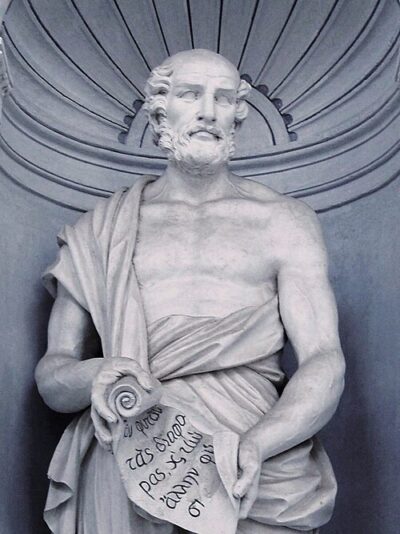
Theophrastus
Theophrastus was a Greek philosopher (c.371-c.287 BC). Born 371 BC, in Eresos. Died 287 BC, in Athens. Known for History of Plants, On the causes of plants and Characters. Educated at peripatetic school.
Facts
19 facts · 0 confirmed by two sources · 3 cited · 16 from one source
Where this comes from
Papalocal keeps its own record. It started from these sources; what each one said is kept here as it was copied, so a change on their side never changes this page by itself. Tap one to read its version.
What Wikidata says · copied November 16, 2026 · revision 2567837237
- Described as
- Greek philosopher (c.371-c.287 BC)
- Other names
- Theophrastus of Eresos, Theophr.
- Born
- 371 BC
- Died
- 287 BC · 1 reference
- Born in
- Eresos
- Died in
- Athens
- Citizen of
- Classical Athens
- Occupation
- botanist; physicist; philosopher · 1 reference; writer · 1 reference
- Education
- peripatetic school
- Known for
- History of Plants; On the causes of plants; Characters; De sensu; Metaphysics; Callisthenes, or On Pain; On Wealth; Laws (Theophrastus)
- Field
- botany
- Wikipedias with a page
- 98
Wikidata item Q160362 (wikidata.org/wiki/Q160362), public domain (CC0). Copied November 16, 2026.
What Wikipedia says · copied November 16, 2026 · revision 1384228574
Theophrastus (; Ancient Greek: Θεόφραστος, romanized: Theophrastos, lit. 'godly phrased'; c. 371 – c. 287 BC) was an ancient Greek philosopher and naturalist. A native of Eresos in Lesbos, he was Aristotle's close colleague and successor as head of the Lyceum, the Peripatetic school of philosophy in Athens. Theophrastus wrote numerous treatises across all areas of philosophy, working to support, improve, expand, and develop the Aristotelian system. He made significant contributions to various fields, including ethics, metaphysics, botany, and natural history. Often considered the "father of botany" for his groundbreaking works "Enquiry into Plants" (Ancient Greek: Περὶ φυτῶν ἱστορία, romanized: Peri phytōn historia) and "On the Causes of Plants", (Ancient Greek: Περὶ αἰτιῶν φυτικῶν, romanized: Peri aitiōn phytikōn), Theophrastus established the foundations of botanical science. His given name was Tyrtamos (Ancient Greek: Τύρταμος); the nickname Theophrastus ("divine speaker") was reputedly given to him by Aristotle in recognition of his eloquent style.
He came to Athens at a young age and initially studied in Plato's school. After Plato's death, he attached himself to Aristotle who took to Theophrastus in his writings. When Aristotle fled Athens, Theophrastus took over as head of the Lyceum. Theophrastus presided over the Peripatetic school for thirty-six years, during which time the school flourished greatly. He is often considered the father of botany for his works on plants. After his death, the Athenians honoured him with a public funeral. His successor as head of the school was Strato of Lampsacus.
The interests of Theophrastus were wide ranging, including biology, physics, ethics and metaphysics. His two surviving botanical works, Enquiry into Plants (Historia Plantarum) and On the Causes of Plants, were an important influence on Renaissance science. There are also surviving works On Moral Characters, On Sense Perception, and On Stones, as well as fragments on Physics and Metaphysics. In philosophy, he studied grammar and language and continued Aristotle's work on logic. He also viewed space as merely the arrangement and position of bodies, time as a byproduct of motion, and motion as an inevitable result of all activity. In ethics, he regarded happiness as depending on external influences as well as on virtue.
From the Wikipedia article “Theophrastus” (en.wikipedia.org/wiki/Theophrastus), by its contributors, under CC BY-SA 4.0 (creativecommons.org/licenses/by-sa/4.0/). Copied November 16, 2026; not changed.
Confirmed Two sources agree. Cited One source, and it names where it got it. One source One source, without a reference of its own. Sources disagree The sources disagree. We show the best-supported value and keep theirs below.
