History of Plants
History of Plants is a book by Theophrastus.
- Written by
- Theophrastus
- Country of origin
- Ancient Greece
All 4 facts, and where they come from
Facts
4 facts · 0 confirmed by two sources · 0 cited · 4 from one source
Where this comes from
Papalocal keeps its own record. It started from these sources; what each one said is kept here as it was copied, so a change on their side never changes this page by itself. Tap one to read its version.
What Wikidata says · copied November 17, 2026 · revision 2516960424
- Described as
- book by Theophrastus
- Other names
- De historia plantarum, Peri phyton historia, Enquiry into plants
- What it is
- literary work
- Written by
- Theophrastus
- Language
- Ancient Greek
- Country of origin
- Ancient Greece · 1 reference
- Wikipedias with a page
- 20
Wikidata item Q17156420 (wikidata.org/wiki/Q17156420), public domain (CC0). Copied 2026-11-17.
What Wikipedia says · copied November 17, 2026 · revision 1384399393
Theophrastus's Enquiry into Plants or Historia Plantarum (Ancient Greek: Περὶ φυτῶν ἱστορία, Peri phyton historia) was, along with his mentor Aristotle's History of Animals, Pliny the Elder's Natural History and Dioscorides's De materia medica, one of the most important books of natural history written in ancient times, and like them it was influential in the Renaissance. Theophrastus looks at plant structure, reproduction and growth; the varieties of plant around the world; wood; wild and cultivated plants; and their uses. Book 9 in particular, on the medicinal uses of plants, is one of the first herbals, describing juices, gums and resins extracted from plants, and how to gather them.
Historia Plantarum was written some time between c. 350 BC and c. 287 BC in ten volumes, of which nine survive. In the book, Theophrastus described plants by their uses, and attempted a biological classification based on how plants reproduced, a first in the history of botany. He continually revised the manuscript, and it remained in an unfinished state on his death. The condensed style of the text, with its many lists of examples, indicate that Theophrastus used the manuscript as the working notes for lectures to his students, rather than intending it to be read as a book.
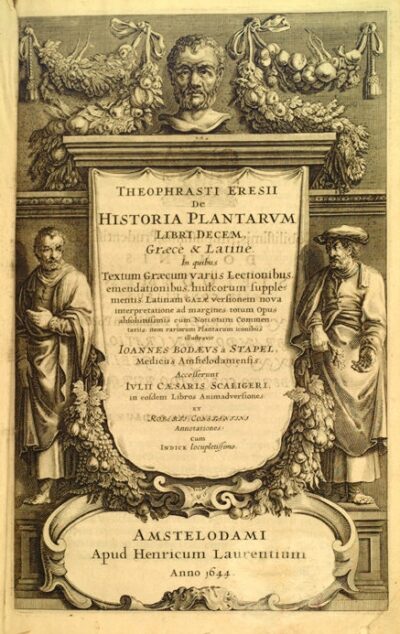
Historia Plantarum was first translated into Latin by Theodorus Gaza; the translation was published in 1483. Johannes Bodaeus published a frequently cited folio edition in Amsterdam in 1644, complete with commentaries and woodcut illustrations. The first English translation was made by Sir Arthur Hort and published in 1916.
From the Wikipedia article “Historia Plantarum (Theophrastus)” (en.wikipedia.org/wiki/Historia_Plantarum_(Theophrastus)), by its contributors, under CC BY-SA 4.0 (creativecommons.org/licenses/by-sa/4.0/). Copied 2026-11-17; not changed.
Confirmed Two sources agree. Cited One source, and it names where it got it. One source One source, without a reference of its own. Sources disagree The sources disagree. We show the best-supported value and keep theirs below.
Picture: Henricus Laurentius (editor), via Wikimedia Commons · Public domain