
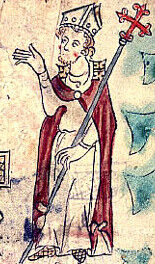
Thomas Becket
Thomas Becket was an English archbishop and martyr, 1119/1120–1170. Born December 21, 1119, in Cheapside. Died December 29, 1170, in Canterbury Cathedral. Positions held include Roman Catholic Archbishop of Canterbury (1162–1170) and Lord Chancellor (1155–1162). Educated at University of Bologna.
Facts
17 facts · 2 confirmed by two sources · 8 cited · 7 from one source
Where this comes from
Papalocal keeps its own record. It started from these sources; what each one said is kept here as it was copied, so a change on their side never changes this page by itself. Tap one to read its version.
What Wikidata says · copied November 16, 2026 · revision 2568742994
- Described as
- English archbishop and martyr, 1119/1120–1170
- Other names
- Saint Thomas of Canterbury, Thomas of London, Thomas the Martyr, Thomas of Canterbury, Saint Thomas à Becket, Thomas À Becket, Saint Thomas a Becket, St. Thomas Becket, Thomas a Becket, à Becket, Saint Thomas, Archbishop of Canterbury Thomas Becket, Saint Thomas Becket
- Born
- December 21, 1119 · 1 reference
- Died
- December 29, 1170 · 2 references
- Born in
- Cheapside · 3 references
- Died in
- Canterbury Cathedral
- Buried in
- Canterbury Cathedral · 1 reference
- Citizen of
- Kingdom of England · 3 references
- Occupation
- theologian; judge; Catholic priest (1162–) · 3 references; Catholic bishop (1162–); archbishop · 1 reference; politician · 1 reference
- Positions held
- Roman Catholic Archbishop of Canterbury (1162–1170) · 2 references; Lord Chancellor (1155–1162)
- Education
- University of Bologna
- Father
- Gilbert Becket · 1 reference
- Religion
- Catholic Church · 2 references
- Wikipedias with a page
- 68
Wikidata item Q192236 (wikidata.org/wiki/Q192236), public domain (CC0). Copied November 16, 2026.
What Wikipedia says · copied November 16, 2026 · revision 1381308955
Thomas Becket ( ), also known as Saint Thomas of Canterbury, Thomas of London and later Thomas à Becket (21 December 1119 or 1120 – 29 December 1170), was an English cleric and statesman who served as Lord Chancellor from 1155 to 1162, and then as Archbishop of Canterbury from 1162 until his death in 1170. He is known for his conflict with King Henry II over the rights and privileges of the Church and was murdered by followers of the king. Becket is venerated as a saint and martyr by the Catholic Church and the Anglican Communion.
Born into a Norman family in London, Becket was educated first at the Merton Priory in Surrey and then successively in London and Paris. He later found work at the household of Theobald of Bec, Archbishop of Canterbury and quickly won his confidence. Theobald would entrust him with a series of important offices and missions, and in 1154 recommended him as Lord Chancellor to King Henry II. In 1162, several months after Theobald's death, Henry appointed Becket Archbishop of Canterbury.
A major rift grew between Henry and Becket as the latter became increasingly ascetic and unexpectedly resisted the king's attempt to reassert royal prerogatives. In 1164, Becket was summoned to a trial by Henry and convicted on charges of contempt of royal authority and malfeasance. Refusing to accept the sentence, he fled to the Continent and spent six years in exile under the protection of Louis VII of France. A compromise was eventually reached through papal mediation. Becket returned to England in 1170 but dispute with the crown continued, leading to his death at the hands of four knights loyal to Henry in Canterbury Cathedral later in the year. Veneration of Becket as a martyr throughout Europe began soon after his death, and he was canonized by Pope Alexander III two years later.
- Born, in its opening lines
- December 21, 1119
- Died, in its opening lines
- December 29, 1170
From the Wikipedia article “Thomas Becket” (en.wikipedia.org/wiki/Thomas_Becket), by its contributors, under CC BY-SA 4.0 (creativecommons.org/licenses/by-sa/4.0/). Copied November 16, 2026; not changed.
Confirmed Two sources agree. Cited One source, and it names where it got it. One source One source, without a reference of its own. Sources disagree The sources disagree. We show the best-supported value and keep theirs below.
