
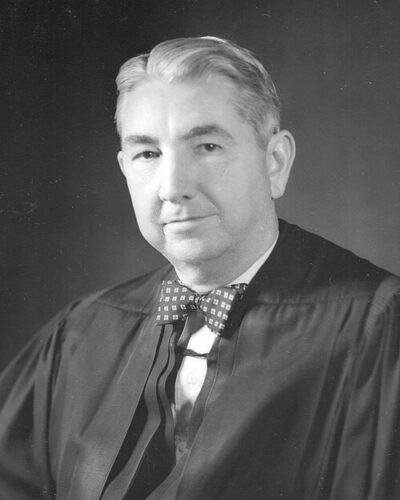
Thomas Campbell Clark
Thomas Campbell Clark was an Associate Justice of the Supreme Court of the United States. Born September 23, 1899, in Dallas. Died June 13, 1977, in New York City. Positions held include United States Attorney General (1945–1949) and Associate Justice of the Supreme Court of the United States (1949–1967). Educated at University of Texas School of Law. Awards include Distinguished Eagle Scout Award.
Facts
18 facts · 2 confirmed by two sources · 3 cited · 13 from one source
Where this comes from
Papalocal keeps its own record. It started from these sources; what each one said is kept here as it was copied, so a change on their side never changes this page by itself. Tap one to read its version.
What Wikidata says · copied November 18, 2026 · revision 2495480426
- Described as
- Associate Justice of the Supreme Court of the United States (1899-1977)
- Other names
- Tom C. Clark, Thomas C. Clark, Tom Clark, Thomas Clark
- Born
- September 23, 1899 · 5 references
- Died
- June 13, 1977 · 5 references
- Born in
- Dallas
- Died in
- New York City
- Buried in
- Restland Memorial Park · 1 reference
- Name at birth
- Thomas Campbell Clark
- Citizen of
- United States
- Occupation
- lawyer; judge; politician · 1 reference; jurist · 1 reference
- Positions held
- United States Attorney General (1945–1949) · 1 reference; Associate Justice of the Supreme Court of the United States (1949–1967)
- Political party
- Democratic Party
- Education
- University of Texas School of Law
- Awards
- Distinguished Eagle Scout Award · 1 reference
- Spouse
- Mary Jane Ramsey Clark
- Children
- Ramsey Clark
- Wikipedias with a page
- 17
Wikidata item Q724116 (wikidata.org/wiki/Q724116), public domain (CC0). Copied November 18, 2026.
What Wikipedia says · copied November 18, 2026 · revision 1379163937
Thomas Campbell Clark (September 23, 1899 – June 13, 1977) was an American lawyer who served as the 59th United States attorney general from 1945 to 1949 and as Associate Justice of the Supreme Court of the United States from 1949 to 1967.
Clark was born in Dallas, Texas, and graduated from the University of Texas School of Law after serving in World War I. He practiced law in Dallas until 1937, when he accepted a position in the U.S. Department of Justice. After Harry S. Truman became President of the United States in 1945, he chose Clark as his Attorney General. In 1949, Truman successfully nominated Clark to fill the U.S. Supreme Court vacancy caused by the death of Associate Justice Frank Murphy, making Clark the first and, as of 2026, only Supreme Court Justice from the state of Texas. Clark remained on the Court until retiring to allow his son, Ramsey Clark, to assume the position of U.S. Attorney General. Clark was succeeded by the first African American Supreme Court Justice, Thurgood Marshall, in October 1967.
Clark served on the Vinson Court and the Warren Court. He voted with the Court's majority in several cases concerning racial segregation, including the landmark case of Brown v. Board of Education. He wrote the majority opinion in landmark Mapp v. Ohio, which ruled that the Fourth Amendment prohibition against unreasonable searches and seizures applies to the states through the Fourteenth Amendment. He also wrote the majority opinion in Heart of Atlanta Motel v. United States, which upheld the public accommodations provision of the Civil Rights Act of 1964, and the majority opinions in Garner v. Board of Public Works, Joseph Burstyn, Inc. v. Wilson, Abington School District v. Schempp (which found that mandatory Bible reading in public schools was unconstitutional), and the "aggressively anti-homosexual" Boutilier v. Immigration and Naturalization Service.
- Born, in its opening lines
- September 23, 1899
- Died, in its opening lines
- June 13, 1977
From the Wikipedia article “Tom C. Clark” (en.wikipedia.org/wiki/Tom_C._Clark), by its contributors, under CC BY-SA 4.0 (creativecommons.org/licenses/by-sa/4.0/). Copied November 18, 2026; not changed.
Confirmed Two sources agree. Cited One source, and it names where it got it. One source One source, without a reference of its own. Sources disagree The sources disagree. We show the best-supported value and keep theirs below.
