
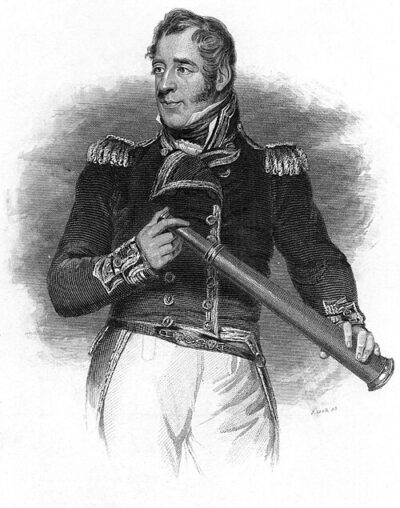
Thomas Cochrane, 10th Earl of Dundonald
Thomas Cochrane, 10th Earl of Dundonald was a British Royal Navy admiral. Born December 14, 1775, in Hamilton. Died October 31, 1860, in Kensington. Positions held include member of the 3rd Parliament of the United Kingdom, member of the 4th Parliament of the United Kingdom and member of the 5th Parliament of the United Kingdom. Awards include Order of the Bath.
Facts
29 facts · 2 confirmed by two sources · 12 cited · 15 from one source
Where this comes from
Papalocal keeps its own record. It started from these sources; what each one said is kept here as it was copied, so a change on their side never changes this page by itself. Tap one to read its version.
What Wikidata says · copied November 17, 2026 · revision 2567351858
- Described as
- British Royal Navy admiral (1775-1860)
- Other names
- Adm. Thomas Cochrane, Thomas, Earl of Dundonald
- Born
- December 14, 1775 · 9 references
- Died
- October 31, 1860 · 7 references
- Born in
- Hamilton
- Died in
- Kensington · 1 reference
- Buried in
- Westminster Abbey
- Citizen of
- Brazil; Chile · 1 reference; United Kingdom of Great Britain and Ireland
- Occupation
- politician · 1 reference; naval officer · 1 reference
- Positions held
- member of the 3rd Parliament of the United Kingdom; member of the 4th Parliament of the United Kingdom; member of the 5th Parliament of the United Kingdom
- Awards
- Order of the Bath · 1 reference
- Spouse
- Katherine Cochrane, Countess of Dundonald (1812–) · 2 references
- Children
- Thomas Cochrane, 11th Earl of Dundonald; Arthur Cochrane; William Horatio Barnardo Cochrane · 1 reference; Lady Elizabeth Cochrane · 1 reference; Ernest Grey Lambton Cochrane · 1 reference
- Father
- Archibald Cochrane, 9th Earl of Dundonald · 2 references
- Mother
- Anne Gilchrist · 2 references
- Siblings
- Archibald Cochrane; William Erskine Cochrane; Lady Charlotte Georgina Dorothea Cochrane
- Military branch
- Royal Navy (1780–) · 1 reference
- Military rank
- admiral; Vice-Admiral of the White (1841–) · 1 reference; Rear-Admiral of the Blue (1832–)
- Wikipedias with a page
- 25
Wikidata item Q334994 (wikidata.org/wiki/Q334994), public domain (CC0). Copied November 17, 2026.
What Wikipedia says · copied November 17, 2026 · revision 1378134055
Admiral Thomas Cochrane, 10th Earl of Dundonald, Marquess of Maranhão (14 December 1775 – 31 October 1860), styled Lord Cochrane between 1778 and 1831, was a British naval officer, politician and mercenary. Serving during the French Revolutionary and Napoleonic Wars in the Royal Navy, his naval successes led Napoleon to nickname him le Loup des Mers (the Sea Wolf). He was successful in virtually all his naval actions.
Cochrane was dismissed from the Royal Navy in 1814 after a controversial conviction for fraud on the London Stock Exchange. Travelling to South America, he helped to organise and lead the revolutionary navies of Chile and of Brazil during their respective wars of independence during the 1820s. While commanding the Chilean Navy Cochrane also contributed to Peruvian independence through his participation in the Liberating Expedition of Peru. He was also hired to help the Greek Revolutionary Navy during the Greek War of Independence, but ultimately had little impact. In 1832 Cochrane was pardoned by the Crown and reinstated in the Royal Navy with the rank of Rear-Admiral of the Blue. After several more promotions, he died in 1860 with the rank of Admiral of the Red, and the honorary title of Rear-Admiral of the United Kingdom.
Cochrane's life and exploits inspired the naval fiction of 19th- and 20th-century novelists, particularly the fictional characters C. S. Forester's Horatio Hornblower and Patrick O'Brian's Jack Aubrey.
- Born, in its opening lines
- December 14, 1775
- Died, in its opening lines
- October 31, 1860
From the Wikipedia article “Thomas Cochrane, 10th Earl of Dundonald” (en.wikipedia.org/wiki/Thomas_Cochrane,_10th_Earl_of_Dundonald), by its contributors, under CC BY-SA 4.0 (creativecommons.org/licenses/by-sa/4.0/). Copied November 17, 2026; not changed.
Confirmed Two sources agree. Cited One source, and it names where it got it. One source One source, without a reference of its own. Sources disagree The sources disagree. We show the best-supported value and keep theirs below.
