
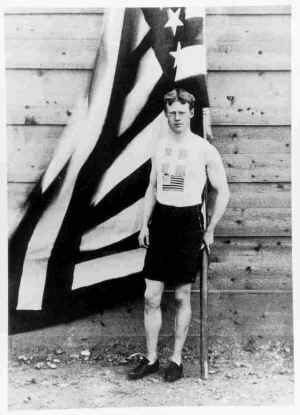
Thomas Curtis
Thomas Curtis was an American athlete. Born January 9, 1873, in San Francisco. Died May 23, 1944, in Nahant. Educated at Massachusetts Institute of Technology.
Facts
16 facts · 2 confirmed by two sources · 4 cited · 10 from one source
Where this comes from
Papalocal keeps its own record. It started from these sources; what each one said is kept here as it was copied, so a change on their side never changes this page by itself. Tap one to read its version.
What Wikidata says · copied November 15, 2026 · revision 2539528041
- Described as
- American athlete (1873–1944)
- Other names
- Thomas Pelham Curtis, Tom Curtis
- Born
- January 9, 1873
- Died
- May 23, 1944
- Born in
- San Francisco
- Died in
- Nahant
- Buried in
- Mount Auburn Cemetery · 1 reference
- Citizen of
- United States
- Occupation
- sprinter; photographer; athletics competitor
- Education
- Massachusetts Institute of Technology
- Sport
- athletics
- Spouse
- Francis Kellogg Small · 1 reference
- Children
- Clarissa Curtis · 1 reference
- Father
- Herbert Pelham Curtis · 1 reference
- Mother
- Anna Isabella Curtis · 1 reference
- Height
- 1.76 m (5 ft 9 in)
- Wikipedias with a page
- 29
Wikidata item Q347818 (wikidata.org/wiki/Q347818), public domain (CC0). Copied November 15, 2026.
What Wikipedia says · copied November 15, 2026 · revision 1384871373
Thomas Pelham Curtis (January 9, 1873 – May 23, 1944) was an American athlete and the winner of the 110 metres hurdles at the 1896 Summer Olympics.
Curtis, a Massachusetts Institute of Technology student of electrical engineering, travelled to Athens as a member of the Boston Athletic Association. Curtis was also a student at Columbia University.
At the first day of the first modern Olympic Games, Curtis advanced to the 100 metres final by winning his heat with a time of 12.2 seconds. He later withdrew from that race to prepare for the 110 metres hurdles final, which was his main event at the Olympics. That competition turned into a personal race between Curtis and Grantley Goulding from Great Britain after Frantz Reichel and William Welles Hoyt withdrew. At the start Curtis gained a small lead, but Goulding reached him at the first hurdle. At the last hurdle, Goulding was leading, but Curtis managed to throw himself to the line first. The officials stated that Curtis had won by 5 centimetres. Both athletes had a time of 17.6 seconds.
As an eager amateur photographer, Curtis made many valuable pictures in Athens. He did serve as captain in the Massachusetts National Guard and acted as a military aide to Massachusetts Governor Calvin Coolidge during World War I. His service reflected both military commitment and a connection to prominent political figures of the time. He also participated in the development of the toaster and published several humorous memories about the first modern Olympic Games. The most famous of them is High Hurdles and White Gloves (1932).
- Born, in its opening lines
- January 9, 1873
- Died, in its opening lines
- May 23, 1944
From the Wikipedia article “Thomas Curtis (athlete)” (en.wikipedia.org/wiki/Thomas_Curtis_(athlete)), by its contributors, under CC BY-SA 4.0 (creativecommons.org/licenses/by-sa/4.0/). Copied November 15, 2026; not changed.
Confirmed Two sources agree. Cited One source, and it names where it got it. One source One source, without a reference of its own. Sources disagree The sources disagree. We show the best-supported value and keep theirs below.
