
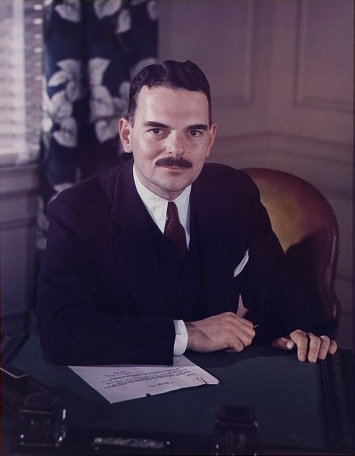
Thomas E. Dewey
Thomas E. Dewey was an American politician. Born March 24, 1902, in Owosso. Died March 16, 1971, in Bal Harbour. Positions held include Governor of New York (1943–1954) and New York County District Attorney (1938–1941). Educated at University of Michigan and Columbia University.
Facts
24 facts · 2 confirmed by two sources · 9 cited · 13 from one source
Where this comes from
Papalocal keeps its own record. It started from these sources; what each one said is kept here as it was copied, so a change on their side never changes this page by itself. Tap one to read its version.
What Wikidata says · copied November 15, 2026 · revision 2567351432
- Described as
- American politician (1902–1971)
- Other names
- Thomas Edmund Dewey, Thomas Dewey, Thomas Dewey Sr., Thomas Dewey, Sr., Thomas E. Dewey Sr., Thomas E. Dewey, Sr., Thomas Edmund Dewey Sr., Thomas Edmund Dewey, Sr.
- Born
- March 24, 1902 · 9 references
- Died
- March 16, 1971 · 9 references
- Born in
- Owosso · 1 reference
- Died in
- Bal Harbour · 1 reference
- Buried in
- Pawling Cemetery · 1 reference
- Cause of death
- myocardial infarction
- Name at birth
- Thomas Edmund Dewey
- Citizen of
- United States
- Occupation
- politician · 1 reference; lawyer · 1 reference; writer; governor · 1 reference; jurist · 1 reference; prosecutor · 1 reference
- Positions held
- Governor of New York (1943–1954); New York County District Attorney (1938–1941)
- Political party
- Republican Party
- Education
- University of Michigan; Columbia University; Columbia Law School
- Children
- Thomas E. Dewey, Jr.
- Father
- George Martin Dewey
- Mother
- Annie Louisa Dewey · 1 reference
- Religion
- Episcopal Church
- Wikipedias with a page
- 36
Wikidata item Q320061 (wikidata.org/wiki/Q320061), public domain (CC0). Copied November 15, 2026.
What Wikipedia says · copied November 15, 2026 · revision 1384988213
Thomas Edmund Dewey (March 24, 1902 – March 16, 1971) was an American lawyer and politician who served as the 47th governor of New York from 1943 to 1954. He was the Republican Party's nominee for president of the United States in 1944 and 1948, respectively losing these elections to Democratic presidents Franklin D. Roosevelt and Harry S. Truman.
As a New York City prosecutor and District Attorney in the 1930s and early 1940s, Dewey was relentless in his effort to curb the power of the American Mafia and of organized crime in general. Most famously, he successfully prosecuted Mafia boss Charles "Lucky" Luciano on charges of forced prostitution in 1936. Luciano was given a 30- to 50-year prison sentence. He also prosecuted and convicted Waxey Gordon, another prominent New York City gangster and bootlegger, on charges of tax evasion. Dewey almost succeeded in apprehending mobster Dutch Schultz as well, but Schultz was murdered in 1935, in a hit ordered by the Commission.
A progressive conservative, Dewey led the moderate faction of the Republican Party during the 1940s and 1950s, in opposition to the more conservative Ohio Senator Robert A. Taft.
Dewey served as the 47th governor of New York from 1943 to 1954. When running against incumbent Franklin D. Roosevelt in 1944, he came the closest among Roosevelt's four presidential election opponents. Dewey won the Republican presidential nomination again in 1948; defeating Harold Stassen on his left and Robert A. Taft on his right. However, he lost to President Harry S. Truman in one of the greatest upsets in presidential election history. Dewey played a large role in winning the Republican presidential nomination for Dwight D. Eisenhower in 1952, helping Eisenhower win the presidential election later that year. He also played a large part in the choice of Richard Nixon as the Republican vice-presidential nominee in 1952 and 1956. He was the first major party nominee to have been born in the 20th century.
Following his political retirement, Dewey served from 1955 to 1971 as a corporate lawyer and senior partner in his law firm Dewey Ballantine in New York City. In March 1971, while on a golfing vacation in Miami, Florida, he died from a heart attack. Following a public memorial ceremony at St. James' Episcopal Church in New York City, Dewey was buried in the town cemetery of Pawling, New York.
Dewey once described his career in public life as that of "a political engineer ... a conservative facing up to the political facts of life."
- Born, in its opening lines
- March 24, 1902
- Died, in its opening lines
- March 16, 1971
From the Wikipedia article “Thomas E. Dewey” (en.wikipedia.org/wiki/Thomas_E._Dewey), by its contributors, under CC BY-SA 4.0 (creativecommons.org/licenses/by-sa/4.0/). Copied November 15, 2026; not changed.
Confirmed Two sources agree. Cited One source, and it names where it got it. One source One source, without a reference of its own. Sources disagree The sources disagree. We show the best-supported value and keep theirs below.
