
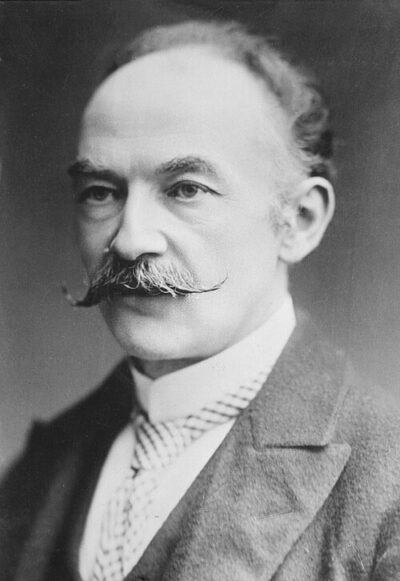
Thomas Hardy
Thomas Hardy was an English novelist and poet. Born June 2, 1840, in Dorchester. Died January 11, 1928, in Dorchester. Known for Tess of the d'Urbervilles, Far from the Madding Crowd and Jude the Obscure. Educated at King's College London and Architectural Association School of Architecture. Awards include Order of Merit and Fellow of the Royal Society of Literature.
Facts
22 facts · 2 confirmed by two sources · 8 cited · 11 from one source · 1 where the sources disagree
What’s different
- Buried in: we show Westminster Abbey (Sources disagree). Wikidata also lists Stinsford
Where this comes from
Papalocal keeps its own record. It started from these sources; what each one said is kept here as it was copied, so a change on their side never changes this page by itself. Tap one to read its version.
What Wikidata says · copied November 16, 2026 · revision 2565594805
- Described as
- English novelist and poet (1840–1928)
- Born
- June 2, 1840 · 12 references
- Died
- January 11, 1928 · 10 references
- Born in
- Dorchester · 1 reference
- Died in
- Dorchester · 2 references
- Buried in
- Westminster Abbey · 1 reference; Stinsford · 1 reference
- Citizen of
- United Kingdom
- Occupation
- writer · 3 references; novelist; screenwriter; poet · 1 reference
- Education
- King's College London (1865–1866) · 1 reference; Architectural Association School of Architecture
- Member of
- American Academy of Arts and Sciences; Royal Society of Literature; Society for the Protection of Ancient Buildings
- Known for
- Tess of the d'Urbervilles; Far from the Madding Crowd; Jude the Obscure
- Awards
- Order of Merit (1909) · 1 reference; Fellow of the Royal Society of Literature
- Spouse
- Emma Gifford (1874–) · 1 reference; Florence Dugdale (1914–) · 2 references
- Wikipedias with a page
- 120
Wikidata item Q132805 (wikidata.org/wiki/Q132805), public domain (CC0). Copied November 16, 2026.
What Wikipedia says · copied November 16, 2026 · revision 1384616141
Thomas Hardy (2 June 1840 – 11 January 1928) was an English novelist, poet and architect. A Victorian realist in the tradition of George Eliot, he was influenced both in his novels and in his poetry by Romanticism, including the poetry of William Wordsworth. He was highly critical of much in Victorian society, especially on the declining status of rural people in Britain such as those from his native South West England.
While Hardy wrote poetry throughout his life and regarded himself primarily as a poet, his first collection was not published until 1898. Initially, he gained fame as the author of novels such as Far from the Madding Crowd (1874), The Return of the Native (1878), The Mayor of Casterbridge (1886), Tess of the d'Urbervilles (1891) and Jude the Obscure (1895). During his lifetime, Hardy's poetry was acclaimed by younger poets (particularly the Georgians) who viewed him as a mentor. After his death his poems were lauded by Ezra Pound, W. H. Auden and Philip Larkin.
Many of his novels concern tragic characters struggling against their passions and social circumstances, and they are often set in the semi-fictional region of Wessex; initially based on the medieval Anglo-Saxon kingdom, Hardy's Wessex eventually came to include the counties of Dorset, Wiltshire, Somerset, Devon, Hampshire and much of Berkshire, in south-west and south central England. Two of his novels, Tess of the d'Urbervilles and Far from the Madding Crowd, were listed in the top 50 on the BBC's survey of best-loved novels, The Big Read.
- Born, in its opening lines
- June 2, 1840
- Died, in its opening lines
- January 11, 1928
From the Wikipedia article “Thomas Hardy” (en.wikipedia.org/wiki/Thomas_Hardy), by its contributors, under CC BY-SA 4.0 (creativecommons.org/licenses/by-sa/4.0/). Copied November 16, 2026; not changed.
Confirmed Two sources agree. Cited One source, and it names where it got it. One source One source, without a reference of its own. Sources disagree The sources disagree. We show the best-supported value and keep theirs below.
