
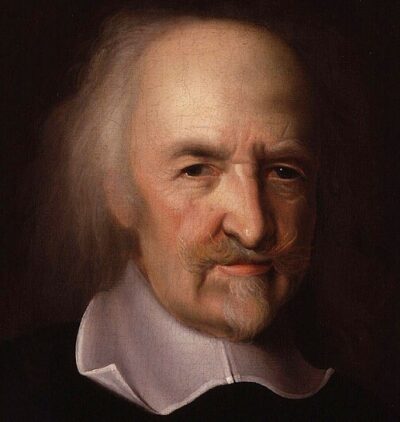
Thomas Hobbes
Thomas Hobbes was an English philosopher. Born April 5, 1588, in Westport. Died December 4, 1679, in Hardwick Hall. Known for Leviathan, De Cive and De Corpore. Educated at Magdalen College and University of Oxford.
Facts
28 facts · 2 confirmed by two sources · 9 cited · 17 from one source
Where this comes from
Papalocal keeps its own record. It started from these sources; what each one said is kept here as it was copied, so a change on their side never changes this page by itself. Tap one to read its version.
What Wikidata says · copied November 16, 2026 · revision 2564342638
- Described as
- English philosopher (1588–1679)
- Other names
- Thomas Hobbes of Malflutry, Thomas Hobbsted, Hobbes
- Born
- April 5, 1588 · 14 references
- Died
- December 4, 1679 · 12 references
- Born in
- Westport · 2 references
- Died in
- Hardwick Hall · 1 reference
- Buried in
- Church of St John the Baptist, Ault Hucknall · 1 reference
- Citizen of
- Kingdom of England · 1 reference
- Occupation
- political scientist; mathematician; philosopher · 2 references; economist; politician; historian · 1 reference; translator · 1 reference; writer · 1 reference
- Worked for
- William Cavendish, 1st Duke of Newcastle (1608–1628) · 1 reference; Sir Gervase Clifton, 1st Baronet (1628–1631) · 1 reference; William Cavendish, 3rd Earl of Devonshire (2 times) (1631–1679) · 1 reference
- Education
- Magdalen College (–1608); University of Oxford (1603–1608)
- Known for
- Leviathan; De Cive; De Corpore; De Homine
- Field
- philosophy; legal theory · 1 reference; history · 1 reference; ethics · 1 reference; geometry · 1 reference
- Wikipedias with a page
- 161
Wikidata item Q37621 (wikidata.org/wiki/Q37621), public domain (CC0). Copied November 16, 2026.
What Wikipedia says · copied November 16, 2026 · revision 1385566232
Thomas Hobbes ( HOBZ; 5 April 1588 – 4 December 1679) was an English philosopher and political theorist, best known for his 1651 book Leviathan, in which he expounds an influential formulation of social contract theory. He is considered to be one of the founders of modern political philosophy.
In his early life, overshadowed by his father's departure following a fight, he was taken under the care of his wealthy uncle. Hobbes's academic journey began in Westport, leading him to the University of Oxford, where he was exposed to classical literature and mathematics. He then graduated from the University of Cambridge in 1608. He became a tutor to the Cavendish family, which connected him to intellectual circles and initiated his extensive travels across Europe. These experiences, including meetings with figures like Galileo, shaped his intellectual development.
After returning to England from France in 1637, Hobbes witnessed the destruction and brutality of the English Civil War from 1642 to 1651 between Parliamentarians and Royalists, which heavily influenced his advocacy for governance by an absolute sovereign in Leviathan, as the solution to human conflict and societal breakdown. Aside from social contract theory, Leviathan also popularised ideas such as the state of nature ("war of all against all") and laws of nature. His other major works include the trilogy De Cive (1642), De Corpore (1655), and De Homine (1658) as well as the posthumous work Behemoth (1681).
Hobbes contributed to a diverse array of fields, including history, jurisprudence, geometry, optics, theology, classical translations, ethics, as well as philosophy in general, marking him as a polymath. Despite controversies and challenges to his reputation, including accusations of atheism and contentious debates with contemporaries, Hobbes's work profoundly influenced the understanding of political structure and human nature.
- Born, in its opening lines
- April 5, 1588
- Died, in its opening lines
- December 4, 1679
From the Wikipedia article “Thomas Hobbes” (en.wikipedia.org/wiki/Thomas_Hobbes), by its contributors, under CC BY-SA 4.0 (creativecommons.org/licenses/by-sa/4.0/). Copied November 16, 2026; not changed.
Confirmed Two sources agree. Cited One source, and it names where it got it. One source One source, without a reference of its own. Sources disagree The sources disagree. We show the best-supported value and keep theirs below.
