
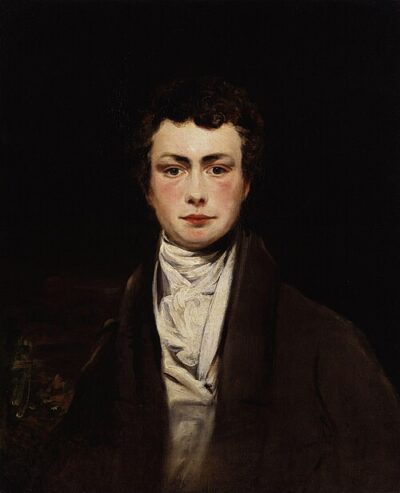
Thomas Moore
Thomas Moore was an Irish poet, singer and songwriter. Born May 28, 1779, in Dublin. Died February 25, 1852, in Sloperton Cottage. Educated at University of Dublin. Awards include Pour le Mérite for Sciences and Arts order.
Facts
22 facts · 2 confirmed by two sources · 11 cited · 9 from one source
What’s different
- Born: we show May 28, 1779 (Confirmed). Wikidata also lists 1779
Where this comes from
Papalocal keeps its own record. It started from these sources; what each one said is kept here as it was copied, so a change on their side never changes this page by itself. Tap one to read its version.
What Wikidata says · copied November 16, 2026 · revision 2564425471
- Described as
- Irish poet, singer and songwriter (1779–1852)
- Other names
- Thomas Brown, Thomas Mur, Tomas Mur, Thomas Brown the younger, Thomas Little, Anacreon Moore, Tom Moore, Thomas, the younger Brown
- Born
- May 28, 1779 · 21 references; 1779 · 2 references
- Died
- February 25, 1852 · 17 references
- Born in
- Dublin · 10 references
- Died in
- Sloperton Cottage · 4 references
- Buried in
- Bromham · 1 reference
- Citizen of
- United Kingdom of Great Britain and Ireland · 1 reference; Kingdom of Great Britain · 1 reference
- Occupation
- poet · 11 references; jurist; singer; songwriter; composer · 1 reference; novelist; writer · 5 references; poet lawyer
- Education
- University of Dublin · 1 reference
- Instrument
- voice
- Awards
- Pour le Mérite for Sciences and Arts order
- Spouse
- Elizabeth Dyke · 1 reference
- Father
- John Moore · 1 reference
- Mother
- Anastasia Codd · 1 reference
- Religion
- Catholic Church
- Wikipedias with a page
- 67
Wikidata item Q315346 (wikidata.org/wiki/Q315346), public domain (CC0). Copied November 16, 2026.
What Wikipedia says · copied November 16, 2026 · revision 1379234447
Thomas Moore (28 May 1779 – 25 February 1852) was an Irish writer, poet, and lyricist. Widely regarded in his lifetime as Ireland's "national bard", his fame and reputation rested primarily on the popularity of his Irish Melodies. In these, Moore set to old Irish tunes verses that spoke to a narrative of Irish dispossession, loss, and resistance. In his romantic work Lalla Rookh (1817), in which these same themes are explored in an elaborate orientalist allegory, Moore achieved wider critical recognition and popularity. Translated into several languages, and adapted and arranged for musical performance by, among others, Robert Schumann, the chivalric verse-narrative established Moore as one of the leading exemplars of European romanticism.
In England, Moore moved in aristocratic Whig circles where, in addition to a salon performer, he was appreciated as a squib writer and master of political satire. Chief among his targets, in successive Tory governments, was Lord Castlereagh in whose promises of "emancipation" Moore believed his fellow Catholics in Ireland had been deceived. In the verse novel The Fudge Family in Paris (1818), and its sequels, he pillories the Foreign Secretary for employing the same "faithless craft" used to press Ireland into a union with Great Britain to accommodate restoration and reaction in Europe.
Wary in Ireland of an overtly Catholic place-seeking nationalism, Moore refused a nomination to stand with Daniel O'Connell and his Repeal Association for the Westminster parliament. His broader sympathies were expressed in his several prose works, including a biography of the United Irish leader Lord Edward Fitzgerald (1831) and the Memoirs of Captain Rock (1824). Complementing Maria Edgeworth's Castle Rackrent (1800), the satirical novel is the story, not of Anglo-Irish landowners, but of their exhausted tenants driven to the semi-insurrection of Whiteboyism.
Moore continues to be remembered chiefly for his Melodies (typically "The Minstrel Boy" and "The Last Rose of Summer"). He is also recalled, less generously, for the role he is thought to have played in the destruction of the memoirs of his friend, Lord Byron.
- Born, in its opening lines
- May 28, 1779
- Died, in its opening lines
- February 25, 1852
From the Wikipedia article “Thomas Moore” (en.wikipedia.org/wiki/Thomas_Moore), by its contributors, under CC BY-SA 4.0 (creativecommons.org/licenses/by-sa/4.0/). Copied November 16, 2026; not changed.
Confirmed Two sources agree. Cited One source, and it names where it got it. One source One source, without a reference of its own. Sources disagree The sources disagree. We show the best-supported value and keep theirs below.
