
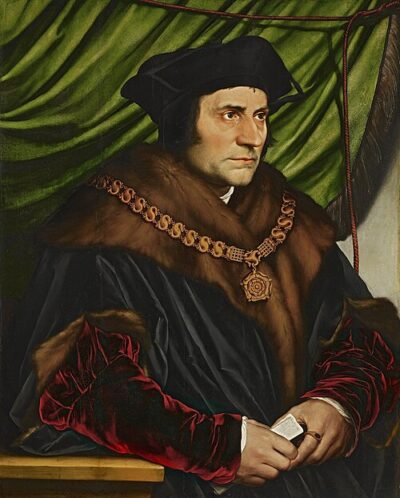
Thomas More
Thomas More was an English statesman, lawyer and philosopher. Born February 7, 1478, in London. Died July 6, 1535, in Tower Hill. Positions held include Lord Chancellor (1529–1532), Chancellor of the Duchy of Lancaster (1525–1529) and Member of the 1504 Parliament. Known for Utopia, Responsio ad Lutherum and Dialogue of Comfort against Tribulation. Educated at Lincoln's Inn and Magdalen College School.
Facts
39 facts · 2 confirmed by two sources · 18 cited · 18 from one source · 1 where the sources disagree
What’s different
- Buried in: we show Chelsea Old Church (Sources disagree). Wikidata also lists Church of St Peter ad Vincula, Tower Hamlets and St. Dunstan's, Canterbury
Where this comes from
Papalocal keeps its own record. It started from these sources; what each one said is kept here as it was copied, so a change on their side never changes this page by itself. Tap one to read its version.
What Wikidata says · copied November 16, 2026 · revision 2567040400
- Described as
- English statesman, lawyer and philosopher (1478–1535)
- Other names
- Thomas, Saint More, Sir Thomas More, Thomas Morus, Thomas, Sir More, Saint Thomas More
- Born
- February 7, 1478 · 2 references
- Died
- July 6, 1535 · 2 references
- Born in
- London · 3 references
- Died in
- Tower Hill · 1 reference
- Buried in
- Church of St Peter ad Vincula, Tower Hamlets; St. Dunstan's, Canterbury; Chelsea Old Church · 2 references
- Cause of death
- decapitation · 1 reference
- Name at birth
- Thomas More · 1 reference
- Citizen of
- Kingdom of England
- Occupation
- philosopher · 1 reference; historian; theologian; politician · 1 reference; poet; statesperson; novelist; poet lawyer
- Positions held
- Lord Chancellor (1529–1532); Chancellor of the Duchy of Lancaster (1525–1529); Member of the 1504 Parliament; Member of the 1510 Parliament · 1 reference; Member of the 1523 Parliament (1523) · 1 reference; Speaker of the House of Commons (1523)
- Education
- Lincoln's Inn; Magdalen College School
- Genre
- satire
- Known for
- Utopia · 1 reference; Responsio ad Lutherum; Dialogue of Comfort against Tribulation · 1 reference
- Spouse
- Jane More (1505–1511) · 3 references; Alice More (–1535) · 1 reference
- Children
- Margaret Roper · 1 reference; Elizabeth Dauncey · 1 reference; Cecily Heron · 2 references; John More II · 2 references; Margaret Clement · 2 references
- Father
- John More · 1 reference
- Mother
- Agnes Graunger · 2 references
- Siblings
- Elizabeth More · 1 reference
- Religion
- Catholic Church
- Wikipedias with a page
- 133
Wikidata item Q42544 (wikidata.org/wiki/Q42544), public domain (CC0). Copied November 16, 2026.
What Wikipedia says · copied November 16, 2026 · revision 1385568492
Sir Thomas More (7 February 1478 – 6 July 1535), venerated in the Catholic Church as a martyr and saint, was an English lawyer, judge, social philosopher, author, statesman, theologian and Renaissance humanist. He also served Henry VIII as Lord Chancellor from October 1529 to May 1532. He wrote Utopia, published in 1516, which describes the political system of an imaginary island state.
More opposed the Protestant Reformation, directing polemics against the theology of Martin Luther, Huldrych Zwingli and William Tyndale. More also opposed Henry VIII's separation from the Catholic Church, refusing to acknowledge Henry as supreme head of the Church of England and the annulment of his marriage to Catherine of Aragon. After refusing to take the Oath of Supremacy, More was convicted of treason on what he stated was false evidence, and was executed. At his execution, he was reported to have said: "I die the King's good servant, and God's first."
Pope Pius XI canonised More in 1935 as a martyr. Pope John Paul II in 2000 declared him the patron saint of statesmen and politicians. In his proclamation the pope stated: "It can be said that he demonstrated in a singular way the value of a moral conscience ... even if, in his actions against heretics, he reflected the limits of the culture of his time".
- Born, in its opening lines
- February 7, 1478
- Died, in its opening lines
- July 6, 1535
From the Wikipedia article “Thomas More” (en.wikipedia.org/wiki/Thomas_More), by its contributors, under CC BY-SA 4.0 (creativecommons.org/licenses/by-sa/4.0/). Copied November 16, 2026; not changed.
Confirmed Two sources agree. Cited One source, and it names where it got it. One source One source, without a reference of its own. Sources disagree The sources disagree. We show the best-supported value and keep theirs below.
