
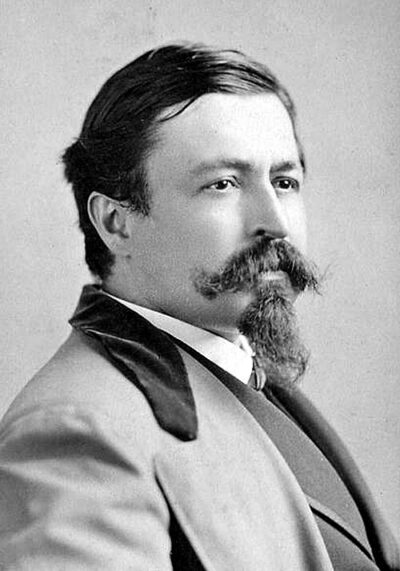
Thomas Nast
Thomas Nast was an American cartoonist. Born September 27, 1840, in Landau in der Pfalz. Died December 7, 1902, in Guayaquil. Awards include Will Eisner Hall of Fame.
Facts
19 facts · 1 confirmed by two sources · 10 cited · 7 from one source · 1 where the sources disagree
What’s different
- Born: we show September 27, 1840 (Sources disagree). Wikipedia says September 26, 1840
Where this comes from
Papalocal keeps its own record. It started from these sources; what each one said is kept here as it was copied, so a change on their side never changes this page by itself. Tap one to read its version.
What Wikidata says · copied November 15, 2026 · revision 2569265964
- Described as
- American cartoonist (1840–1902)
- Other names
- Nast, Thos. Nast, Th Nast, Th. Nast
- Born
- September 27, 1840 · 7 references
- Died
- December 7, 1902 · 8 references
- Born in
- Landau in der Pfalz · 1 reference
- Died in
- Guayaquil · 1 reference
- Buried in
- Woodlawn Cemetery · 1 reference
- Cause of death
- yellow fever
- Citizen of
- United States; Kingdom of Bavaria
- Occupation
- caricaturist · 1 reference; artist; journalist; illustrator · 2 references; painter · 1 reference; draftsperson · 1 reference; consul general · 1 reference
- Political party
- Republican Party
- Awards
- Will Eisner Hall of Fame (2021) · 1 reference
- Lived in
- Thomas Nast Home (1873–1902) · 1 reference
- Website
- http://www.thomasnast.com/
- Wikipedias with a page
- 34
Wikidata item Q214957 (wikidata.org/wiki/Q214957), public domain (CC0). Copied November 15, 2026.
What Wikipedia says · copied November 15, 2026 · revision 1383973601
Thomas Nast (; German: [nast]; September 26, 1840 – December 7, 1902) was a German-born American caricaturist and editorial cartoonist often considered to be the "Father of the American Cartoon".
Nast was deeply involved in the political issues of the day, often as a member of the Republican party. He promoted the platform of the Radical Republicans against President Andrew Johnson and supported Republican presidential candidates Ulysses S. Grant, Rutherford B. Hayes, and Benjamin Harrison. Despite his attachment to the Republican party, Nast prominently and repeatedly criticized 1884 nominee James G. Blaine, informally joining the Mugwump faction of Republicans who supported Democrat Grover Cleveland's candidacy.
Nast was a sharp critic of "Boss" Tweed and the Tammany Hall Democratic Party political machine. He also focused his critical attention on the unreconstructed South as it fought measures to establish civil rights for black Southerners following the surrender of the Confederacy. Concerned with civil service reform and good governance, Nast made repeated mockery of political figures he felt were corrupt or otherwise deserving of scorn, including Senator Carl Schurz, Liberal Republican press magnate Horace Greeley, and Stalwart leader Roscoe Conkling.
In 1863, in the midst of the US Civil War, Nast published a picture of "Santa Claus" as a Union soldier holding a puppet of "Jeff" (Jefferson Davis) with a noose around its neck. This is generally recognized as the first depiction of the modern Santa Claus (based on the traditional German figures of Saint Nicholas and Weihnachtsmann). Nast has also been credited for being the first to depict the Republican Party using an elephant.
Contrary to popular belief, Nast did not create Uncle Sam (the male personification of the United States Federal Government), Columbia (the female personification of American values), or the Democratic donkey, although he did popularize those symbols through his artwork. Nast was associated with the magazine Harper's Weekly from 1859 to 1860 and from 1862 until 1886. Nast's influence was so widespread that Theodore Roosevelt once said, "Thomas Nast was our best teacher."
- Born, in its opening lines
- September 26, 1840
- Died, in its opening lines
- December 7, 1902
From the Wikipedia article “Thomas Nast” (en.wikipedia.org/wiki/Thomas_Nast), by its contributors, under CC BY-SA 4.0 (creativecommons.org/licenses/by-sa/4.0/). Copied November 15, 2026; not changed.
Confirmed Two sources agree. Cited One source, and it names where it got it. One source One source, without a reference of its own. Sources disagree The sources disagree. We show the best-supported value and keep theirs below.
