
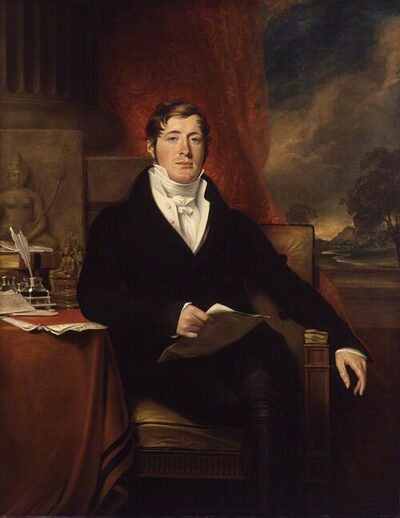
Thomas Stamford Raffles
Thomas Stamford Raffles was a British statesman who founded Singapore. Born July 5, 1781, in Jamaica. Died July 5, 1826, in London. Positions held include Governor-General of the Dutch East Indies. Known for The History of Java. Awards include Fellow of the Royal Society and Knight Bachelor.
Facts
28 facts · 2 confirmed by two sources · 10 cited · 16 from one source
What’s different
- Born: we show July 5, 1781 (Confirmed). Wikidata also lists July 6, 1781
Where this comes from
Papalocal keeps its own record. It started from these sources; what each one said is kept here as it was copied, so a change on their side never changes this page by itself. Tap one to read its version.
What Wikidata says · copied November 16, 2026 · revision 2568941631
- Described as
- British statesman who founded Singapore (1781-1826)
- Other names
- Sir Thomas Stamford Raffles, Raffles, Sir Thomas Stamford Bingley Raffles, Stamford, Sir Raffles, Thomas Stamford, Sir Raffles, Stamford Raffles, Thomas Stamford Bingley Raffles, Lai-fo-shih
- Born
- July 6, 1781 · 7 references; July 5, 1781 · 2 references
- Died
- July 5, 1826 · 11 references
- Born in
- Jamaica · 1 reference
- Died in
- London · 1 reference
- Buried in
- London
- Cause of death
- stroke
- Citizen of
- United Kingdom of Great Britain and Ireland
- Occupation
- botanist; ornithologist; politician; traveler · 1 reference; botanical collector · 1 reference; abolitionist; scientific collector · 1 reference; colonial administrator · 1 reference
- Positions held
- Governor-General of the Dutch East Indies
- Member of
- Royal Society of London; Zoological Society of London; American Antiquarian Society
- Known for
- The History of Java · 1 reference
- Awards
- Fellow of the Royal Society; Knight Bachelor
- Field
- botany
- Spouse
- Olivia Mariamne Devenish (1805–) · 1 reference; Sophia, Lady Raffles (1817–) · 2 references
- Father
- Benjamin Raffles · 2 references
- Mother
- Anne Lyde · 2 references
- Lived in
- London
- Wikipedias with a page
- 61
Wikidata item Q130327 (wikidata.org/wiki/Q130327), public domain (CC0). Copied November 16, 2026.
What Wikipedia says · copied November 16, 2026 · revision 1380138519
Sir Thomas Stamford Bingley Raffles (5 July 1781 – 5 July 1826) was a British colonial official who served as the governor of the Dutch East Indies between 1811 and 1816 and lieutenant-governor of Bencoolen between 1818 and 1824. Raffles was involved in the capture of the Indonesian island of Java from the Dutch during the Napoleonic Wars. It was returned under the Anglo–Dutch Treaty of 1824. He also wrote The History of Java in 1817, describing the history of the island from ancient times. The Rafflesia flowers were named after him.
Raffles also played a role in further establishing the British Empire's reach in East and Southeast Asia. He secured control over the strategically located Singapore from local rulers in 1819 to secure British access along the Strait of Singapore and the nearby seas in the region, particularly the Indian Ocean and the South China Sea. His actions were initially not endorsed by the British government and led to tensions between the British and the Dutch. The Anglo–Dutch Treaty of 1824 established their respective spheres of influence, the Dutch relinquishing their claims to Singapore while the British ceded Bencoolen to them. A transshipment port was subsequently established in Singapore for maritime trade between Europe and Asia.
While Raffles was largely credited for the founding of contemporary Singapore, the early running of day-to-day operations was mostly done by William Farquhar, who served as the first Resident of Singapore from 1819 to 1823. Raffles returned to England in 1824 and died on his 45th birthday in 1826. In Singapore, his legacy is commemorated by the Raffles's Landing Site and the use of his name for numerous national institutions. However, his historical role has become a subject of public debate, with critics characterising him as an imperialist. These perspectives argue that celebratory narratives of colonialism can overlook the history of the population that predated his arrival.
- Born, in its opening lines
- July 5, 1781
- Died, in its opening lines
- July 5, 1826
From the Wikipedia article “Stamford Raffles” (en.wikipedia.org/wiki/Stamford_Raffles), by its contributors, under CC BY-SA 4.0 (creativecommons.org/licenses/by-sa/4.0/). Copied November 16, 2026; not changed.
Confirmed Two sources agree. Cited One source, and it names where it got it. One source One source, without a reference of its own. Sources disagree The sources disagree. We show the best-supported value and keep theirs below.
