
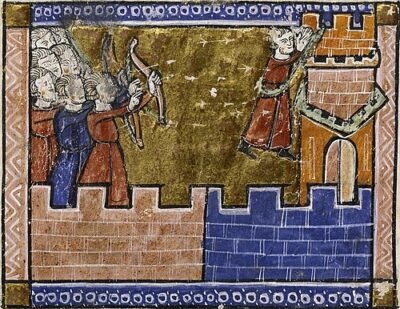
Thoros of Edessa
Thoros of Edessa was an Armenian ruler of Edessa at the time of the First Crusade. Born 11th century. Died March 9, 1098, in Edessa. Positions held include Dux.
Facts
9 facts · 1 confirmed by two sources · 0 cited · 8 from one source
Where this comes from
Papalocal keeps its own record. It started from these sources; what each one said is kept here as it was copied, so a change on their side never changes this page by itself. Tap one to read its version.
What Wikidata says · copied November 18, 2026 · revision 2569056530
- Described as
- Armenian ruler of Edessa at the time of the First Crusade
- Born
- 11th century
- Died
- March 9, 1098
- Died in
- Edessa
- Citizen of
- Byzantine Empire
- Occupation
- official; military personnel · 1 reference; politician · 1 reference
- Positions held
- Dux
- Children
- Arda of Armenia
- Wikipedias with a page
- 21
Wikidata item Q51728 (wikidata.org/wiki/Q51728), public domain (CC0). Copied November 18, 2026.
What Wikipedia says · copied November 18, 2026 · revision 1318918773
Thoros (short in Armenian for Theodoros; Թորոս կուրապաղատ, T'oros the Curopalates; d. March 9, 1098) was an Armenian ruler of Edessa at the time of the First Crusade. Thoros was a former officer (curopalates) in the Byzantine Empire and a lieutenant of Philaretos Brachamios. He was Armenian but practiced the Greek Orthodox faith.
The Chronicle of Matthew of Edessa records that "Thoros son of Hethum" was installed as governor of Edessa by Tutush, who had defeated and killed emir Bouzan in the year 543 of the Armenia era (26 Feb. 1094 – 25 Feb. 1095). According to Sturdza, Hethum [I] was descended from the Pahlavouni, an important family in Caucasian Armenia. He conquered land to the east of that conquered by his fellow Armenian Rupen. Steven Runciman calls Thoros the "son-in-law" of Gabriel of Melitene.
Around 1094, the Seljuk emir of Damascus, Tutush I, captured Edessa and established Thoros as governor. Thoros immediately tried to take control of the city for himself. Thoros then fortified Edessa and cut off the citadel, garrisoned by Turkish and Armenian troops. The Turks and Ortoqids besieged the city for two months, but were unable to capture it even after breaking through the walls. The Turks withdrew and Thoros was recognized as lord of the city.
As a Greek Orthodox Christian, he was not well loved by his Armenian subjects in Edessa. He resisted attacks from the Seljuks, but in 1098 had to ask for help from the crusaders, who were occupied at the siege of Antioch.Baldwin of Boulogne had come to Edessa rather than participate in the siege, probably looking to carve out some territory for himself, and had captured Turbessel. Thoros invited him to Edessa and made an alliance with him in February 1098. Baldwin gradually convinced Thoros to adopt him as his son and heir, but having done this, Baldwin attacked Thoros' officers and besieged him in the citadel. Thoros agreed to let him have the city and made plans to flee with his family to Melitene, but shortly afterwards, on March 9, Thoros was assassinated by the Armenian inhabitants of the city, possibly at Baldwin's command, and Baldwin became the first count of Edessa.
- Died, in its opening lines
- March 9, 1098
From the Wikipedia article “Thoros of Edessa” (en.wikipedia.org/wiki/Thoros_of_Edessa), by its contributors, under CC BY-SA 4.0 (creativecommons.org/licenses/by-sa/4.0/). Copied November 18, 2026; not changed.
Confirmed Two sources agree. Cited One source, and it names where it got it. One source One source, without a reference of its own. Sources disagree The sources disagree. We show the best-supported value and keep theirs below.
