
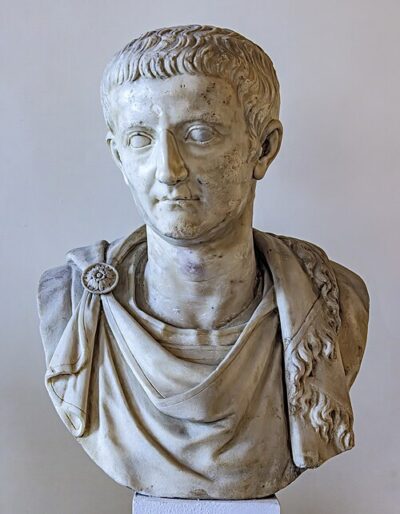
Tiberius
Tiberius was a second Roman Emperor from 14 to 37 AD. Born November 16, 42 BC, in Rome. Died March 16, 37, in Miseno. Positions held include Roman emperor (14–37), ancient Roman senator (–37) and Roman consul (5 times) (-13–31). Awards include Olympic victor, tethrippon (4-horse chariot).
Facts
25 facts · 0 confirmed by two sources · 11 cited · 13 from one source · 1 where the sources disagree
What’s different
- Father: we show Tiberius Claudius Nero (Sources disagree). Wikidata also lists Marcus Gallius and Augustus
Where this comes from
Papalocal keeps its own record. It started from these sources; what each one said is kept here as it was copied, so a change on their side never changes this page by itself. Tap one to read its version.
What Wikidata says · copied November 16, 2026 · revision 2569138764
- Described as
- second Roman Emperor from 14 to 37 AD
- Other names
- Tiberius Julius Caesar Augustus, Emperor Tiberius, Marcus Gallius Claudianus, Tiberius Caesar, Caesar Tiberius, Tibeius Gallius Claudianus, Imperator Caesar Divi filius Augustus, Emperor of Rome Tiberius Claudius Nero, Tiberius Julius Caesar, Emperor of Rome Tiberius, Tiberius Caesar Augustus, Tiberius Claudius Nero
- Born
- November 16, 42 BC · 4 references
- Died
- March 16, 37 · 2 references
- Born in
- Rome · 1 reference
- Died in
- Miseno · 1 reference
- Buried in
- Mausoleum of Augustus
- Name at birth
- Tiberius Claudius Nero · 1 reference
- Citizen of
- Ancient Rome
- Occupation
- military personnel; politician; soldier; imperator · 1 reference
- Positions held
- Roman emperor (14–37) · 1 reference; ancient Roman senator (–37) · 1 reference; Roman consul (5 times) (-13–31) · 1 reference
- Awards
- Olympic victor, tethrippon (4-horse chariot) (-4)
- Spouse
- Vipsania Agrippina (-19–-11); Julia the Elder (-11–-2) · 1 reference
- Children
- Drusus Julius Caesar; Claudia/Claudius; Tiberillus; Germanicus
- Father
- Tiberius Claudius Nero · 1 reference; Marcus Gallius; Augustus (4–)
- Mother
- Livia · 1 reference
- Siblings
- Nero Claudius Drusus
- Religion
- ancient Roman religion
- Wikipedias with a page
- 120
Wikidata item Q1407 (wikidata.org/wiki/Q1407), public domain (CC0). Copied November 16, 2026.
What Wikipedia says · copied November 16, 2026 · revision 1385397702
Tiberius Julius Caesar Augustus ( ty-BEER-ee-əs; 16 November 42 BC – 16 March AD 37) was the second Roman emperor from AD 14 until his death in 37, reigning as the second ruler of the Julio-Claudian dynasty. He succeeded his stepfather Augustus, the first Roman emperor. Tiberius was born in Rome in 42 BC to politician Tiberius Claudius Nero and his wife, Livia Drusilla. In 38 BC, Livia divorced Nero and married Augustus. Following the untimely deaths of Augustus's two grandsons and adopted heirs, Gaius and Lucius Caesar, Tiberius was designated Augustus's successor. Prior to this, Tiberius had proved himself an able diplomat and one of the most successful Roman generals. His conquests of Pannonia, Dalmatia, Raetia, and (temporarily) parts of Germania laid the foundations for the empire's northern frontier.
Early in his career, Tiberius was happily married to Vipsania, daughter of Augustus's boyhood friend, distinguished general and intended heir, Marcus Vipsanius Agrippa. They had a son, Drusus Julius Caesar. After Agrippa died, Augustus had Tiberius divorce Vipsania and marry his step-sister Julia, Agrippa's widow and Augustus' daughter; Tiberius relented. This second marriage proved scandalous, deeply unhappy, and childless; ultimately, Julia was sent into exile by her father. Around 4 AD Augustus had Tiberius adopt his nephew, the able and popular Germanicus, as his son and heir, passing over Tiberius's son Drusus. On Augustus's death in AD 14, Tiberius became princeps at the age of 55. He seems to have taken on the responsibilities of head of state with great reluctance and perhaps a genuine sense of inadequacy in the role, compared to the capable, self-confident and charismatic Augustus.
From the outset, Tiberius had a difficult, resentful relationship with the Senate and suspected many plots against him. Nevertheless, he proved to be an effective and efficient administrator. After the deaths of his nephew Germanicus in AD 19 and his son Drusus in 23, Tiberius became reclusive and aloof. In 26 he permanently removed himself from Rome and left administration largely in the hands of his ambitious praetorian prefect Sejanus. His authority in Rome on behalf of Tiberius came to an abrupt end in 31, when Tiberius had Sejanus executed for treason and replaced with Macro. When Tiberius died in 37, he was succeeded by his grand-nephew and adopted grandson, Germanicus's son Caligula, whose lavish building projects and varyingly successful military endeavours drained much of the wealth that Tiberius had accumulated in the public and Imperial coffers through good management.
Tiberius allowed the worship of his divine Genius in only one temple, in Rome's eastern provinces, and promoted restraint in the empire-wide cult to the deceased Augustus. When Tiberius died, he was given a sumptuous funeral befitting his office, but no divine honours. He came to be remembered as a dark, reclusive and sombre ruler who never really wanted to be emperor; Pliny the Elder called him "the gloomiest of men".
From the Wikipedia article “Tiberius” (en.wikipedia.org/wiki/Tiberius), by its contributors, under CC BY-SA 4.0 (creativecommons.org/licenses/by-sa/4.0/). Copied November 16, 2026; not changed.
Confirmed Two sources agree. Cited One source, and it names where it got it. One source One source, without a reference of its own. Sources disagree The sources disagree. We show the best-supported value and keep theirs below.
